
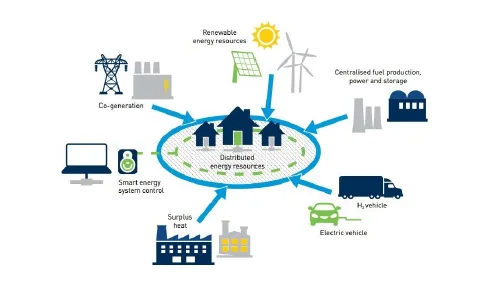
The purpose of this article is to demonstrate the importance of modeling to generate strategic information that allows comparison of different technological pathways for a given energy system, using France and the study of a 100% renewable case as examples.
Industry professionals, researchers, and electrical operators work on "multi-technology" mixes to achieve 100% renewable energy
Massive amounts of storage would need to be installed to cover night demand in the case of a 100% solar system, or to cover demand when wind is weak in the case of a 100% wind system. These scenarios are therefore generally not studied.
A model is then necessary to simulate the operation of different equipment/technologies and to see under which conditions electricity supply and demand can be balanced.
On the demand side, annual series at hourly intervals will be used, reproducing a typical annual profile, with sensitivities to test extreme cases and other peculiarities.
On the supply side, power plants, grid support equipment (e.g. batteries), energy transformation technologies (e.g. electrolyzers), and storage technologies (e.g. pumped hydro storage/batteries) are considered. Each element is described with cost parameters (investment and maintenance) and operational characteristics.
Some models also take into account imports and exports to/from other countries and transportation constraints, particularly for interconnections, by limiting the flows that can transit between zones.
Meteorological profiles are also used, utilizing series over 20 years or more, to reproduce typical climatic profiles, also with sensitivities to test extreme cases (for example, several days without wind and low sunlight).
The objective of the model is then to calculate the optimal technological mix according to the chosen criterion. For example: optimization to achieve the lowest cost per kWh, or the scenario with the least CO2 emissions, or the most resilient one.
Simplified 100% renewable models at a minimum include: Solar PV / Onshore Wind / Offshore Wind / Pumped Hydro Storage / Hydroelectric dams / Run-of-river Hydroelectric / Biogas / Electrolyzers / Batteries
Examples of models:
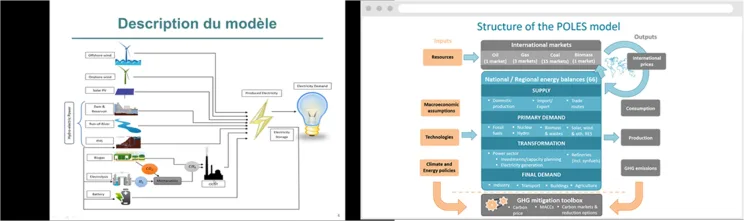
On the left: Simplified Renewable Model – electricity (EOLES)
On the right: 'Integrated Assessment' Model – Energy Master Plan (Pole)
Scenarios rely on detailed hourly modeling to calculate costs related to managing variability of renewables
Modeled systems must naturally respond to the worst climatic events recorded in the historical reference, have necessary reserves meeting constraints imposed by electrical operators, and be capable of providing power levels observed in the past.
For example, in France:
- Climatic events: 2 weeks with very low wind and low sunlight (reference year: 2012)
- Reserves and grid constraints: max 3 hours of demand reduction allowed per year in France, secondary reserve as defined by ENTSO-E (2013)
- Maximum power: high demand volatility requiring the grid to react quickly and supply strong power (>10GW) in a short time.
In particular, the simulations carried out allow understanding of optimal residual demand management strategies according to different demand scenarios and climatic scenarios. Storage, often mentioned, is actually just one of several possible solutions - see the next section.
- On the definition of residual demand (demand minus variable production): https://www.erneuerbareenergien.de/archiv/energy-transition-vocabulary-residual-load-150-437-80793.html
Example below of scenarios and supply/demand response. One can easily appreciate the complexity of these exercises.
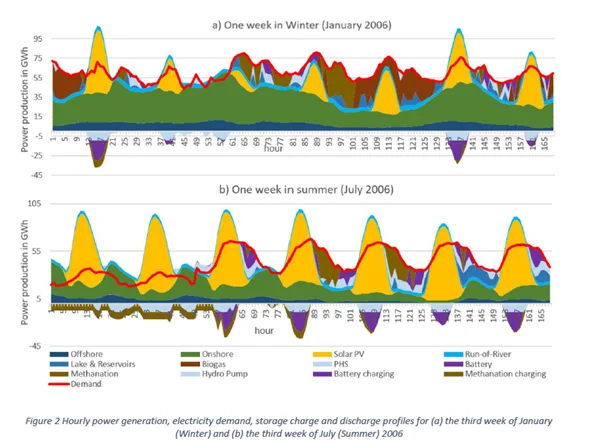
The CIRED, based on the EOLES model and hourly climate series over 18 years – thus including climate anomalies, long periods without wind, etc. – states that storage needs of a 100% renewable system in France represent only about 15% of the annual system cost.
A flexible system allows optimizing installed capacities and reducing overall system costs
Below are some system flexibility tools.
Curtailment
Given the very low cost of electricity produced by renewables, it may be more economical to oversize installed capacities rather than increase storage needs to cover cases where the resource, wind or solar, is low. Production is then curtailed when generated electricity exceeds demand.
Oversizing renewable capacities is an interesting strategy, not only to reduce system costs but also to enable sector coupling, that is, using electricity surpluses to supply energy to other sectors [e.g., H2 production]
- For more on curtailment strategies: https://blog.ucsusa.org/mark-specht/renewable-energy-curtailment-101
"Green gas"
There is indeed "green" gas in a 100% renewable world, such as Power-to-Gas (notably for H2), Biogas, Methanation, or CO2 capture technologies. Combined cycle gas turbines (CCGT) can thus be used to contribute to grid flexibility, for example by using methane from biogas directly or methanation performed with CO2 from biogas and H2 from electrolyzers.
On green gas: Ref1: https://www.usinenouvelle.com/article/trois-autres-voies-de-production-de-gaz-vert.N953086 / Ref2: https://www.grdf.fr/institutionnel/actualite/dossiers/biomethane-biogaz/unites-injection-gaz-vert
Pumped Hydro Storage (PHS)
The potential for developing PHS still exists in Europe.
Potential study by JRC: https://www.sciencedirect.com/science/article/abs/pii/S096014811400706X
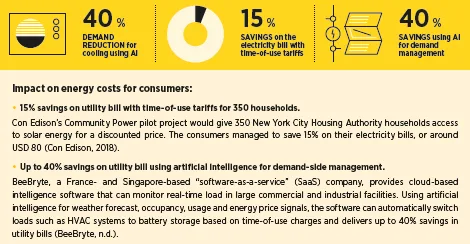
Demand management systems
A 100% renewable world is not centered only on production but also tries to better manage demand.
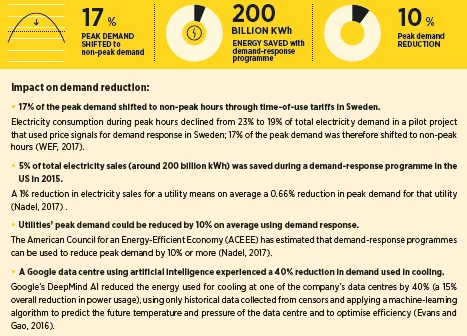
Below are examples of demand management programs (IRENA, Innovation Landscape 2019). They show the impressive impacts of these programs in their ability to reduce or shift demand.
Batteries
Batteries today allow storage of significant quantities, over durations currently up to 4 hours, for several hundred MW and MWh
Recommended by LinkedIn
 Yes, we recommend centralized inverters…
Zest
2 years ago
 AXODYN committed alongside Syntec-Ingénierie to…
AXODYN
5 months ago
 Solar: reasons for a (possible) misunderstanding
Clement Menviel
5 months ago
Example of projects announced in 2019, under construction: https://energyacuity.com/blog/2019-top-10-energy-storage-battery-projects/
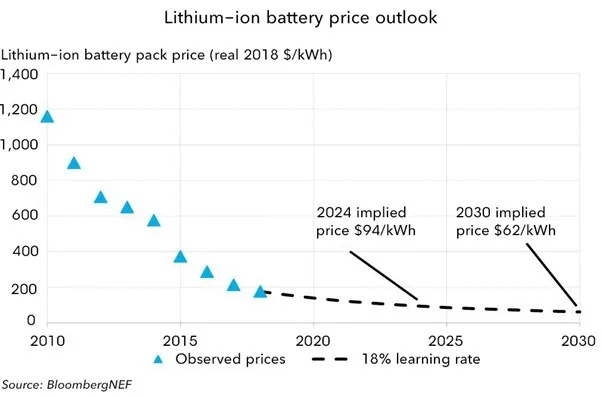
Battery costs follow an extremely rapid development curve, as shown below:
Integration of France into the European electrical system increases grid flexibility and reduces overall system costs.
There is indeed a smoothing effect for wind and solar across Europe: solar/wind complementarity / reduction of standard deviations thanks to offshore wind / integration of different climatic zones, like the Iberian Peninsula / interconnections with North Africa and Nordic countries.
An example of a strategic interconnection under construction: https://en.wikipedia.org/wiki/NordLink
On correlations in Europe: Ref1: https://www.researchgate.net/publication/314154801_A_spatial_and_temporal_correlation_analysis_of_aggregate_wind_power_in_an_ideally_interconnected_Europe / Ref2: https://www.mdpi.com/1996-1073/9/6/449/htm
An interconnected grid also allows sharing storage capacities. Exports/imports are also a way to balance supply/demand of European countries, each with different energy mix optima depending on their technical, economic, social, and geographical specificities, thus optimizing certain risk coverage strategies.
Calculation of the system kWh cost
The model can calculate the optimal renewable mix that would achieve the minimum system kWh cost. For example, CIRED finds that in the most pessimistic scenarios, kWh costs, excluding network infrastructure costs, would be below 60EUR/MWh. This order of magnitude aligns with existing literature: between 50 and 80EUR/MWh for a full cost of a 100% renewable system (ADEME, LUT/Energy Watch Group/IRENA...)
The link at the bottom of this article to the CIRED Webinar helps better understand the assumptions linked to this result and the factors increasing/decreasing this cost.
Taking a step back on the energy transition
Thanks to models, it is possible to produce a lot of useful information and propose technological pathways, thus developing action plans that are the foundation of national energy policy. These action plans can cover choices regarding R&D, investment, development of interconnections, or regulations.
Naturally, other considerations are taken into account in energy policy development, such as social acceptance of certain technical choices, geopolitical issues, and challenges for employment and industry.
The role of nuclear power
Unless there is societal rejection of nuclear power – which one may or may not share – this technology can absolutely be included in simulation models to understand the role it can play on the grid, depending on its cost and technical characteristics.
Indeed, this is exactly the message from the European Commission: “Do the numbers and then draw your conclusion" (Oct 2020, Timmerman)
Reactor shutdowns can be modeled to see new balances. New investments in nuclear can also be simulated and their consequences in terms of prices and system balance assessed. Or the opportunity to extend existing plants can be modeled. Costs of such investments and maintenance, expected availability, are taken into account by comparing with other options and performing sensitivity scenarios linked to uncertainties (notably duration and construction costs, maintenance costs over 60 years, and availability).
Excluding nuclear, a low-carbon solution with a high capacity factor, whether to prematurely shut down plants or to not reinvest in new ones, must be done with well-developed arguments and solid studies precisely indicating the needed forthcoming investments to balance supply/demand without penalizing the climate, as well as the risk matrix associated with this technology.
Conversely, advocating nuclear technology without a clear idea of the technical and economic impacts this could have on systems via modeling, without comparing different strategies and without presenting a detailed risk matrix, is of limited interest, as – I hope – has been clearly explained in this article.
And renewable energies?
Renewable energies today represent the majority of additional electrical capacities connected to grids worldwide. They are considered the cornerstone enabling us to reach our climate goals.
By 2025, renewables are expected for the first time in industrial history to become the world’s leading electricity generation means. The following link offers some reasons explaining this growth:
To give an idea, China, which will likely host 50% of all nuclear installations worldwide by 2050, plans a highly ambitious nuclear program of about 300-500 GW total by 2050 (I indicated a range to account for political and economic uncertainties in implementation). This same country will see renewable plant installations (solar, onshore and offshore wind) exceeding 100 GW each year in coming years. This implies capacity figures at least 10 times greater.
Investments in research, the number of researchers, think tanks, equipment manufacturers, operators, and industry players working on and around these technologies are also significant. Renewable technologies also drive economic development in other sectors: electric vehicles, energy savings, digital, agriculture; all these sectors intersect, feed one another, and help generate jobs, benefit from economies of scale to reduce costs, and thus accelerate the energy transition.
The flexibility these installations provide, in a context of technological uncertainties and limited carbon budgets, also offers significant added value: large capacities can be rapidly deployed, but it is also possible to adjust each year based on cost and technology developments to choose new strategies.
If analyses do not take into account the current dynamics of these technical and social changes our societies are experiencing today, it then becomes very difficult to formulate realistic proposals – whether to support, slow, or change this dynamic.
What to do in such a context?
First, it is necessary to move away from simplified views of electrical grids and place analyses of technical and economic impacts of technological pathways in an appropriate framework.
Nevertheless, it is not easy for citizens to access this information. Questions are mainly related to i) the transparency with which these models are made to assist government decision-making (for example, how the choice to have 50% nuclear in France was justified) and ii) how to communicate on these complex issues and invite citizens to take a stance. Indeed, models also reflect our societal choices, and in this sense it is important that they are subject to consultation.
That is why RTE, in developing its new study aiming to explore scenarios with high renewable penetration rates, opened its work to consultation. Access to these consultations can be found through the link below:
For further reading
For those interested in the subject of energy mix modeling, you can consult the excellent webinar below:
The second part of this article will cover model assumption choices and discuss two frequently observed errors: atemporality and anachronism