

I share here the recent interview of Brice Lalonde published in Le Point, where he questions the relevance of Europe's energy and climate policy based on renewable energies.
This discourse is an excellent example of the energy arguments circulating within civil society coming from conservative nuclear circles, so I wanted to make a quick but detailed critique of it.
For several months, these arguments have been flooding our public space to influence our opinions on energy-related issues and thus take control of our democratic processes: civil society had to give its opinion concerning the construction of a program of 6 EPR2 reactors, and our elected officials worked on laws to accelerate renewables and nuclear energy.
They are working perfectly so far. They have led to the insertion of many obstacles within the law on the acceleration of renewables, and forced the government to find a compromise on wind power development in France by greatly reducing our installation targets for 2050.
They already have consequences on our climate actions and energy supply security: wind power is extremely important in France because, unlike solar, it can produce electricity at night, with a good capacity factor, and without new nuclear power for 15 years while the availability of our existing fleet is structurally declining and we need to electrify, hindering renewables is an insane position.
This wave will not stop. It will amplify: soon the PPE (energy programming plan) will have to be revised – this document plans our investments in the energy sector – and these circles will do everything to slow down renewables. Then there are the presidential elections: conservative parties hope to leverage this disinformation that echoes their energy program. To understand the energy mix they propose, see here the critique of the inquiry commission's report:
I also take this opportunity to indicate that I do not want to point fingers at those who are convinced by these speeches for various reasons they have and that must be respected.
Everyone has their own convictions which I do not dispute. It is perfectly legitimate to consider nuclear energy as the quintessential French technology and that we should continue to devote all our resources to it in the electric sector. One could also oppose renewables, for example simply because we do not find them pretty in our landscape.
But whatever our convictions, we must build a rational, documented discourse, with referenced studies, indispensable on such complex topics.
Our collective intelligence and free will face daily attacks of unprecedented violence, and it is very difficult for citizens to find their way.
Unfortunately, we do not all have the time to consult studies, nor often even the desire, since these studies are tedious to read, the content not always accessible, often very long (the RTE study is 600 pages), in unattractive formats. Solutions will need to be found, and I propose some here.
First, I will identify the arguments of the interview, then extract the one that seems defensible to me, and finally criticize the others. In conclusion, I will try to explore some solutions to protect ourselves as much as possible from these attacks.
1. Summary of the argument
Brice Lalonde emphasizes 4 points
1. The only countries that have successfully decarbonized their electricity have relied on hydroelectric and nuclear power. All others, despite developing renewables, have a much higher carbon intensity in their mix.
2. The variability of renewable energies is an insurmountable constraint: when there is no wind or sun, fossil fuels take over. To remedy this, a phenomenal amount of renewables would need to be installed, severely constraining our electricity demand.
3. By setting renewable penetration targets at 40% of the energy mix by 2035 with its ambitious Fit for 55 climate program, Europe imposes its vision of energy on member states. It is not based on a decarbonization goal but merely on the will to multiply renewables through subsidies and reduce energy consumption by one-third – a level deemed unthinkable: we are "in kindergarten."
4. Opposition to nuclear power in Europe is seen as an attack against the French economy and makes no sense when Germany even prioritizes phasing out nuclear over the far more dangerous coal phase-out for humanity.
Here is his interview:
2. The truth: nuclear vs renewables opposition contributes to destroying our collective intelligence and endangers our democracies.
Nuclear technology is compatible with our climate actions and of strategic importance for France
Germany's opposition to nuclear development beyond its borders, shared by other countries and echoed within the European Commission, seems irrelevant for 2 reasons:
1/ Even if construction takes time and costs soar, a nuclear plant produces large amounts of decarbonized electricity. The technology is compatible with our climate scenarios, and its controllable nature allows us to reduce flexibility needs. Given the expected increasing demand due to electrification, prudence suggests we should not close this option. The JRC also published a study validating the "do no significant harm" criterion (though nuclear accident risk was not addressed).
I had already built an argument in favor of nuclear here and indicated the challenges this sector will face, which will probably require a profound restructuring:
2/ The nuclear industry plays an important role in France with 220,000 jobs, colossal R&D budgets, and a diplomatic function. Given its compatibility with climate scenarios, France has no valid reason to abandon this industry, on the contrary, it is normal to seek to develop it. Given the low number of potential constructions even with a proactive revival and the many plants to be decommissioned, also for calming European relations, one could imagine a limited role for nuclear – very limited in any case with very small budgets over 30 years compared to the transition budgets – under conditions like restructuring this sector. Instead of this concession, the renewable vs nuclear battle is a source of political conflicts spreading in European civil society, causing a rise in conservatives, and immersing us in disinformation and climate-skeptic positions. The key challenges today are more social than technical. Calming this situation should be a priority – including in France.
Some figures:
- 11 states are part of the nuclear alliance. Assuming it is possible to reorganize the sector to launch a European construction program, at most we might talk about 15-20 reactors by 2050 – but such a program already seems unlikely, today only 4 reactors are under construction in Europe. One could also consider building capacity with SMRs – a technology that does not exist today and whose commercial interest must be proven but MoUs are signed in various countries.
- Stretching to the maximum, we might imagine 300 billion euros over 30 years. By comparison, the energy transition will cost Europe around 5.3 trillion euros – without nuclear but including hydrogen. So nuclear investments could represent at most 6% of the total budget.
- The average reactor age in Europe is already 36 years. In green: reactors older than 30 years. Today 142 reactors are operational in Europe including the UK and Switzerland.
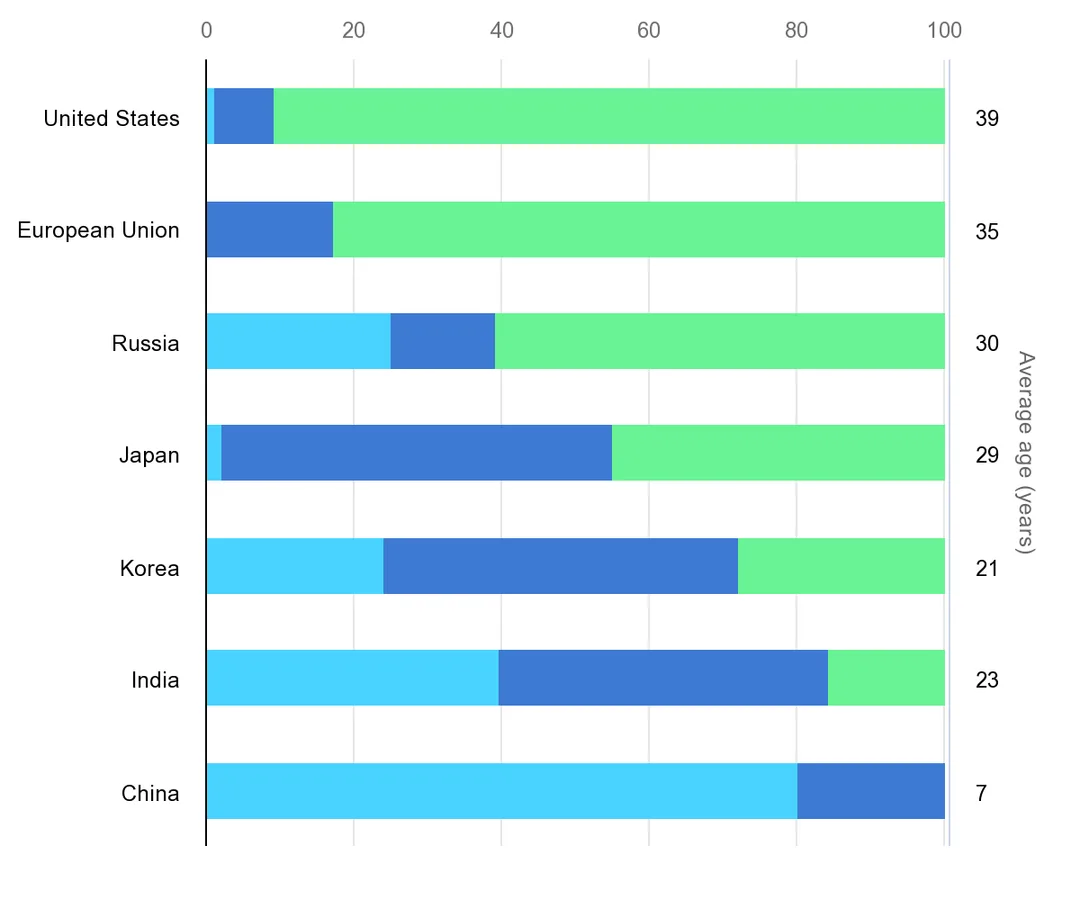
▶️ Nuclear today accounts for 25% of the European electricity mix. Waves of decommissioning are expected by 2050, the vast majority of our reactors already being more than 30 years old. Even a nuclear revival will reduce its share in our electricity mix, and at most we are talking about 6% of our transition budget. Turning what seems a minor but major stakes question for our country into one of Europe's most violent social conflicts, whose consequences include barriers to renewables, the rise of conservative and extremist parties, and rampant disinformation in the public space with climate-skeptic arguments, does not seem reasonable. A solution should be found.
Is the sector really ready to be reborn?
To stop its decline, establishing a realistic development program based on strategic, economic, technical, and geopolitical nuclear market analysis seems essential today. Is EPR2 the right technology? What organization for what volume? Does the sector meet the specifications of future grids? What governance would be best to face these challenges?
However, it is not certain that the current organization of the nuclear sector allows the establishment of such a program. Two signals can exemplify this:
1/ The absence of strategic studies and discussions around these subjects in our public space, and instead the profusion of irrational speeches from nuclear supporters, disconnected from reality and of another time.
2/ The proposals regarding the nuclear sector in the inquiry commission's report are of very low quality and the strategic place of this technology in the future is not analyzed at all – yet this is fundamental to building an industrial strategy. Organizational proposals, notably to strengthen Parliament's role and the Technical Office in governance, seem to indicate an inability to identify the current weaknesses of its organization and the real needs of this industry.
See here the critical review of the inquiry commission's report:
We can also wonder about the compatibility of the sector's corporate culture with our climate actions. Some speeches strongly conflict with the social and energy organization we aim for in our Net Zero strategies: opposing renewables, promoting centralized energy, questioning demand management strategies, nationalizing energy activities, etc. These elements do not seem to leave room for renewables, which are the foundations of our climate strategies.
These signals could indicate our industrial tool's unpreparedness or even its inability to transform. Particular attention should be paid to this point.
▶️ While the technology still has a future, the current industry organization may not have one.
3. The false: everything else
3.1. Historically only nuclear and hydro decarbonized countries –> FALSE
There is no country worldwide that has successfully followed any decarbonization strategy. France, for example, has low-carbon energy not because it wished so, but because of its fossil phase-out strategy for electricity for sovereignty reasons.
Likewise, renewables' development dates to about 2005, with the first FITs in Europe launching solar, triggering a resurgence of wind that had started a few years before. So renewables began their rise less than 20 years ago, and their LCOE has only been competitive for a few years, making massive deployment possible worldwide.
The country that decarbonized its electricity quickly is France, thanks to its nuclear program. It took 30 years – preceded by 10-20 years of research and trials to find a viable technology. The start of Fessenheim's work dates to 1971 and the nuclear peak was reached between 2000 and 2005. Also, our decarbonized electricity includes hydro at 11%, developed long before, at the beginning of the century.
The dates do not match, and we will have to wait before making such comparisons – which in any case make no sense since those nuclear + hydro mixes are not replicable except by exceptions.
We could stop here and close this section, but the argument seems to go beyond the country examples: it rests on the conviction that renewables can only contribute marginally to decarbonization and their deployment is very slow.
Let's try to find a mid-way point to assess the transition with renewables:
- Several countries or regions have already reached 50% renewables in their grids (e.g., Germany, Australia, or California)
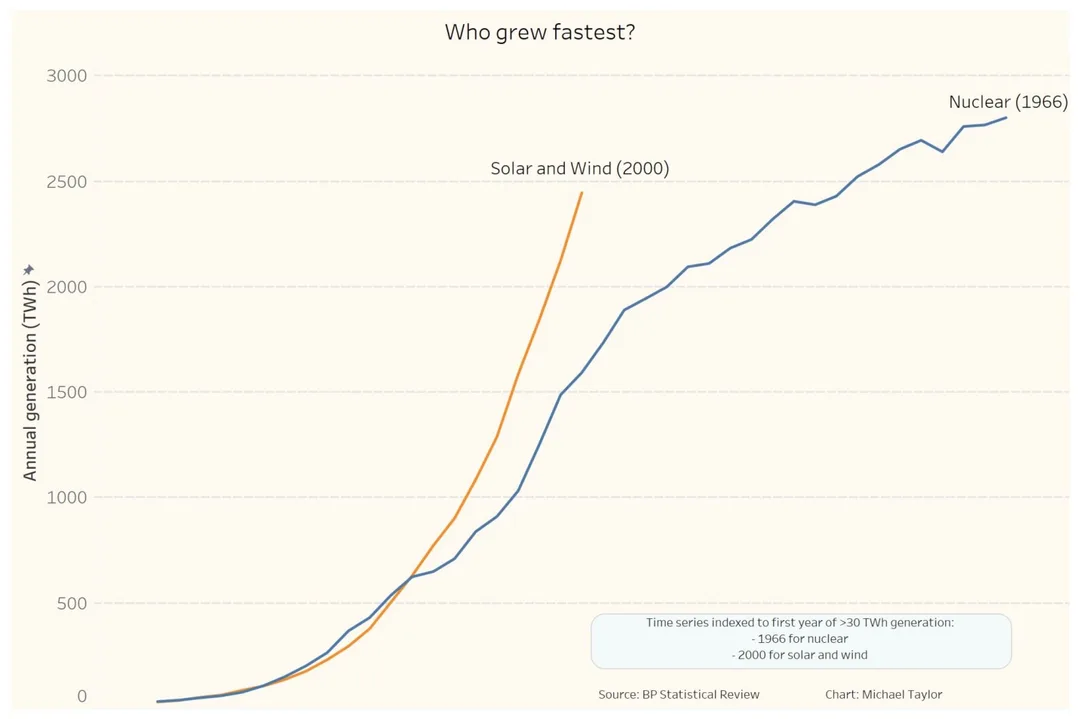
- Solar and wind after 15 years produce more worldwide than nuclear which has existed in grids for 50 years. Moreover, renewables deploy faster than nuclear.
- Solar and wind contribute to decarbonizing grids worldwide, not just a few large countries. Currently, 50% of global capacities are absorbed by China, and India follows after Europe and the US. China and India have electricity demand growth twice as fast as OECD countries post-WWII, a pace no technology deployment can keep up with. In all OECD countries, renewables replace fossil fuels.
- Renewables will now support rising electricity demand even in OECD countries due to electrification, which has emerged recently (thanks to renewables) as a key climate action. Though this scale is much smaller than during northern countries' growth phases and even smaller compared to current emerging markets, the combined challenge (emerging markets + electrification) is vast. Renewables maintain a strong installation pace: it took 13 years worldwide to reach the first TW installed, and 5 years for the second. 95% of newly built power plants globally are renewables, and this percentage is planned to remain steady over the next 5 years. The sector targets 1 TW/year by 2030 to meet a 1.5°C scenario. Based on the last 10 years' growth rates, this goal seems attainable, especially as nearly all countries except a few (France and North Korea) accelerate renewables deployment.
▶️ Although seemingly logical and attractive, this argument assumes cutting off a significant part of our cognitive functions and knowledge and forces us into a temporal mess to be acceptable. Note this argument is widely spread by the nuclear circle and their main communicators in public space.
▶️ Sources of the data
Evolution of the German mix
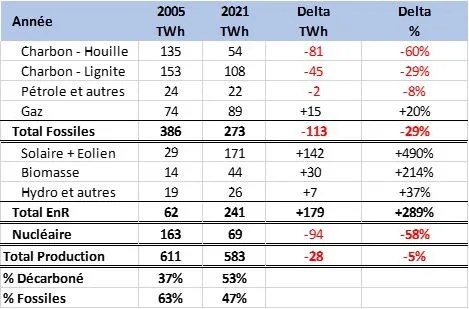
Deployment speed of renewables vs nuclear
For further reading on decarbonizing economies via renewables and sources for other figures, see this comprehensive article:
3.2. Priority should be given to controllable low-carbon energies –> FALSE
Three answers can be proposed to this argument, from simple to complex.
The first is that in the 1970s renewables were absent from the power sector and thus this option could not be considered.
Today they exist, and studies show an optimal mix centers on renewables, capturing low-cost electricity flow, supported by various technologies and system organization strategies (demand-(production-grid) to manage intermittency). Among these supporting technologies is nuclear, which reduces flexibility needs.
The second, extending the first, is that the nuclear option does not exist for decarbonizing our power grids. The most optimistic trajectories foresee nuclear around 15% of the global mix by 2050, but we are moving towards under 10%.
The first section gave figures for Europe: maybe 20 reactors could be built by 2050 besides French ones, but over 100 will likely be decommissioned in the next 30-40 years. At best nuclear in Europe will be 20% of the electricity mix, probably less.
In reality, nuclear's strategic place today is not system center but as a controllable system-tool, complementing a mostly renewables-based mix. Nuclear and renewables play different roles and mostly are not in competition.
Here are global nuclear figures:
The third rests on describing a majority-renewables grid and explaining its operation. This technical subject will be referenced at the end of this section. Some responses here:
It is quite true that a system based on renewables – currently the identified mix for our climate constraints and the need for decarbonized energy – needs controllable sources.
Two types of demand should be distinguished:
1/ Flexible demand: e.g., hydrogen production, smart charging of electric vehicles, and heat, which can be shifted within the day, or even several days or much more for hydrogen with salt cavern storage.
2/ Inflexible demand (e.g., hospitals where surgeries happen).
To cover inflexible demand in power, we have batteries, pumped hydro, gas plants, and possibly biomass and/or nuclear, in addition to renewables capacities except base-load plants. However, each of these covers a small energy fraction. Gas covers seasonal variability and accounts for less than 5% of total demand in a 100% renewables scenario.
The difference between power and energy thus gains new meaning in the transition, as our core power plants will produce energy flows, supplemented by other tools to meet power needs. Our future electricity system is fundamentally different from today's.
Two other ideas complete the interview's justification for prioritizing controllable low-carbon development:
1. Hydropower should also be developed alongside nuclear (logical as he claims only nuclear + hydro work).
2. The number of renewables to replace fossil fuels would be gigantic.
To avoid complicating things, I correct these two points in Annex 1 at this paper's end. If interested, please consult Annex 1 at page end.
▶️ The proposal to prioritize controllable low-carbon energies seems based on complete ignorance of our climate scenarios and energy sector. This same proposal is in the inquiry report, the conservative right's energy program, and JMJ's position. These ideas fail any brief reflection and are ideological or technological lobbying stances, leading us to an energy and climate catastrophe. RTE even dedicated a full section to an opposing analysis, concluding definitively.
▶️ Some references on systems with high renewable penetration. See again this article:
3.3. Setting renewable and energy demand reduction targets is not a climate goal –> FALSE
The previous sections already respond, but let's detail and especially open discussion on France's particular case and the fact these targets alone are not enough to keep under 2°C.
Our climate policies broadly rely on our Net Zero scenarios.
No country today – except unknown exceptions – has a Net Zero scenario without renewables development. Even in France, all leading scenarios, including Shift's, rely on significant renewable growth in the next three decades, especially the next 15 years where they are indispensable. But our scenarios also indicate renewable expansion must be paired with electrification of uses to decarbonize most of the energy mix, not just electricity, plus significant energy consumption reductions to close the loop.
Europe did not impose a renewables vision to all countries: it is essential to meet climate goals and exit fossil dependency. The whole planet knows these priorities... but some refuse results found in all studies, including independent varied sources.
Demand reduction
Mr. Lalonde probably means sobriety when he talks about energy demand reduction and fears these reductions. In reality, sobriety is only part of demand reduction strategies, mainly based on social restructuring, energy vector changes, and energy efficiency.
While social restructuring can be seen as sobriety, this strategy rests on the observation that our current society is not set to make sobriety natural; it's often a constraint or even impossible (e.g., no bike lanes in a city where riding on roads is dangerous, like Dubai). Thus, societies must be reorganized around sobriety, requiring infrastructure, innovation (technological and social), and regulation.
Our industrial civilization depends on an energy system whose losses still far exceed what is acceptable. One should not fear energy demand reduction goals: they offer a chance to improve societies and align our future more closely with environmental reality. These transformations are positive, contrary to their sometimes negative portrayal. The current energy system that wastes two-thirds of energy input is absurd (dumb energy vs smart energy).
See here:
France's particular case
While most countries rely heavily on fossil fuels for electricity, France temporarily gained an advantage – now rapidly consumed – with a decarbonized nuclear system.
For our country, a high renewable target was of no interest until recently and was not a priority – but necessary to prepare the future and contribute to global decarbonization.
France was thus never behind compared to others... but this has changed and will change more markedly.
Renewables in the next 15 years will serve to i) cover reduced availability of the historic nuclear fleet and ii) cover additional demand from electrification. Only renewables can connect to our grid in this 15-year period. Our country will thus have to propose a renewable penetration rate for 2035 probably exceeding 30% excluding hydro.
Our climate policies are still insufficient and the mentioned objectives do not put us under 2°C.
Renewables lower our electricity sector emissions that's true – in France this impact is more limited – but we must tackle emissions beyond electricity, and electrification strategy plays a key role, replacing fossil fuel by decarbonized electricity. Proposing renewable development goals without linking to electrification rates sends the wrong message.
To conclude, recall our policies are still insufficient. The social issue is still untouched – and the climate battle will be fought there.
Note on Europe's renewable target: strictly we should speak of decarbonized electricity targets, including all energies to develop like hydro, respecting France's specific status. But our priority in Europe and globally remains this renewable target that will guide energy system transformation. Here the discourse should be reviewed to be more inclusive of other energies.
▶️ Brice Lalonde's analysis is logical only if one ignores renewables' role in climate scenarios or imagines an alternative scenario to avoid renewables, at least short term. This parallel discourse now grows in France from nuclear circles: develop thermal renewables and maximize sobriety could be another path. To date, no scenario made rigorously allows quality discussion on this path; figures, magnitudes, and analyses show it leads straight into a deep pit.
Conclusion: how to protect ourselves from disinformation?
I wish to emphasize once more: some people agree with these discourses and may take offense at being labeled as disinformation.
To overcome this, I might use softer phrasing. Beyond my writing style, I believe today we cannot be lenient towards these speeches.
Let's call a spade a spade. The disinformation level has reached unsustainable stages. Deviations from reality and knowledge widen daily. It diverts us from knowledge and climate actions, preventing us from owning ongoing societal changes, yet this is essential for citizens to participate.
Ultimately, these discourses steal possible futures and lead us into corridors with few options – mainly limiting change – all dictated by unknown third parties.
It might help to distinguish conviction from technical arguments.
If some think nuclear is the best choice for France or Earth, perfect. Everyone has convictions and we must respect them. But technical arguments supporting them can and should be openly debated.
Here lies the problem. From an energy professional's view, many technical arguments in these conflicting energy discourses – where nuclear is the climate white knight and renewables are sordid resource-consuming machines – are akin to a demonstration that hippos are supreme beings from Mars 4,000 years ago riding intergalactic bikes, awaiting GranPopo's signal to attack and reconquer the universe they once ruled.
Therefore, I conclude: citizens cannot clearly identify disinformation even when extreme on such specialized topics.
The reasons seem obvious:
- Speech carriers seem unthinkable to be so off-base, causing doubts and viewing it as mere differing opinions.
- These arguments flood our public space from seemingly different but actually same information sources.
- Some arguments resonate emotionally with us: sobriety importance, climate action necessity, defending France's interests, etc.
- Arguments always contain some truth but bend at some point; this bifurcation, the discourse's real objective, is sometimes hard to grasp.
- Generally, we lack time for detailed discourse study, with many demands; we apply filters. Disinformation strategies are highly sophisticated, evading our nets.
Having established this, what solutions can we implement?
I have no precise answer yet; this societal topic deserves broad discussion for collective solutions. What I perceive is that societies will have to transform to address this problem which has worsened with information technology growth and societal complexity.
We will need not only to reconnect with our environment and change energy infrastructures but also rebuild links between people and institutions, transform our relationship with knowledge and information within a governance that has evolved, allowing more active citizen involvement.
Meanwhile, we must be very careful by applying some rules I myself use, and each find their own.
- Truly diversify information sources: If all references preach the imminent end of irreplaceable fossil fuels, and/or nuclear, and/or collapse, with half humanity doomed and medieval return, and/or resource impossibilities, and/or critique renewables, that is not source diversity even if author names differ. True diversity means exploring different universes.
- Seek information affirming your beliefs and the opposite. Compare analysis methods and paper quality.
- Most important in a study are never conclusions but analysis methods based on transparent, identifiable tools from a specific knowledge corpus. Each sector has work methods evolving over years. Today, discussing climate without Net Zero scenarios is dubious.
- Try to identify communicators’ circles and biases, diffusion channels and methods. See who agrees or disagrees. Identify argumentation in public space and if contradictory debates occurred. Read those, they teach a lot.
- No easy knowledge acquisition exists in these fields. Reports are complex, arguments complicated. Don’t give up: keep reading even if you understand nothing (from experience). Our brain absorbs info subconsciously, then suddenly we understand more and more.
- Knowledge is driven by our ignorance. Knowing all removes curiosity and knowledge decays over time. We must live with and accept our ignorance.
- Finally, trust no one by default. Everyone can err, has biases, conflicts of interest including with own convictions. No "safe" info channel exists; today we can no longer be passive about information.
***
Annex 1: corrections regarding hydraulics and the gigantic number of renewables needed to phase out fossil fuels
On hydraulics
While it is true that hydraulic development is essential and we should launch all possible European programs, the scales are off, and this technology, extensively developed in Europe for a century, now has constraints on remaining sites.
In France for example, remaining potential is apparently at most 4% of current capacity.
See the hydraulics section in the inquiry commission's report critique.
On the link between pyramids and renewables
This is a classic nuclear and climate skeptic disinformation tied to "energy density," which in the energy transition is not key except for certain technologies like batteries, since electricity transmission replaces fuel.
The area occupied by renewables for a 100% renewable mix in France, Europe, and worldwide in 2050 is about 0.3% of our lands. For comparison, agriculture covers 50% of habitable land worldwide.
Naturally this figure doesn’t circulate in disinformation networks that prefer incorrect numbers from absurd calculations or comparisons (e.g., "it takes x wind turbines to replace y nuclear plants").
Jean Marc Jancovici mentioned a completely absurd 550,000 wind turbines in France based on a calculation with errors at every step, clearly indicating hidden intentions.
These errors were exposed by several experts including Cédric Philibert in direct exchanges. Ultimately, he refused corrections: after inventing ‘‘offhand’’ different calculation methods hoping one could save him, facing the unbreachable wall of reason and knowledge, he disappeared… only to reappear a few posts later with the same arguments. This is disinformation: spreading knowingly false speech passing as true because it serves us.
Here are corrections (correct answer for France 2050 100% renewables is under 30,000 wind turbines, i.e., the current German wind park).
Here is the second exchange with JMJ, same as the first: