

NetZero Citizen
Home
Transition
Decarbonization
Write to us
NetZero Citizen
Analyse du rapport de la Commission d'enquête sur la perte de souveraineté énergétique de la France - revue des "6 erreurs"

Analysis of the Inquiry Commission's Report on the Loss of France's Energy Sovereignty – Review of the "6 Mistakes"

Karim Megherbi

Original source

I won't hide it: simply writing the article's title – which paraphrases the theme of the inquiry commission – was already difficult for me. The analytical angle it suggests is indeed necessarily confrontational. Such an entry point, as vague as it is biased, invites free imagination and the expression of analyses that would be based primarily on our personal convictions.

2050 is very close. Our climate actions are mostly well known. France has limited leeway in its energy policy. It will have to combine demand reduction, electrification, development of renewables (EnR), and nuclear power.

Of course, it is essential to formulate critiques of our identified decarbonization pathways given the still significant gap between our climate policies and what we should actually do, as well as evident omissions such as taking all planetary boundaries and social reorganizations into account.

Each sector has its own codes and analytical tools to produce information and critiques. Regarding energy mix scenarios, particularly electrical, given their systemic aspect and the necessity to consider many factors to calculate supply-demand balances in minutes/15-minute/30-minute time steps over a long duration, involving defining annual evolution trajectories for each factor (climate, industrial deployment, sectoral demands, interconnections and mix of neighboring countries, flexibility tools, production plants, etc.), engaging in critique necessarily requires defining a reference framework.

One can thus refer to a third-party study—like the RTE report—or if resources allow (companies, associations, or think tanks with modeling teams gathering necessary information)—build our own scenario to submit for external critique. Then, methodologies used and assumptions can be described, and debates can occur to find points of convergence and differences.

For this article, I propose using as an analytical framework the review of the "6 mistakes" from the summary as well as the energy mix defended by the report, which allows identifying the reference framework it uses and understanding the nature of the proposals submitted, some of which will be discussed here.

Two reasons motivated this article:

1/ First, it is unacceptable to issue public criticisms on such important topics without proposing documented analyses and making proposals. I therefore must commit to this exercise if I am to discuss this report which proposes—without having studied it in depth—an energy mix that disagrees with our most accomplished studies in France (Negawatt, RTE, Ademe, and Shift) and does not hold up to analysis. This situation leads to anti-climate positions that also place us in danger regarding securing our energy supplies.

2/ Second, to contribute—at my very modest level—to an ongoing movement in France toward rebalancing information and positions disseminated in the public space, now flooded with misinformation and left unattended. Without claiming to offer quality analyses, and although, like everyone, I am subject to biases in my analyses, I at least try to draw attention to different possible positions, be transparent in my references, document my statements, and propose analytical tools to then produce an opinion, whatever it may be.

Though unable to read the report in full, I browsed it seeking information to check if chapters could address the critiques written here. I propose four sections:

  1. The context of the report
  2. Analysis of the report section "6 mistakes of our energy policy"
  3. Analysis of the energy mix defended by the report and certain resulting proposals
  4. Conclusion and Proposals

The report will also be included in the annex.

Enjoy reading and please feel free to leave comments and critiques!

1. The Context of the Report

The inquiry commission was requested by the political party Les Républicains.

1/ What is an inquiry commission?

Each party in France has an annual right, regulated by various conditions but today almost automatically granted, to create an inquiry commission. It lasts no more than 6 months, during which it can "summon" any person, who is then obliged to appear to testify.

Here are the regulations:

Fact Sheet No. 49: Inquiry Commissions and Information Missions Created by the Conference of Presidents

2/ The Position of the LR Party on Renewable Energies

To understand this party's positions on renewable energies, here is an excerpt from parliamentary debates:

Discover the Locations

One can read there that combating climate change cannot be assured by intermittent, unpredictable, and non-controllable energy; that wind turbines have no positive impact on the climate since they replace already decarbonized nuclear and hydroelectric power; that wind turbines may induce unknown health risks on humans and animals; and many other rather fanciful arguments.

These positions, whose existence even in 2023 and presence in parliamentary debates are surprising, contradict our knowledge, studies, and data on these subjects. Given this is not the article's focus, I simply include contradictory elements in the annex for consultation if needed.

3/ The First Part of LR's Political and Communication Strategy: the Inquiry Commission on Renewable Energies

LR requested two inquiry commissions: the first on renewables (EnR), and the second on nuclear power—although the second commission's title does not explicitly designate this technology, the final objective is indeed nuclear promotion as we will see.

In the first part on renewables, LR's party positions are expressed throughout the document via analyses and interventions of expert witnesses.

An introductory context element immediately signals the quality of analyses that will be presented:

"This is not about claiming that there are ways to produce energy without disadvantages, but to emphasize the imbalance between an excessively critical narrative in the case of fossil fuels and an excessively lenient narrative regarding so-called green energies. In its hearings, the inquiry commission sought to correct this imbalance."

The report notably highlights critical interventions on wind turbines from the following allegedly qualified persons: "Mr. Jean-Pierre Riou, Mr. Jean-Marc Jancovici, Patrice Cahart, Arnaud Casalis, Jean-Louis Butré, Lawyer Morvan Le Berre, Mr. François-Marie Bréon".

All these persons have actively campaigned for extreme nuclear and strongly opposed renewable development over two decades, some via highly questionable actions.

For example, Jean-Louis Butré is the long-time president of the association Fédération Environnement Durable which opposes wind deployment in France, and Patrice Cahart and Arnaud Casalis are founding members of the Cérémé, who, for example, on the eve of the renewable energy law adoption paid for double-page ads in various newspapers to distribute anti-renewable propaganda; see here:

Karim Megherbi on LinkedIn: 3 French associations launched anti-renewable propaganda in several… | 167 comments

Jean-Marc Jancovici's positions on renewables are notably cited in the report:

"During our inquiry commission, Mr. Jean-Marc Jancovici and others of the same school questioned the economic and technological relevance of the current energy policy increasing the renewable energy share in the electricity mix. Expressing a clear priority for fighting climate change over nuclear risk, Mr. Jancovici argues: 'Climate change is a cumulative process. Year after year, greenhouse gases accumulate in the atmosphere. It takes more than ten thousand years to clear an excess of CO2 emitted into the atmosphere! Ten thousand years of irreversible global destabilization! Compared to that, nuclear waste is a small matter.'"

"However, Mr. Jancovici and other experts called before our commission expressed their conviction that developing renewable electric energies to replace nuclear represents an economic and technological dead end. By analyzing costs, technological constraints, and comparative benefits of gradually replacing some nuclear electricity production with renewable electricity production, he concludes not only that developing electrical renewables corresponds to creating a sort of 'costly detour' for decarbonized electricity production but also that this 'detour' would technologically end up at a 'dead end.'"

Critiques of these positions are found in section 3 of the article.

4/ Timing of the Launch of the Second Inquiry Commission

This commission was requested at the time of launching reviews of laws to accelerate renewables and nuclear power, as well as the public consultation on building six new EPR reactors. It follows the European Union's decision to speed up renewables, asking member states to establish regulatory conditions to participate in this objective, given the climate and energy emergencies.

The dates:

  • September 5, 2022: request for commission creation by LR
  • September 7, 2022: CNDP announcement of public consultation on construction of six new EPR nuclear reactors
  • September 26, 2022: submission of draft bill relating to acceleration of renewable energy production under fast-track procedure
  • November 2, 2022: draft bill relating to speeding procedures linked to new nuclear installations' construction near existing sites and operation of existing installations

Meanwhile, extremely strong prominence of pro-nuclear personalities advocating for a massive nuclear recovery plan was observed in the public space, most defending positions against renewable development.

We can therefore seriously question the inquiry commission's influence both on public opinion and our elected officials during consultation phases on such essential and complex topics.

This point will be the subject of a specific proposal at the article's end.

2. Analysis of the "6 Mistakes of Our Energy Policy"

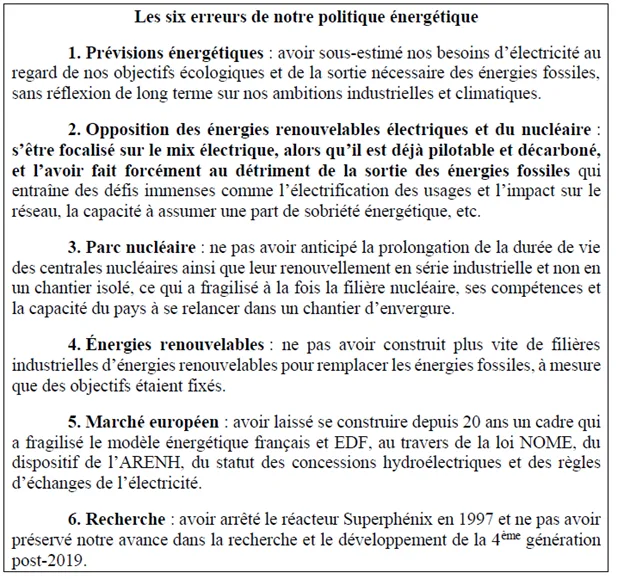
Here are the 6 mistakes the report identifies:
No alt text provided for this image

I propose a critical reading of 5 of the 6 points:

1/ Energy Forecasting

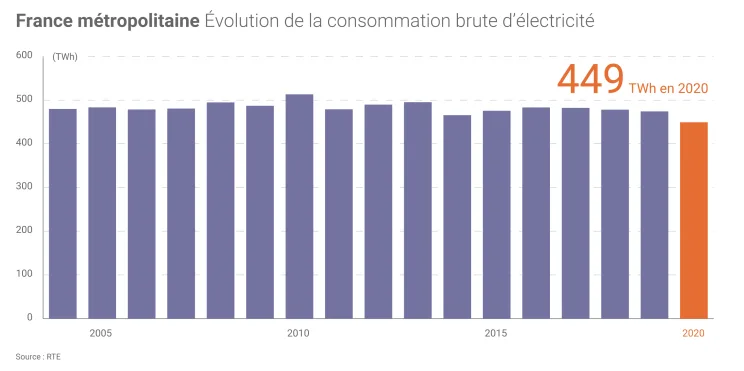
France experienced stable electricity consumption for almost two decades.
No alt text provided for this image

The increase in forecasted demand comes from electrification of uses, identified as a key climate action. It consists in replacing thermal processes by more efficient electric processes using electricity that we know how to decarbonize by renewables and nuclear.

This electrification strategy originates from the declining costs of renewable electricity production and other technologies like batteries and EVs. It is, for example, the main reason for the hydrogen revival produced by electrolysers: only an electricity cost below 20 USD/MWh, plus a capacity factor of at least 30% (in some world regions, it can exceed 50% by combining wind and solar), and a significant drop in electrolysers' production costs enable green H2 to be competitive.

Possible Development Models for Green Hydrogen Produced by Electrolyser? Part 1 - Economic Aspects

Between 2010 and 2020, LCOEs dropped by 90% for solar and 66% for wind. According to the IEA, solar is the cheapest method ever in industrial history for electricity generation (note: this concerns electricity flow output, not the total system cost, and this is true only in certain countries).

In most countries worldwide, renewables generate some of the cheapest electricity fluxes compared to other technologies—if not the cheapest—explaining their success.

The climate electrification strategy thus gained increasingly pronounce importance from 2010-2020, becoming today a primary axis, alongside demand reduction and renewable energy development. The general idea of technological and regulatory evolutions we are living through is building an energy system able to utilize this decarbonized low-cost energy flow despite solar and wind production variability linked to meteorology.

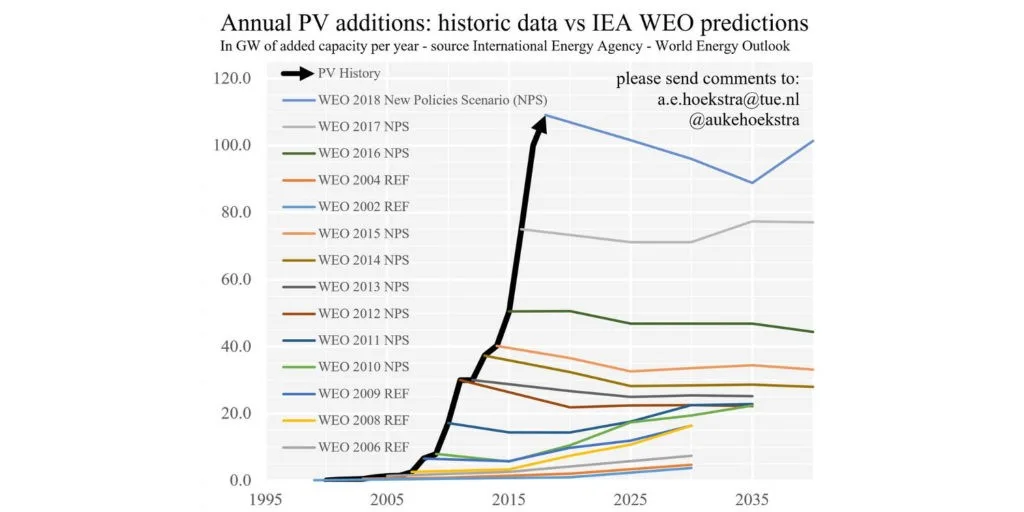
The IEA's Net Zero report is only from 2021. Here are its past projections on solar, for example:
No alt text provided for this image

No country, institution, with rare exceptions, had anticipated such an evolution of renewables and electrification. Even now, some refuse this orientation, including LR itself, whose first recommendation in its initial renewable energy inquiry is:

"Exit the 'all-electric' logic and use the best energy for a given use (thinking of work done on energy). Our energy policies should tend to match the best decarbonized energy to its use and environment (e.g., thermal renewables for heating)."

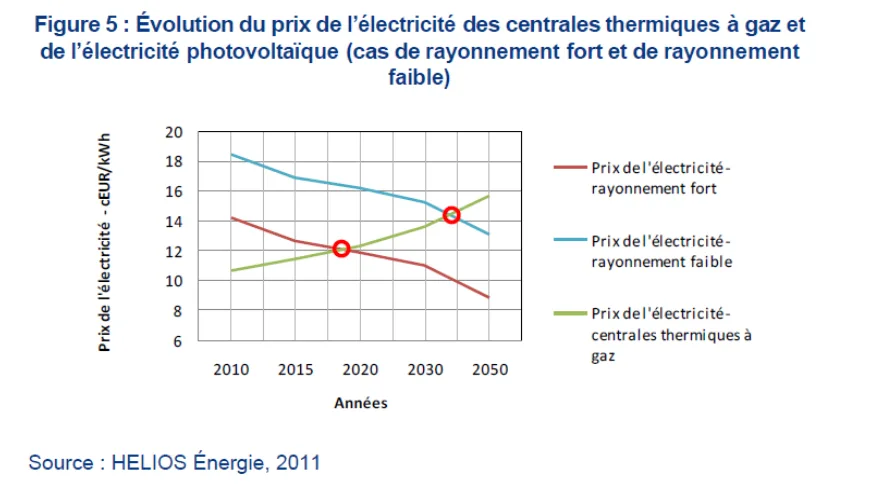
In fact, I confess I myself have made analysis errors here: my solar LCOE forecast made in 2011 and published in 2013 at IFRI on "Photovoltaic energy: an effective development tool for sub-Saharan economies" proposed prices in 2050... already reached in 2022. See below:
No alt text provided for this image

▶️ Thus, it is somewhat hasty to blame the State for not anticipating the rise in electricity demand: the commission seems caught in the classic retrospective analysis trap: analyzing the past as if future information was already available, which is not the case here.

2/ Opposition Renewables vs Nuclear: Focusing on the Electrical Mix which is Already Controllable and Decarbonized and Such Opposition Hindered Fossil Phase-out and Created Huge Challenges like Electrification

This sentence’s logic is quite obscure:

  1. It suggests we shouldn't have focused on the electrical mix, yet electrification is a huge challenge
  2. The mention of renewables vs nuclear opposition is incomprehensible, as is the pilotable characteristic of nuclear

I will try to analyze what I think it means. It’s the classic critique: "We shouldn't have invested in renewables; our mix is decarbonized; investments should have gone elsewhere like heat pumps, trains, or [insert your example]."

This is often found in nuclear lobby analyses, like in JMJ's comic:

Karim Megherbi on LinkedIn: An image is circulating on social media (source: Jean-Marc | 147 comments

This critique contains truths and falsehoods.

Starting with truths:

Our 2010-2020 policies were clearly insufficient for climate and fossil exit challenges, as with all past decades, though improving now. While renewables were developed, major issues like thermal insulation, complete mobility redefinition, agricultural practice changes, and social reorganizations remained timid or absent.

Awareness grew gradually notably thanks to Net Zero scenarios. For example, oil companies announced their net-zero strategies only around 2020-2021, reorganizing their activities, e.g., BP, Shell, and Total:

BP sets ambition for net zero by 2050, fundamentally changing organisation to deliver | News and insights | Home

Shell accelerates drive for net-zero emissions with customer-first strategy | Shell Global

Total adopts a new Climate Ambition to Get to Net Zero by 2050

Now the falsehoods:

  • Opposing climate actions makes no sense. The climate challenge is huge, and only ALL climate actions combined can achieve net zero. It is equally essential to develop renewables, trains, heat pumps, building insulation, etc.
  • France still subsidizes fossil fuels, yet the report does not denounce this, preferring to denounce renewable investments.
  • France, like many OECD countries, helped finance the initial development costs of renewable sectors, notably via high feed-in tariffs supporting the purchase of initially expensive electricity. Thanks to this support, renewables can now deploy worldwide, and their share in "Net Zero" electric systems is expected to be majority in all countries. This enables electrification strategy to begin substituting fossil fuels with non-marginal decarbonized energy quantities.
  • Our electric mix is only temporarily decarbonized; the nuclear majority poses challenges we must manage today: corrosion phenomenon causing 50% plant shutdowns (including maintenance), lack of resilience amid Covid crisis, structurally longer maintenance outages, etc. Given nuclear plants' long construction times, renewable development is essential, and it is fortunate we have a sector well-organized to accelerate them in the next 15 years. For technical details, see here:

The moratorium on renewable development in France: between incoherence, ideology, and climate risk

▶️ The argument that we shouldn't have invested in renewables during 2010-2020 and that they diverted us from climate actions is thus unacceptable.

3/ On Nuclear: Anticipate Lifespans and Launch Serial Constructions to Ensure Fleet Renewal

This point contains truths and falsehoods.

Again, let's start with the truths.

Certainly, better anticipation of our nuclear fleet's problems is necessary.

Now the falsehoods.

  • Lifespans could be argued as operator matters, yet the report makes them political and governance issues.
  • Anticipating cumulative corrosion, maintenance workload increase post-Fukushima, pandemic crisis effects on maintenance and production feels unlikely; the analysis again falls into the "retrospective" trap.
  • The State launched a new construction: FLA3. Had it gone well or progressed correctly, imagining further expansion would be possible. However, this construction started in 2007 and 16 years later is still not operational and will immediately be disconnected for vessel head replacement, which will take months. The budget grew from 3 billion to 19 billion euros (!). Other EPR constructions also suffer significant delays and massive budget overruns, besides the Chinese ones done in partnership.
  • Our fleet is not yet at renewal; we aim to extend existing plants.
  • The State invests in nuclear: the grand maintenance program costs as much as the total investments for building our entire historic nuclear fleet.
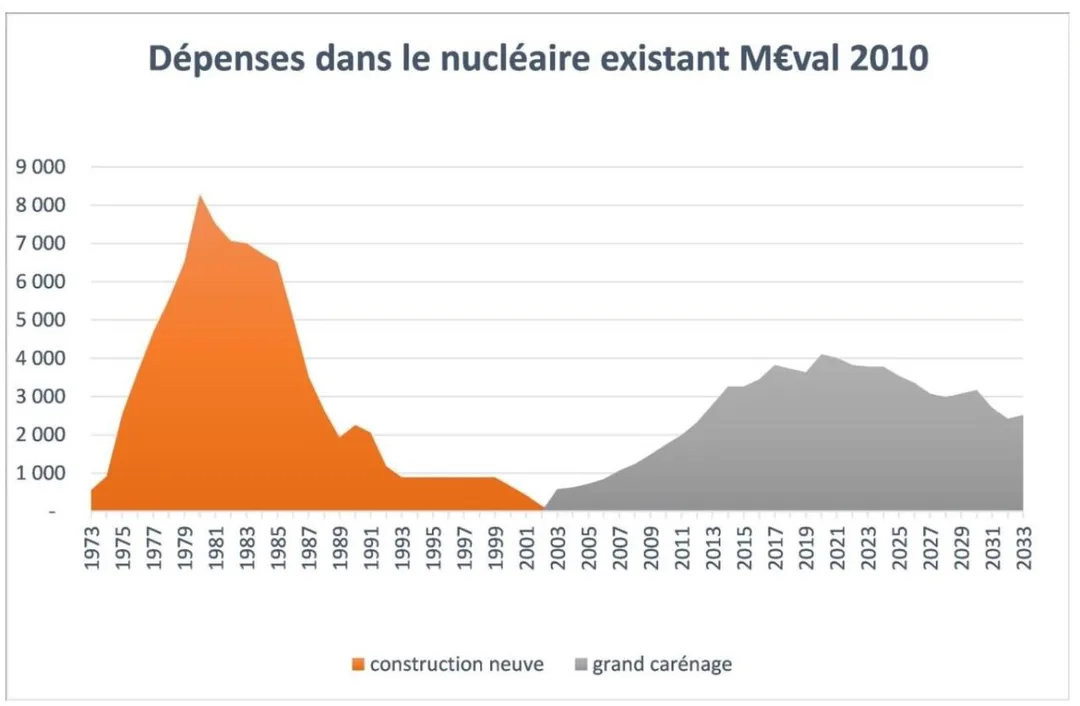
No alt text provided for this image

▶️ Ultimately, the argument is unclear. The report likely again falls into the retro-prospective analysis trap: we should have prepared 10 years ago for a large-scale nuclear program like Messmer 2, without signals of need and unable to anticipate highly improbable risks materializing 15 years later.

▶️ Our energy trajectories must now anticipate degraded nuclear production risks. Studies seem required but I admit not knowing if such studies can anticipate these risks even 5 or 10 years ahead and with what probability degree. The report does not address these essential points.

▶️ To anticipate these risks, it is necessary to strongly accelerate renewable electricity development—which the report does not recommend.

▶️ As we will see later, a Messmer 2 plan would increase our electrical system's costs, which the report does not recognize.

4/ Renewables: Set up Chains to Replace Fossil Fuels

The report deals here with a subject apparently not mastered at all. Which is normal: no renewables industrial actor was interviewed during this commission.

France did try to set up renewable chains; we have some industrial activities: a blade factory, recycling companies, installers, developers, investors, consultants, etc.

Blade factory:

Cherbourg: Wind turbine blade factory doubles production capacity and recruits

Wind sector:

Wind Observatory 2020 - France Energie Eolienne

Regarding jobs, with less than 10% of the electric mix in 2019, electric renewables already represented 34,000 jobs:

Green economy: 72% increase in renewable energy, low terrestrial transport, and renovation jobs between 2006 and 2019

But indeed, the equipment value chain is still limited. A silicon project in the 2010s failed, the Photowatt factory is now depleted, the CEA set up a module factory in Kazakhstan using French tech which had poor feedback...

▶️ This issue goes beyond France; Europe as a whole missed its industrial policy related to renewables.

Personally, I permit an analysis open to discussion: competition and market openness rules, along with fragmented European markets where each country has very different regulations, made industrial setting very difficult. Even in 2018, mistakes occurred: SolarPower Europe advocated to stop import taxes on Chinese panels thinking it would lower LCOEs and accelerate renewables; ultimately, this mainly increased "development fees" (margins for project developers).

▶️ It was therefore difficult for a country like France, with small market volume 2010-2020, to develop large industrial ambitions. This also applies to nuclear, explaining France's recent policy of forming a European nuclear alliance to enlarge future markets if EPR2 constructions resume.

This situation is not fate. On one hand, ambitious projects emerge, like the French solar panel factory Carbon, which needs support:

CARBON - Photovoltaics Made In France

On the other hand, Europe has (finally) decided to support European industry in response to the US Inflation Reduction Act that attracts many industrial projects formerly intended for Europe. This policy is the Green Deal Industrial Plan; much remains to be done to realize it.

Press corner

▶️ Waiting for industrial activities to relocate to France and Europe to continue renewables development prevents electrification strategy expansion and limits electric production to low levels during the next 15 years, with significant risk of variations. (Re)industrializations will thus happen in parallel with renewables deployment worldwide.

5. European Market

Lacking sufficient competency for a detailed analysis here, I will not address this point.

Recommended by LinkedIn
Réindustrialisation et transition énergétique : l’urgence d’un cap clair ! Reindustrialization and energy transition: the urgent need for a clear direction! Christelle Morançais 1 year ago Le Gaz Vert : l'Atout Caché de la Flexibilité Énergétique Green Gas: The Hidden Asset of Energy Flexibility Arnaud Bergounhon 2 months ago Prix négatifs, congestion et raccordements : l’ingénierie système, nouveau goulot Negative Prices, Congestion and Connections: System Engineering, the New Bottleneck Tekeria 7 months ago

However, I include critiques evoking this report chapter in annex.

6. Superphénix and Gen IV

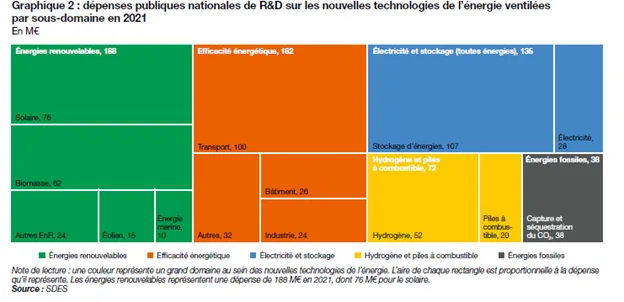
France already invests heavily in nuclear R&D:
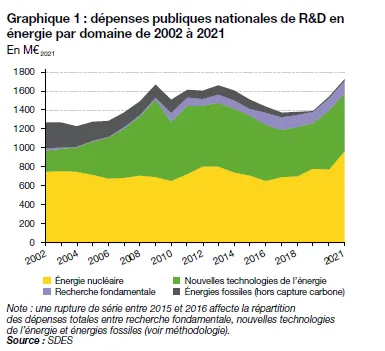
No alt text provided for this image

Furthermore, it launched an ambitious SMR program:

The solution

As seen earlier, the grand maintenance budget plus construction budget of 3 pairs of EPR2 and nuclear industry's recapitalizations/restructurings add up. The report now recommends rehabilitating Superphenix and investing in Gen IV research.

These proposals seem seriously lacking in rigor and realism. Nuclear represents less than 5% of global electricity sector investments, over half of which are in China. The project pipeline is very limited, and that accessible to EDF even more, since markets divide practically by geopolitical influences: US-China-Russia-France.

Studying opportunities to follow such proposed R&D programs would require detailed cost, timeframe, uncertainty studies, the potential format (club European or international), and market potential behind. The sector will be busy with SMR, grand maintenance, upkeep, 6 EPR constructions, and decommissioning.

Success of the first EPR pair construction is absolutely critical: a new failure like FLA3 would harm reputation, impacting positioning in Europe and stakeholders' and politicians' visions of the technology.

None of these questions are addressed in the report.

▶️ The report does not provide a pertinent analysis of nuclear R&D choices.

3. Analysis of the Energy Mix Defended by the Report and Some Proposals

1/ The Report's Huge Omission: the 2023–2037 Period

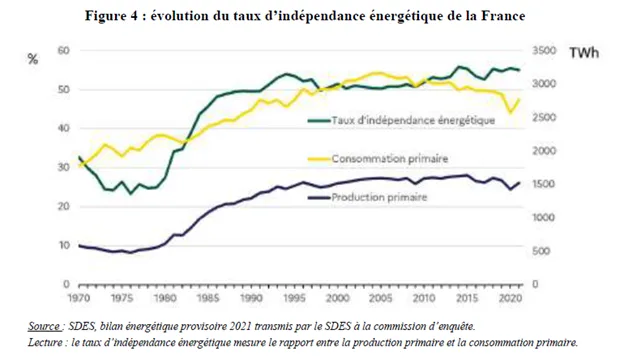
Let's start with a note that could be humorous if this report had been written by a student for their Baccalaureate exam. According to the report, France's energy independence rate... has been increasing since 2000!

No alt text provided for this image

Although these figures are much debatable, they do not remove trends. The commission could thus have stopped immediately given this result.

But the report forgets a crucial element of energy independence: France depends over 64% on fossil fuels, and only demand reduction and electrification can abolish this dependence. There will be no EPR2 plant before at least 2035-2037 in an ideal scenario. Thus, France's energy independence for the next 15 years depends mainly on renewables and demand reduction.

It should therefore have devoted a major part to this question: what is the nature of our dependence/independence with renewables?

Renewables are assets that do not require external flows to operate, so once installed, they ensure our independence. But equipment must be procured: what horizon allows us to cover much of our demand locally or in Europe, what policies are necessary to achieve better independence, and which strategic agreements should we weave at European and other levels?

▶️ The report does not address any of these questions, which should be priority examinations.

2/ Distinction Between Electrical and Thermal Renewables

The communication strategy of opposition movements to renewables is partly based on differentiating thermal renewables—acceptable because non-competitive with nuclear (apparently, actually can be via electrification of uses but indeed potential is more limited than electrical renewables)—and “electrical” renewables, judged as direct nuclear competitors to be stopped at all costs. Among electrical renewables, only hydro and some offshore wind are accepted by some.

This communication strategy is technically grounded in Jean-Marc Jancovici’s ideas developed over several years. His explanation is found here, during his Orano intervention:

Jean-Marc Jancovici and the Low-carbon Transition | Orano

"Wind and solar, heavily present in speeches and investment sums for these energies, have intrinsic physical limitations (diffuse and intermittent), strongly reducing their ability to substitute fossil fuels. Fossil fuels are controllable, easily transportable and storable (high energy density per volume), and can power large machines."

"To retain as much as possible of this 'modern' comfort while fighting climate disruption, nuclear complements renewables, whose specialty is more heat (fuels, industry, heating) than electricity."

This communication strategy—validated by no study—offers advantages for these opposition groups:

1. It sows confusion by allowing claims to actually be pro-renewables... but it depends which ones (aha!).

2. It divides renewable sectors; promoters of thermal renewables may feel—sometimes rightly—overlooked in public policies compared to other renewables. Yet each technology plays an important role in our present and future energy mix, deserving attention and specific regulation. Associations like ENERPLAN accompany both thermal and photovoltaic solar in France, and the government launched a large geothermal development plan:

Geothermal: An Action Plan to Accelerate

3. It diverts attention to other topics presented as more important, notably because our electricity is already decarbonized (argument refuted in section 2).

▶️ There is no reason to oppose thermal and electrical renewables. Thermal renewables cannot substitute electrification strategy at scales indicated below in section 5, nor cover nuclear fleet availability declines or electrify uses for transport. Each technology has a specific profile and a crucial role in achieving Net Zero. They must all receive dedicated policies.

3/ The Disguise in the Speech on Replacing Nuclear by Renewables

Another opposition movement’s rhetorical strategy is to claim that replacing nuclear by renewables is useless for climate.

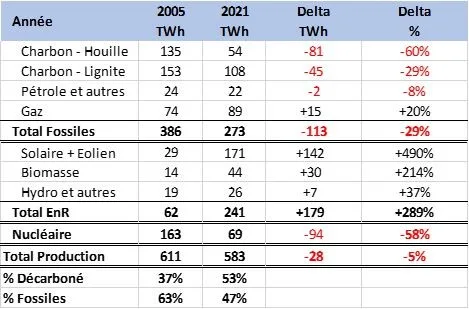
This is, for example, what Germany has done over 10 years, with renewables covering nuclear phase-out and lowering fossil dependence for electricity, which might have decreased more if nuclear plants weren’t closed. Here are the figures as a reminder.

No alt text provided for this image

It is entirely correct to say that replacing nuclear by renewables isn't climate-useful. But this is not what happened in France nor what will happen.

For the past:

RTE studied this issue; the conclusion is clear: renewables did not replace nuclear production during 2010-2020 or only marginally. Thus, it would be desirable for this myth to stop circulating in France. Here is the study:

CO2 Balance Note V3.pdf

For the future:

The likely decline in nuclear’s share doesn’t mean replacement but dynamic evolution of the energy mix to cover growing demand under time, industrial deployment, cost optimization, and risk constraints.

Indeed, for the next 15 years, no EPR2 will be built. FLA3 should connect but then immediately disconnect for vessel head replacement, taking many months. Renewables thus won’t replace nuclear plants but cover additional demand and compensate for historic fleet availability hazards, which we hope can be extended as much as possible; otherwise, we’ll need to accelerate renewables and demand reduction further.

Even after first EPR2 arrival, renewables must grow to complement the fleet growth insufficient given needs and schedule.

Naturally, we might hope our sector manages to build new plants at record pace post-2040—which would be excellent—but uncertainties require risk coverage strategies: accelerating renewables and demand reduction are paradoxically essential for nuclear deployment strategy. More details here:

French electricity policy by 2050: issues and constraints

▶️ The replacement argument is a rhetorical device aiming to advocate for nuclear share stability: when this share falls, it’s claimed renewables replace nuclear. This is incorrect and ignores system evolutions. It traps us into anti-climate positions; for example, in 15 years even if all nuclear plants held, nuclear share would fall sharply because of renewables additions, increased demand, and possibly reduced availability. Maintaining nuclear share until 2035 means neglecting our electric system and halting electrification, leading to shortages and missed climate goals.

4/ LR’s Hydroelectric Joker Mirage

Asked whether going without renewables for the next 15 years is possible, LR answers: develop hydraulics!

Already, this proposal to develop hydraulics as much as possible is correct: studies by France Hydro Electricité indicate a +20% producible potential. See the detailed study:

Development

Now, let's look at numbers:

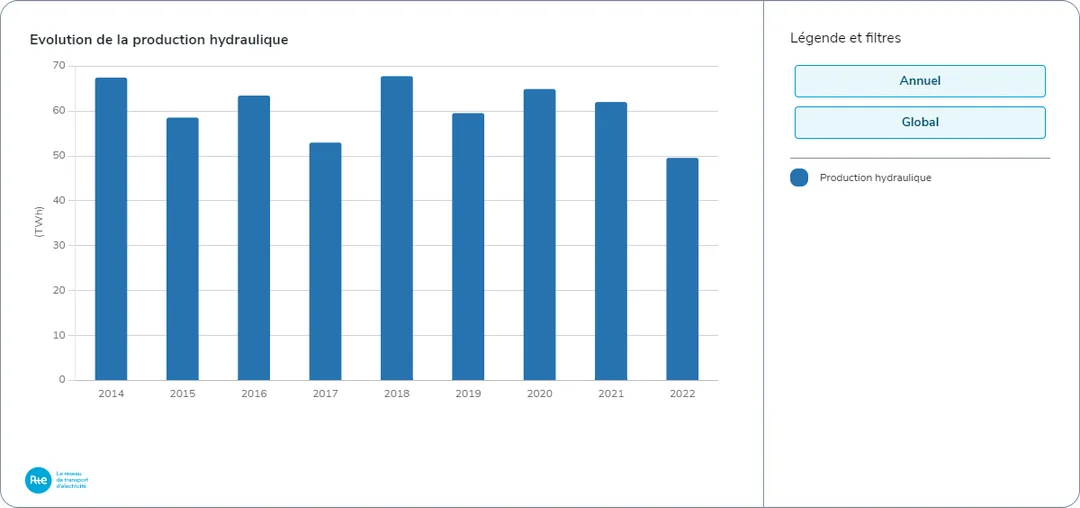
We have about 12% hydro in our mix; +20% means ~14.5% at constant demand. However:

  1. Demand will rise during the next 15 years
  2. Climate change affects producible output

As shown below, hazards far exceed 2.5%.

No alt text provided for this image

Recall, according to RTE, to follow trajectory N1 (with six EPR2s built), we need to install 4 GW renewables annually for 15 years.

These figures are logical: the climate challenge is huge, fossil dependency is 64%. Even if demand lowers, electrification adds ~30% to the system. Adding planned nuclear retirements and availability drops, we need at least half of our current system added over 27 years.

Remember, 2023–2030 is critical for climate and energy.

  • On the climate front:
  • On the energy front:

How then imagine these +4% hydro will suffice? How imagine going without substantial renewable development alongside nuclear, given the sector’s commitments to build, operate, maintain, and execute grand maintenance?

▶️ LR’s joker is thus unsurprisingly a poor bet.

5/ An Energy Mix Not Studied and Contradicting All Available French (and World) Studies

Summarizing the report’s recommended energy mix:

  • Electricity: nuclear, hydraulics, and offshore wind development
  • Thermal processes: thermal renewables
  • Regarding electrical renewables: a pause and more detailed studies to understand their real contribution
  • Energy sobriety

One recognizes here Jean-Marc Jancovici’s exact position: moratorium on renewables to "pause and reflect", develop thermal renewables (he asked Carbone 4 for a study which lacks economic and comparative analysis), lots of nuclear, and sobriety.

But only a few minutes reflection suffices to reject this proposal:

  • We saw already, no EPR2s for 15 years and huge electrification capacities needed across scenarios—even sobriety, Shift, or Nucléaire Voices scenarios
  • The idea of pausing forgets we are in an energy and climate crisis with all studies available to accelerate within 10-15 years
  • No French study validates such scenario

▶️ Such proposals pose insane risks and delay climate action deployment. They jeopardize energy supply in the next 15 years.

Regarding economics:

A/ Economic optima exist for EnR-nuclear shares.

In 1970 renewables weren’t an option unlike today. In 2023, our electrical system’s economic equation is:

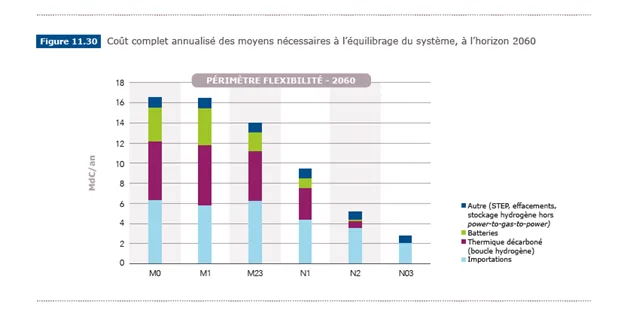
  • More nuclear reduces flexibility needs
  • More renewables increase flexibility needs and associated rising costs
  • Nuclear produces kWh at a higher flux cost than renewables
  • Thresholds depend on each country’s resources. France, with hydro and environment, can absorb 50% renewables including hydro without significant cost.

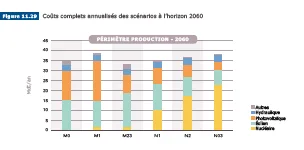
Two key graphs illustrate these principles: cost evolution from M23 to N03 plus flexibility costs.

Article content
Article content

▶️ The conclusion: each country has nuclear-renewable share optima depending on available resources and achievable kWh prices. In France, this depends on first EPR2 unit price but will probably be under 50% nuclear.

B/ Renewables with fixed costs over 20 or 30 years act as price volatility coverage instruments.

It is abusive to call renewables support mechanisms (feed-in tariffs and CfD) subsidies:

  • A renewable plant can sell electricity at a fixed long-term price as all cost parameters are known upfront, notably no fuel needed.
  • This fixed price isolates from market volatility and hydrocarbon price fluctuations. Fossil sectors lack comparable long-term price coverage (only 5-7 years).
  • Price value depends on risk perception: if one sees the price as interesting, the value is positive.
  • Sales price reflects the best offer at an instant, granted via competitive rules or negotiated bilaterally to cover costs plus reasonable margin.
  • Given falling prices, tariffs' value is positive in most cases, explaining European PPAs' success with consumers.
  • In CfD contracts, electricity is sold on markets: if spot price is below fixed price, the State pays the difference; if above, the State earns it—a CfD is thus a risk coverage tool.

Here is an article for further reading:

The lazy (and incorrect) use of the word “subsidy”

This analysis reflects in the Court of Audit’s support cost estimates: it used a 39 EUR/MWh referential projected 30 years with 1% inflation, then looked at differentials vs signed CfDs.

The popular figure of 121 billion euros in France is often misunderstood: it is a future projection (costs not yet spent but committed) dependent on future spot prices. Two remarks:

  1. Renewables’ LCOEs declining reduces this mechanism’s cost significantly. It’s imagined this cost disappears within a decade.
  2. During the recent crisis, the State earned tens of billions from renewables which funded the price shield, fully playing the price coverage role.

▶️ The report did not identify these economic issues which are central to today’s tech deployment strategies.

6/ Proposals Reflecting This Energy Mix Vision

Given the context, 6 mistakes analysis, and elements above, one easily understands the framework underpinning the report’s "30 proposals."

  • Sovereignty is mainly seen as nuclear revival: this is incorrect—and a grave analysis error. Regarding electricity production, out of 30 proposals, 12 concern nuclear and 1 offshore wind; nothing on renewables.
  • Sovereignty is viewed as "freedom of choice", favoring political choices based on electoral and ideological motivations over studies. Yet thanks to RTE’s report, we limited this (unfortunately intrinsic to politics). This report is thus a clear regression against our gains, whose fragility we witness.
  • The report proposes studies that already exist; the way electric trajectories are built is unknown: we don’t reason by comparing technologies on cost/benefit but scenario studies of energy mixes whose pros and cons are compared.
  • The proposals are inadequate given ignored challenges, as the underlying "magical" energy mix lacks in-depth mention of intermittency and flexibility challenges, renewables deployment, citizens’ technology appropriation, local supply-demand adjustments, territorial energy development, etc. No proposals relate to real decarbonization scenario issues.
  • On nuclear, restructuring the nuclear sector including communication, citizen relations, governance, and institutional organization was not addressed. Internal problems were turned into external ones. Given many interviewed sector-relevant people and their present or past roles, it was an ideal occasion to discuss institutional roles in decision-making, role of associations, political and industrial governance, institutional organization overall. The absence of these recommendations is regrettable, as they are crucial to maximize chances of EPR2 construction success. Conversely, the report proposes framing the sector with strengthened Parliament power—traditionally more conservative—and OPECST, also conservative, praising a recent nuclear report whose content is as questionable as this commission’s: no market analysis, no budget, no economic or transition place analysis. Parliament recently gutted the renewables acceleration law, putting France in danger. This proposal simply puts nuclear governance into conservative nuclear groups' hands—if accepted, annihilating all hopes for climate strategies and nuclear sector revival. Instead, decentralizing today’s poisoned nuclear sector, varying governance profiles, regaining entrepreneurial dynamism, including critical experts and citizen representatives should have been proposed, along with rethinking institutional organization within an energy transition accompaniment logic.
  • Proposals related to sobriety and thermal, hydraulic, and various other energy developments are positive.

▶️ The proposals seem mismatched to energy, climate, and sovereignty challenges.

4. Conclusion and Proposals

This article attempted to provide an analytical reading framework of the report without aiming at a detailed analysis. If errors occurred, feel free to point them out.

The report’s reflection framework, notably the energy mix underlying the general approach, is far from reality. Of course, some good reflections and proposals are present here and there but cannot be integrated coherently to meet climate targets and our energy needs while ensuring sovereignty and addressing the current energy crisis.

Supporting such an energy mix only leads to major analysis errors. The report’s own sovereign treatment proves it: noting energy independence unattainable, the document associates it with freedom to choose mix. But this view is superficial: the European electrical grid strengthens cooperation through shared assets and expands with Iberian grid opening and North African interconnections; renewables lead us to revisit sovereignty by separating construction, operation, and recycling phases; hydrogen, e-fuels, SAFs, strategic interdependencies due to integration for variability management, and metals also evolve this notion and could be peace factors rather than conflict. None of these topics appear in the report, as electrical renewables do not exist in the defended energy mix. The reality is renewables will likely represent at least 50% of our electricity mix by 2050.

One could imagine advocating for a very nuclear France as Europe’s nuclear battery positively contributing to energy transition. But arguments must be more carefully made, multiple analysis errors corrected—particularly regarding timing—and built on serious studies.

My article does not intend to say France made no past mistakes. On the contrary, we have accumulated many, like others: we missed opportunities to turn the overseas territories into fast 100% renewables zones due to imperfect regulations, nuclear sector seems archaic, we failed to protect our industry, etc. But key topics are not addressed, answers are very (too) weak.

It is important to learn from this exercise. Here are some proposals:

  1. This is LR's second commission producing such a mostly unusable document. Public funds and time are spent, attention of citizens and witnesses absorbed. This seems unacceptable. Inquiry commission validation and organization modalities should be reviewed.
  2. The commission took place amid debates on renewal acceleration laws and nuclear as well as public consultation on 6 EPR2 construction. It obviously influenced these debates, directly attacking democratic processes. It should be verified that commission topics do not coincide with concurrent decision and consultation themes or even approach them.
  3. This report might be used by LR as a communication tool to defend its imaginary energy mix despite study absence. It seems crucial to review validation and communication conditions for such reports. It is unacceptable that citizens fund LR’s presidential campaign indirectly and contribute to nuclear propaganda.
  4. The State must help citizens fight misinformation, now omnipresent in public space. Three ideas:
    • Create an institute studying misinformation actions (sources, diffusion ways), identifying unusual activities linked to democratic processes indicating possibly marked influence attempts. This institute would respect i) freedom of expression—a democratic inalienable right— ii) media and personal spheres’ non-interference, plus other linked liberties. It would serve as an info—not control—tool.
    • Support new, more participative and decentralized info channels, to rebuild links among citizens and decloison opinions. For example, back collectives organizing interactive readings of climate scenarios to master technical subtexts and appropriate them, generating critiques and/or actions. CNDP public debates are fantastic but rare; regular elements of life could be implemented. Financial resources needed are significant (e.g., CCC cost 6m euros, providing scale).
    • Review democratic processes to make them more participative, rebuilding citizen-State links, as trust is low with elected officials and citizens struggle to recognize themselves in representatives. Government staff profiles should also evolve—administrative training needs revision but results only in a decade or more.

These proposals are mere brainstorming open to discussion; certainly many blind spots remain. I also didn't review existing France misinformation research.

Social conflicts will be inevitable throughout the transition given transformation stakes and worldview differences.

But the probability that the 2050 energy mix will include both renewables and nuclear in significant proportions is very high. Dialogue on common references is therefore desirable to enable mutual understanding and avoid excessive polarization.

***

Annex 1 – the Report

l16b1028_rapport-enquete.pdf

I won't hide it: simply writing the article's title – which paraphrases the theme of the inquiry commission – was already difficult for me. The analytical angle it suggests is indeed necessarily confrontational. Such an entry point, as vague as it is biased, invites free imagination and the expression of analyses that would be based primarily on our personal convictions.

2050 is very close. Our climate actions are mostly well known. France has limited leeway in its energy policy. It will have to combine demand reduction, electrification, development of renewables (EnR), and nuclear power.

Of course, it is essential to formulate critiques of our identified decarbonization pathways given the still significant gap between our climate policies and what we should actually do, as well as evident omissions such as taking all planetary boundaries and social reorganizations into account.

Each sector has its own codes and analytical tools to produce information and critiques. Regarding energy mix scenarios, particularly electrical, given their systemic aspect and the necessity to consider many factors to calculate supply-demand balances in minutes/15-minute/30-minute time steps over a long duration, involving defining annual evolution trajectories for each factor (climate, industrial deployment, sectoral demands, interconnections and mix of neighboring countries, flexibility tools, production plants, etc.), engaging in critique necessarily requires defining a reference framework.

One can thus refer to a third-party study—like the RTE report—or if resources allow (companies, associations, or think tanks with modeling teams gathering necessary information)—build our own scenario to submit for external critique. Then, methodologies used and assumptions can be described, and debates can occur to find points of convergence and differences.

For this article, I propose using as an analytical framework the review of the "6 mistakes" from the summary as well as the energy mix defended by the report, which allows identifying the reference framework it uses and understanding the nature of the proposals submitted, some of which will be discussed here.

Two reasons motivated this article:

1/ First, it is unacceptable to issue public criticisms on such important topics without proposing documented analyses and making proposals. I therefore must commit to this exercise if I am to discuss this report which proposes—without having studied it in depth—an energy mix that disagrees with our most accomplished studies in France (Negawatt, RTE, Ademe, and Shift) and does not hold up to analysis. This situation leads to anti-climate positions that also place us in danger regarding securing our energy supplies.

2/ Second, to contribute—at my very modest level—to an ongoing movement in France toward rebalancing information and positions disseminated in the public space, now flooded with misinformation and left unattended. Without claiming to offer quality analyses, and although, like everyone, I am subject to biases in my analyses, I at least try to draw attention to different possible positions, be transparent in my references, document my statements, and propose analytical tools to then produce an opinion, whatever it may be.

Though unable to read the report in full, I browsed it seeking information to check if chapters could address the critiques written here. I propose four sections:

  1. The context of the report
  2. Analysis of the report section "6 mistakes of our energy policy"
  3. Analysis of the energy mix defended by the report and certain resulting proposals
  4. Conclusion and Proposals

The report will also be included in the annex.

Enjoy reading and please feel free to leave comments and critiques!

1. The Context of the Report

The inquiry commission was requested by the political party Les Républicains.

1/ What is an inquiry commission?

Each party in France has an annual right, regulated by various conditions but today almost automatically granted, to create an inquiry commission. It lasts no more than 6 months, during which it can "summon" any person, who is then obliged to appear to testify.

Here are the regulations:

Fact Sheet No. 49: Inquiry Commissions and Information Missions Created by the Conference of Presidents

2/ The Position of the LR Party on Renewable Energies

To understand this party's positions on renewable energies, here is an excerpt from parliamentary debates:

Discover the Locations

One can read there that combating climate change cannot be assured by intermittent, unpredictable, and non-controllable energy; that wind turbines have no positive impact on the climate since they replace already decarbonized nuclear and hydroelectric power; that wind turbines may induce unknown health risks on humans and animals; and many other rather fanciful arguments.

These positions, whose existence even in 2023 and presence in parliamentary debates are surprising, contradict our knowledge, studies, and data on these subjects. Given this is not the article's focus, I simply include contradictory elements in the annex for consultation if needed.

3/ The First Part of LR's Political and Communication Strategy: the Inquiry Commission on Renewable Energies

LR requested two inquiry commissions: the first on renewables (EnR), and the second on nuclear power—although the second commission's title does not explicitly designate this technology, the final objective is indeed nuclear promotion as we will see.

In the first part on renewables, LR's party positions are expressed throughout the document via analyses and interventions of expert witnesses.

An introductory context element immediately signals the quality of analyses that will be presented:

"This is not about claiming that there are ways to produce energy without disadvantages, but to emphasize the imbalance between an excessively critical narrative in the case of fossil fuels and an excessively lenient narrative regarding so-called green energies. In its hearings, the inquiry commission sought to correct this imbalance."

The report notably highlights critical interventions on wind turbines from the following allegedly qualified persons: "Mr. Jean-Pierre Riou, Mr. Jean-Marc Jancovici, Patrice Cahart, Arnaud Casalis, Jean-Louis Butré, Lawyer Morvan Le Berre, Mr. François-Marie Bréon".

All these persons have actively campaigned for extreme nuclear and strongly opposed renewable development over two decades, some via highly questionable actions.

For example, Jean-Louis Butré is the long-time president of the association Fédération Environnement Durable which opposes wind deployment in France, and Patrice Cahart and Arnaud Casalis are founding members of the Cérémé, who, for example, on the eve of the renewable energy law adoption paid for double-page ads in various newspapers to distribute anti-renewable propaganda; see here:

Karim Megherbi on LinkedIn: 3 French associations launched anti-renewable propaganda in several… | 167 comments

Jean-Marc Jancovici's positions on renewables are notably cited in the report:

"During our inquiry commission, Mr. Jean-Marc Jancovici and others of the same school questioned the economic and technological relevance of the current energy policy increasing the renewable energy share in the electricity mix. Expressing a clear priority for fighting climate change over nuclear risk, Mr. Jancovici argues: 'Climate change is a cumulative process. Year after year, greenhouse gases accumulate in the atmosphere. It takes more than ten thousand years to clear an excess of CO2 emitted into the atmosphere! Ten thousand years of irreversible global destabilization! Compared to that, nuclear waste is a small matter.'"

"However, Mr. Jancovici and other experts called before our commission expressed their conviction that developing renewable electric energies to replace nuclear represents an economic and technological dead end. By analyzing costs, technological constraints, and comparative benefits of gradually replacing some nuclear electricity production with renewable electricity production, he concludes not only that developing electrical renewables corresponds to creating a sort of 'costly detour' for decarbonized electricity production but also that this 'detour' would technologically end up at a 'dead end.'"

Critiques of these positions are found in section 3 of the article.

4/ Timing of the Launch of the Second Inquiry Commission

This commission was requested at the time of launching reviews of laws to accelerate renewables and nuclear power, as well as the public consultation on building six new EPR reactors. It follows the European Union's decision to speed up renewables, asking member states to establish regulatory conditions to participate in this objective, given the climate and energy emergencies.

The dates:

  • September 5, 2022: request for commission creation by LR
  • September 7, 2022: CNDP announcement of public consultation on construction of six new EPR nuclear reactors
  • September 26, 2022: submission of draft bill relating to acceleration of renewable energy production under fast-track procedure
  • November 2, 2022: draft bill relating to speeding procedures linked to new nuclear installations' construction near existing sites and operation of existing installations

Meanwhile, extremely strong prominence of pro-nuclear personalities advocating for a massive nuclear recovery plan was observed in the public space, most defending positions against renewable development.

We can therefore seriously question the inquiry commission's influence both on public opinion and our elected officials during consultation phases on such essential and complex topics.

This point will be the subject of a specific proposal at the article's end.

2. Analysis of the "6 Mistakes of Our Energy Policy"

Here are the 6 mistakes the report identifies:

No alt text provided for this image

I propose a critical reading of 5 of the 6 points:

1/ Energy Forecasting

France experienced stable electricity consumption for almost two decades.

No alt text provided for this image

The increase in forecasted demand comes from electrification of uses, identified as a key climate action. It consists in replacing thermal processes by more efficient electric processes using electricity that we know how to decarbonize by renewables and nuclear.

This electrification strategy originates from the declining costs of renewable electricity production and other technologies like batteries and EVs. It is, for example, the main reason for the hydrogen revival produced by electrolysers: only an electricity cost below 20 USD/MWh, plus a capacity factor of at least 30% (in some world regions, it can exceed 50% by combining wind and solar), and a significant drop in electrolysers' production costs enable green H2 to be competitive.

Possible Development Models for Green Hydrogen Produced by Electrolyser? Part 1 - Economic Aspects

Between 2010 and 2020, LCOEs dropped by 90% for solar and 66% for wind. According to the IEA, solar is the cheapest method ever in industrial history for electricity generation (note: this concerns electricity flow output, not the total system cost, and this is true only in certain countries).

In most countries worldwide, renewables generate some of the cheapest electricity fluxes compared to other technologies—if not the cheapest—explaining their success.

The climate electrification strategy thus gained increasingly pronounce importance from 2010-2020, becoming today a primary axis, alongside demand reduction and renewable energy development. The general idea of technological and regulatory evolutions we are living through is building an energy system able to utilize this decarbonized low-cost energy flow despite solar and wind production variability linked to meteorology.

The IEA's Net Zero report is only from 2021. Here are its past projections on solar, for example:

No alt text provided for this image

No country, institution, with rare exceptions, had anticipated such an evolution of renewables and electrification. Even now, some refuse this orientation, including LR itself, whose first recommendation in its initial renewable energy inquiry is:

"Exit the 'all-electric' logic and use the best energy for a given use (thinking of work done on energy). Our energy policies should tend to match the best decarbonized energy to its use and environment (e.g., thermal renewables for heating)."

In fact, I confess I myself have made analysis errors here: my solar LCOE forecast made in 2011 and published in 2013 at IFRI on "Photovoltaic energy: an effective development tool for sub-Saharan economies" proposed prices in 2050... already reached in 2022. See below:

No alt text provided for this image

▶️ Thus, it is somewhat hasty to blame the State for not anticipating the rise in electricity demand: the commission seems caught in the classic retrospective analysis trap: analyzing the past as if future information was already available, which is not the case here.

2/ Opposition Renewables vs Nuclear: Focusing on the Electrical Mix which is Already Controllable and Decarbonized and Such Opposition Hindered Fossil Phase-out and Created Huge Challenges like Electrification

This sentence’s logic is quite obscure:

  1. It suggests we shouldn't have focused on the electrical mix, yet electrification is a huge challenge
  2. The mention of renewables vs nuclear opposition is incomprehensible, as is the pilotable characteristic of nuclear

I will try to analyze what I think it means. It’s the classic critique: "We shouldn't have invested in renewables; our mix is decarbonized; investments should have gone elsewhere like heat pumps, trains, or [insert your example]."

This is often found in nuclear lobby analyses, like in JMJ's comic:

Karim Megherbi on LinkedIn: An image is circulating on social media (source: Jean-Marc | 147 comments

This critique contains truths and falsehoods.

Starting with truths:

Our 2010-2020 policies were clearly insufficient for climate and fossil exit challenges, as with all past decades, though improving now. While renewables were developed, major issues like thermal insulation, complete mobility redefinition, agricultural practice changes, and social reorganizations remained timid or absent.

Awareness grew gradually notably thanks to Net Zero scenarios. For example, oil companies announced their net-zero strategies only around 2020-2021, reorganizing their activities, e.g., BP, Shell, and Total:

BP sets ambition for net zero by 2050, fundamentally changing organisation to deliver | News and insights | Home

Shell accelerates drive for net-zero emissions with customer-first strategy | Shell Global

Total adopts a new Climate Ambition to Get to Net Zero by 2050

Now the falsehoods:

  • Opposing climate actions makes no sense. The climate challenge is huge, and only ALL climate actions combined can achieve net zero. It is equally essential to develop renewables, trains, heat pumps, building insulation, etc.
  • France still subsidizes fossil fuels, yet the report does not denounce this, preferring to denounce renewable investments.
  • France, like many OECD countries, helped finance the initial development costs of renewable sectors, notably via high feed-in tariffs supporting the purchase of initially expensive electricity. Thanks to this support, renewables can now deploy worldwide, and their share in "Net Zero" electric systems is expected to be majority in all countries. This enables electrification strategy to begin substituting fossil fuels with non-marginal decarbonized energy quantities.
  • Our electric mix is only temporarily decarbonized; the nuclear majority poses challenges we must manage today: corrosion phenomenon causing 50% plant shutdowns (including maintenance), lack of resilience amid Covid crisis, structurally longer maintenance outages, etc. Given nuclear plants' long construction times, renewable development is essential, and it is fortunate we have a sector well-organized to accelerate them in the next 15 years. For technical details, see here:

The moratorium on renewable development in France: between incoherence, ideology, and climate risk

▶️ The argument that we shouldn't have invested in renewables during 2010-2020 and that they diverted us from climate actions is thus unacceptable.

3/ On Nuclear: Anticipate Lifespans and Launch Serial Constructions to Ensure Fleet Renewal

This point contains truths and falsehoods.

Again, let's start with the truths.

Certainly, better anticipation of our nuclear fleet's problems is necessary.

Now the falsehoods.

  • Lifespans could be argued as operator matters, yet the report makes them political and governance issues.
  • Anticipating cumulative corrosion, maintenance workload increase post-Fukushima, pandemic crisis effects on maintenance and production feels unlikely; the analysis again falls into the "retrospective" trap.
  • The State launched a new construction: FLA3. Had it gone well or progressed correctly, imagining further expansion would be possible. However, this construction started in 2007 and 16 years later is still not operational and will immediately be disconnected for vessel head replacement, which will take months. The budget grew from 3 billion to 19 billion euros (!). Other EPR constructions also suffer significant delays and massive budget overruns, besides the Chinese ones done in partnership.
  • Our fleet is not yet at renewal; we aim to extend existing plants.
  • The State invests in nuclear: the grand maintenance program costs as much as the total investments for building our entire historic nuclear fleet.
No alt text provided for this image

▶️ Ultimately, the argument is unclear. The report likely again falls into the retro-prospective analysis trap: we should have prepared 10 years ago for a large-scale nuclear program like Messmer 2, without signals of need and unable to anticipate highly improbable risks materializing 15 years later.

▶️ Our energy trajectories must now anticipate degraded nuclear production risks. Studies seem required but I admit not knowing if such studies can anticipate these risks even 5 or 10 years ahead and with what probability degree. The report does not address these essential points.

▶️ To anticipate these risks, it is necessary to strongly accelerate renewable electricity development—which the report does not recommend.

▶️ As we will see later, a Messmer 2 plan would increase our electrical system's costs, which the report does not recognize.

4/ Renewables: Set up Chains to Replace Fossil Fuels

The report deals here with a subject apparently not mastered at all. Which is normal: no renewables industrial actor was interviewed during this commission.

France did try to set up renewable chains; we have some industrial activities: a blade factory, recycling companies, installers, developers, investors, consultants, etc.

Blade factory:

Cherbourg: Wind turbine blade factory doubles production capacity and recruits

Wind sector:

Wind Observatory 2020 - France Energie Eolienne

Regarding jobs, with less than 10% of the electric mix in 2019, electric renewables already represented 34,000 jobs:

Green economy: 72% increase in renewable energy, low terrestrial transport, and renovation jobs between 2006 and 2019

But indeed, the equipment value chain is still limited. A silicon project in the 2010s failed, the Photowatt factory is now depleted, the CEA set up a module factory in Kazakhstan using French tech which had poor feedback...

▶️ This issue goes beyond France; Europe as a whole missed its industrial policy related to renewables.

Personally, I permit an analysis open to discussion: competition and market openness rules, along with fragmented European markets where each country has very different regulations, made industrial setting very difficult. Even in 2018, mistakes occurred: SolarPower Europe advocated to stop import taxes on Chinese panels thinking it would lower LCOEs and accelerate renewables; ultimately, this mainly increased "development fees" (margins for project developers).

▶️ It was therefore difficult for a country like France, with small market volume 2010-2020, to develop large industrial ambitions. This also applies to nuclear, explaining France's recent policy of forming a European nuclear alliance to enlarge future markets if EPR2 constructions resume.

This situation is not fate. On one hand, ambitious projects emerge, like the French solar panel factory Carbon, which needs support:

CARBON - Photovoltaics Made In France

On the other hand, Europe has (finally) decided to support European industry in response to the US Inflation Reduction Act that attracts many industrial projects formerly intended for Europe. This policy is the Green Deal Industrial Plan; much remains to be done to realize it.

Press corner

▶️ Waiting for industrial activities to relocate to France and Europe to continue renewables development prevents electrification strategy expansion and limits electric production to low levels during the next 15 years, with significant risk of variations. (Re)industrializations will thus happen in parallel with renewables deployment worldwide.

5. European Market

Lacking sufficient competency for a detailed analysis here, I will not address this point.

Recommended by LinkedIn

Réindustrialisation et transition énergétique : l’urgence d’un cap clair ! Reindustrialization and energy transition: the urgent need for a clear direction! Christelle Morançais 1 year ago Le Gaz Vert : l'Atout Caché de la Flexibilité Énergétique Green Gas: The Hidden Asset of Energy Flexibility Arnaud Bergounhon 2 months ago Prix négatifs, congestion et raccordements : l’ingénierie système, nouveau goulot Negative Prices, Congestion and Connections: System Engineering, the New Bottleneck Tekeria 7 months ago

However, I include critiques evoking this report chapter in annex.

6. Superphénix and Gen IV

France already invests heavily in nuclear R&D:
No alt text provided for this image

Furthermore, it launched an ambitious SMR program:

The solution

As seen earlier, the grand maintenance budget plus construction budget of 3 pairs of EPR2 and nuclear industry's recapitalizations/restructurings add up. The report now recommends rehabilitating Superphenix and investing in Gen IV research.

These proposals seem seriously lacking in rigor and realism. Nuclear represents less than 5% of global electricity sector investments, over half of which are in China. The project pipeline is very limited, and that accessible to EDF even more, since markets divide practically by geopolitical influences: US-China-Russia-France.

Studying opportunities to follow such proposed R&D programs would require detailed cost, timeframe, uncertainty studies, the potential format (club European or international), and market potential behind. The sector will be busy with SMR, grand maintenance, upkeep, 6 EPR constructions, and decommissioning.

Success of the first EPR pair construction is absolutely critical: a new failure like FLA3 would harm reputation, impacting positioning in Europe and stakeholders' and politicians' visions of the technology.

None of these questions are addressed in the report.

▶️ The report does not provide a pertinent analysis of nuclear R&D choices.

3. Analysis of the Energy Mix Defended by the Report and Some Proposals

1/ The Report's Huge Omission: the 2023–2037 Period

Let's start with a note that could be humorous if this report had been written by a student for their Baccalaureate exam. According to the report, France's energy independence rate... has been increasing since 2000!
No alt text provided for this image

Although these figures are much debatable, they do not remove trends. The commission could thus have stopped immediately given this result.

But the report forgets a crucial element of energy independence: France depends over 64% on fossil fuels, and only demand reduction and electrification can abolish this dependence. There will be no EPR2 plant before at least 2035-2037 in an ideal scenario. Thus, France's energy independence for the next 15 years depends mainly on renewables and demand reduction.

It should therefore have devoted a major part to this question: what is the nature of our dependence/independence with renewables?

Renewables are assets that do not require external flows to operate, so once installed, they ensure our independence. But equipment must be procured: what horizon allows us to cover much of our demand locally or in Europe, what policies are necessary to achieve better independence, and which strategic agreements should we weave at European and other levels?

▶️ The report does not address any of these questions, which should be priority examinations.

2/ Distinction Between Electrical and Thermal Renewables

The communication strategy of opposition movements to renewables is partly based on differentiating thermal renewables—acceptable because non-competitive with nuclear (apparently, actually can be via electrification of uses but indeed potential is more limited than electrical renewables)—and “electrical” renewables, judged as direct nuclear competitors to be stopped at all costs. Among electrical renewables, only hydro and some offshore wind are accepted by some.

This communication strategy is technically grounded in Jean-Marc Jancovici’s ideas developed over several years. His explanation is found here, during his Orano intervention:

Jean-Marc Jancovici and the Low-carbon Transition | Orano

"Wind and solar, heavily present in speeches and investment sums for these energies, have intrinsic physical limitations (diffuse and intermittent), strongly reducing their ability to substitute fossil fuels. Fossil fuels are controllable, easily transportable and storable (high energy density per volume), and can power large machines."

"To retain as much as possible of this 'modern' comfort while fighting climate disruption, nuclear complements renewables, whose specialty is more heat (fuels, industry, heating) than electricity."

This communication strategy—validated by no study—offers advantages for these opposition groups:

1. It sows confusion by allowing claims to actually be pro-renewables... but it depends which ones (aha!).

2. It divides renewable sectors; promoters of thermal renewables may feel—sometimes rightly—overlooked in public policies compared to other renewables. Yet each technology plays an important role in our present and future energy mix, deserving attention and specific regulation. Associations like ENERPLAN accompany both thermal and photovoltaic solar in France, and the government launched a large geothermal development plan:

Geothermal: An Action Plan to Accelerate

3. It diverts attention to other topics presented as more important, notably because our electricity is already decarbonized (argument refuted in section 2).

▶️ There is no reason to oppose thermal and electrical renewables. Thermal renewables cannot substitute electrification strategy at scales indicated below in section 5, nor cover nuclear fleet availability declines or electrify uses for transport. Each technology has a specific profile and a crucial role in achieving Net Zero. They must all receive dedicated policies.

3/ The Disguise in the Speech on Replacing Nuclear by Renewables

Another opposition movement’s rhetorical strategy is to claim that replacing nuclear by renewables is useless for climate.

This is, for example, what Germany has done over 10 years, with renewables covering nuclear phase-out and lowering fossil dependence for electricity, which might have decreased more if nuclear plants weren’t closed. Here are the figures as a reminder.
No alt text provided for this image

It is entirely correct to say that replacing nuclear by renewables isn't climate-useful. But this is not what happened in France nor what will happen.

For the past:

RTE studied this issue; the conclusion is clear: renewables did not replace nuclear production during 2010-2020 or only marginally. Thus, it would be desirable for this myth to stop circulating in France. Here is the study:

CO2 Balance Note V3.pdf

For the future:

The likely decline in nuclear’s share doesn’t mean replacement but dynamic evolution of the energy mix to cover growing demand under time, industrial deployment, cost optimization, and risk constraints.

Indeed, for the next 15 years, no EPR2 will be built. FLA3 should connect but then immediately disconnect for vessel head replacement, taking many months. Renewables thus won’t replace nuclear plants but cover additional demand and compensate for historic fleet availability hazards, which we hope can be extended as much as possible; otherwise, we’ll need to accelerate renewables and demand reduction further.

Even after first EPR2 arrival, renewables must grow to complement the fleet growth insufficient given needs and schedule.

Naturally, we might hope our sector manages to build new plants at record pace post-2040—which would be excellent—but uncertainties require risk coverage strategies: accelerating renewables and demand reduction are paradoxically essential for nuclear deployment strategy. More details here:

French electricity policy by 2050: issues and constraints

▶️ The replacement argument is a rhetorical device aiming to advocate for nuclear share stability: when this share falls, it’s claimed renewables replace nuclear. This is incorrect and ignores system evolutions. It traps us into anti-climate positions; for example, in 15 years even if all nuclear plants held, nuclear share would fall sharply because of renewables additions, increased demand, and possibly reduced availability. Maintaining nuclear share until 2035 means neglecting our electric system and halting electrification, leading to shortages and missed climate goals.

4/ LR’s Hydroelectric Joker Mirage

Asked whether going without renewables for the next 15 years is possible, LR answers: develop hydraulics!

Already, this proposal to develop hydraulics as much as possible is correct: studies by France Hydro Electricité indicate a +20% producible potential. See the detailed study:

Development

Now, let's look at numbers:

We have about 12% hydro in our mix; +20% means ~14.5% at constant demand. However:

  1. Demand will rise during the next 15 years
  2. Climate change affects producible output

As shown below, hazards far exceed 2.5%.
No alt text provided for this image

Recall, according to RTE, to follow trajectory N1 (with six EPR2s built), we need to install 4 GW renewables annually for 15 years.

These figures are logical: the climate challenge is huge, fossil dependency is 64%. Even if demand lowers, electrification adds ~30% to the system. Adding planned nuclear retirements and availability drops, we need at least half of our current system added over 27 years.

Remember, 2023–2030 is critical for climate and energy.

  • On the climate front:
  • On the energy front:

How then imagine these +4% hydro will suffice? How imagine going without substantial renewable development alongside nuclear, given the sector’s commitments to build, operate, maintain, and execute grand maintenance?

▶️ LR’s joker is thus unsurprisingly a poor bet.

5/ An Energy Mix Not Studied and Contradicting All Available French (and World) Studies

Summarizing the report’s recommended energy mix:

  • Electricity: nuclear, hydraulics, and offshore wind development
  • Thermal processes: thermal renewables
  • Regarding electrical renewables: a pause and more detailed studies to understand their real contribution
  • Energy sobriety

One recognizes here Jean-Marc Jancovici’s exact position: moratorium on renewables to "pause and reflect", develop thermal renewables (he asked Carbone 4 for a study which lacks economic and comparative analysis), lots of nuclear, and sobriety.

But only a few minutes reflection suffices to reject this proposal:

  • We saw already, no EPR2s for 15 years and huge electrification capacities needed across scenarios—even sobriety, Shift, or Nucléaire Voices scenarios
  • The idea of pausing forgets we are in an energy and climate crisis with all studies available to accelerate within 10-15 years
  • No French study validates such scenario

▶️ Such proposals pose insane risks and delay climate action deployment. They jeopardize energy supply in the next 15 years.

Regarding economics:

A/ Economic optima exist for EnR-nuclear shares.

In 1970 renewables weren’t an option unlike today. In 2023, our electrical system’s economic equation is:

  • More nuclear reduces flexibility needs
  • More renewables increase flexibility needs and associated rising costs
  • Nuclear produces kWh at a higher flux cost than renewables
  • Thresholds depend on each country’s resources. France, with hydro and environment, can absorb 50% renewables including hydro without significant cost.

Two key graphs illustrate these principles: cost evolution from M23 to N03 plus flexibility costs.
Article content
Article content

▶️ The conclusion: each country has nuclear-renewable share optima depending on available resources and achievable kWh prices. In France, this depends on first EPR2 unit price but will probably be under 50% nuclear.

B/ Renewables with fixed costs over 20 or 30 years act as price volatility coverage instruments.

It is abusive to call renewables support mechanisms (feed-in tariffs and CfD) subsidies:

  • A renewable plant can sell electricity at a fixed long-term price as all cost parameters are known upfront, notably no fuel needed.
  • This fixed price isolates from market volatility and hydrocarbon price fluctuations. Fossil sectors lack comparable long-term price coverage (only 5-7 years).
  • Price value depends on risk perception: if one sees the price as interesting, the value is positive.
  • Sales price reflects the best offer at an instant, granted via competitive rules or negotiated bilaterally to cover costs plus reasonable margin.
  • Given falling prices, tariffs' value is positive in most cases, explaining European PPAs' success with consumers.
  • In CfD contracts, electricity is sold on markets: if spot price is below fixed price, the State pays the difference; if above, the State earns it—a CfD is thus a risk coverage tool.

Here is an article for further reading:

The lazy (and incorrect) use of the word “subsidy”

This analysis reflects in the Court of Audit’s support cost estimates: it used a 39 EUR/MWh referential projected 30 years with 1% inflation, then looked at differentials vs signed CfDs.

The popular figure of 121 billion euros in France is often misunderstood: it is a future projection (costs not yet spent but committed) dependent on future spot prices. Two remarks:

  1. Renewables’ LCOEs declining reduces this mechanism’s cost significantly. It’s imagined this cost disappears within a decade.
  2. During the recent crisis, the State earned tens of billions from renewables which funded the price shield, fully playing the price coverage role.

▶️ The report did not identify these economic issues which are central to today’s tech deployment strategies.

6/ Proposals Reflecting This Energy Mix Vision

Given the context, 6 mistakes analysis, and elements above, one easily understands the framework underpinning the report’s "30 proposals."

  • Sovereignty is mainly seen as nuclear revival: this is incorrect—and a grave analysis error. Regarding electricity production, out of 30 proposals, 12 concern nuclear and 1 offshore wind; nothing on renewables.
  • Sovereignty is viewed as "freedom of choice", favoring political choices based on electoral and ideological motivations over studies. Yet thanks to RTE’s report, we limited this (unfortunately intrinsic to politics). This report is thus a clear regression against our gains, whose fragility we witness.
  • The report proposes studies that already exist; the way electric trajectories are built is unknown: we don’t reason by comparing technologies on cost/benefit but scenario studies of energy mixes whose pros and cons are compared.
  • The proposals are inadequate given ignored challenges, as the underlying "magical" energy mix lacks in-depth mention of intermittency and flexibility challenges, renewables deployment, citizens’ technology appropriation, local supply-demand adjustments, territorial energy development, etc. No proposals relate to real decarbonization scenario issues.
  • On nuclear, restructuring the nuclear sector including communication, citizen relations, governance, and institutional organization was not addressed. Internal problems were turned into external ones. Given many interviewed sector-relevant people and their present or past roles, it was an ideal occasion to discuss institutional roles in decision-making, role of associations, political and industrial governance, institutional organization overall. The absence of these recommendations is regrettable, as they are crucial to maximize chances of EPR2 construction success. Conversely, the report proposes framing the sector with strengthened Parliament power—traditionally more conservative—and OPECST, also conservative, praising a recent nuclear report whose content is as questionable as this commission’s: no market analysis, no budget, no economic or transition place analysis. Parliament recently gutted the renewables acceleration law, putting France in danger. This proposal simply puts nuclear governance into conservative nuclear groups' hands—if accepted, annihilating all hopes for climate strategies and nuclear sector revival. Instead, decentralizing today’s poisoned nuclear sector, varying governance profiles, regaining entrepreneurial dynamism, including critical experts and citizen representatives should have been proposed, along with rethinking institutional organization within an energy transition accompaniment logic.
  • Proposals related to sobriety and thermal, hydraulic, and various other energy developments are positive.

▶️ The proposals seem mismatched to energy, climate, and sovereignty challenges.

4. Conclusion and Proposals

This article attempted to provide an analytical reading framework of the report without aiming at a detailed analysis. If errors occurred, feel free to point them out.

The report’s reflection framework, notably the energy mix underlying the general approach, is far from reality. Of course, some good reflections and proposals are present here and there but cannot be integrated coherently to meet climate targets and our energy needs while ensuring sovereignty and addressing the current energy crisis.

Supporting such an energy mix only leads to major analysis errors. The report’s own sovereign treatment proves it: noting energy independence unattainable, the document associates it with freedom to choose mix. But this view is superficial: the European electrical grid strengthens cooperation through shared assets and expands with Iberian grid opening and North African interconnections; renewables lead us to revisit sovereignty by separating construction, operation, and recycling phases; hydrogen, e-fuels, SAFs, strategic interdependencies due to integration for variability management, and metals also evolve this notion and could be peace factors rather than conflict. None of these topics appear in the report, as electrical renewables do not exist in the defended energy mix. The reality is renewables will likely represent at least 50% of our electricity mix by 2050.

One could imagine advocating for a very nuclear France as Europe’s nuclear battery positively contributing to energy transition. But arguments must be more carefully made, multiple analysis errors corrected—particularly regarding timing—and built on serious studies.

My article does not intend to say France made no past mistakes. On the contrary, we have accumulated many, like others: we missed opportunities to turn the overseas territories into fast 100% renewables zones due to imperfect regulations, nuclear sector seems archaic, we failed to protect our industry, etc. But key topics are not addressed, answers are very (too) weak.

It is important to learn from this exercise. Here are some proposals:

  1. This is LR's second commission producing such a mostly unusable document. Public funds and time are spent, attention of citizens and witnesses absorbed. This seems unacceptable. Inquiry commission validation and organization modalities should be reviewed.
  2. The commission took place amid debates on renewal acceleration laws and nuclear as well as public consultation on 6 EPR2 construction. It obviously influenced these debates, directly attacking democratic processes. It should be verified that commission topics do not coincide with concurrent decision and consultation themes or even approach them.
  3. This report might be used by LR as a communication tool to defend its imaginary energy mix despite study absence. It seems crucial to review validation and communication conditions for such reports. It is unacceptable that citizens fund LR’s presidential campaign indirectly and contribute to nuclear propaganda.
  4. The State must help citizens fight misinformation, now omnipresent in public space. Three ideas:
    • Create an institute studying misinformation actions (sources, diffusion ways), identifying unusual activities linked to democratic processes indicating possibly marked influence attempts. This institute would respect i) freedom of expression—a democratic inalienable right— ii) media and personal spheres’ non-interference, plus other linked liberties. It would serve as an info—not control—tool.
    • Support new, more participative and decentralized info channels, to rebuild links among citizens and decloison opinions. For example, back collectives organizing interactive readings of climate scenarios to master technical subtexts and appropriate them, generating critiques and/or actions. CNDP public debates are fantastic but rare; regular elements of life could be implemented. Financial resources needed are significant (e.g., CCC cost 6m euros, providing scale).
    • Review democratic processes to make them more participative, rebuilding citizen-State links, as trust is low with elected officials and citizens struggle to recognize themselves in representatives. Government staff profiles should also evolve—administrative training needs revision but results only in a decade or more.

These proposals are mere brainstorming open to discussion; certainly many blind spots remain. I also didn't review existing France misinformation research.

Social conflicts will be inevitable throughout the transition given transformation stakes and worldview differences.

But the probability that the 2050 energy mix will include both renewables and nuclear in significant proportions is very high. Dialogue on common references is therefore desirable to enable mutual understanding and avoid excessive polarization.

***

Annex 1 – the Report

l16b1028_rapport-enquete.pdf