
Today we will show why this analysis is wrong.
Let’s start with a little story.
Aglaé and Bouli love chocolate
Aglaé has coins so she buys and eats a lot of it !
Bouli has no coins so he eats tree leaves 😢
At some point Aglaé can’t stand eating chocolate anymore so her consumption slows down 🤢
But Bouli just found coins: the chocolate party is on fire 🔥
In the end, Aglaé + Bouli’s consumption increases. But can we say that chocolate consumption accumulates? No, because there is no link between Aglaé’s and Bouli’s appetites !
OECD vs Emerging Markets
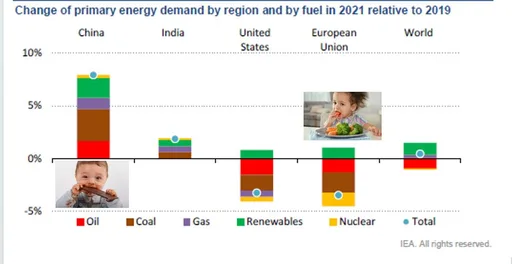
The OECD consumed a lot of energy and metals during “the great acceleration” (post WWII → 2000).
Since 2000 its consumption has strongly slowed — in some countries it even decreases. Normal: saturation of infrastructures and equipment, stagnating or declining demographics. You’re not going to buy 1 fridge per year !
Emerging countries on the other hand have seen their consumption of metals and energy explode since 2000! Above all they are gaining access to basic infrastructures and equipment — of course we can discuss inequalities and growth models, but this is the major trend.
One bloc sees its energy consumption fall, the other rise: overall energy consumption increases. Can we then say that our energies accumulate ?
To say so, one would have to link the blocs and the energies. But the orders of magnitude don’t add up :
- Demand growth in emerging countries is primarily linked to internal demand, not to relocated industries. This decoupling has occurred since 2010 for China. Also, embodied energy—the energy in the goods we import—does not explain the consumption boom in emerging markets.
- Regarding electricity, renewables replace fossil fuels in OECD countries, and now even in China. In Europe it is obvious: gas+coal plunge vs renewables which strongly increase. Yet there is no global electrical system and therefore no communicating vessels.
“But it takes fossil fuels to produce renewables!”
Yes, but again the orders of magnitude are not right.
Take the solar sector, from silicon to panel. In 2021, its energy consumption of 364 PJ corresponds to 0.2% of industrial energy consumption!
The theory of energy accumulation is imaginary: it actually comes from a misunderstanding of our energy systems and the factors impacting consumption.
These factors are demography, our policies, infrastructure and equipment programs, prices, etc. They are national, regional, international.