
France has 57 nuclear reactors representing 65 % of our electricity production.
The evolution of this nuclear capacity is crucial to structuring our energy policy. It relies on 3 elements :
- Failure risks linked to aging and modulation (renewables or not, the size of our fleet forces it to modulate)
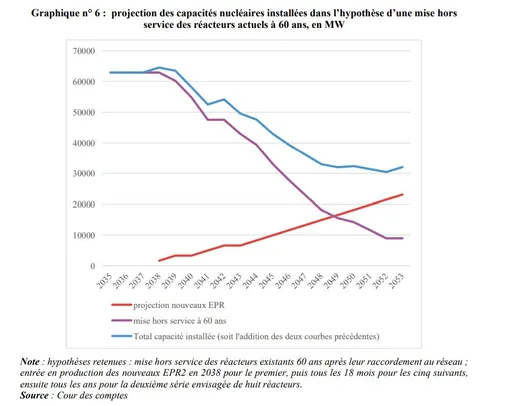
- A gradual shutdown of plants to avoid losing large capacities abruptly, which cannot be replaced in a short time. The schedule depends on life expectancy estimates and their uncertainties
- The construction of new plants
We will not be able to replace nuclear capacities 1 to 1 that will be closed over the next 30 years. Our nuclear capacity will therefore inevitably decline.
At the same time, France wants to end its dependence on fossil fuels. Beyond the climate challenge, which remains an existential question for humanity's future, these imported energies represent 60 % of our final energy.
Thus, France has never been sovereign in terms of energy. This dependence leaves us at the mercy of markets and geopolitical changes. It costs us 40-80 billion euros/year, 130 billion during the 2022-2023 crisis.
To overcome this, we must optimize our consumption and electrify what are currently thermal processes, in industry, buildings, and transport. Moving away from fossil fuels = significant growth in electricity demand. This is unavoidable !
Inevitable decline in nuclear capacity + unavoidable projected demand growth : what to do?
This is where renewables come in, both to compensate for nuclear decline AND provide the additional electrons needed.
So, imposed obligation or good solution?
Two answers :
- Since this situation is unavoidable, rather than fighting it—which will ONLY maintain fossils—let's instead optimize it :
- Regulations to facilitate renewables, lower their costs, increase citizen participation
- Develop flexibility
- Ambitious electrification policies
- Reflection on nuclear governance to improve the chances of success of the 6 EPR2 program
- The 6 EPR2 have a projected LCOE of 130 EUR/MWh, incompatible with electrification. They mainly allow the maintenance of our nuclear know-how, useful when considering, for example, France's role in NATO. Renewables are competitive and can perfectly integrate into our grids.
It is now up to us to establish the appropriate framework and visibility to enable investments to happen.
France could be one of the pillars of European electrification and one of the first nations to approach Net Zero. The economic gains would be immense : in 2025, investments in the transition exceeded 2.3 trillion USD.