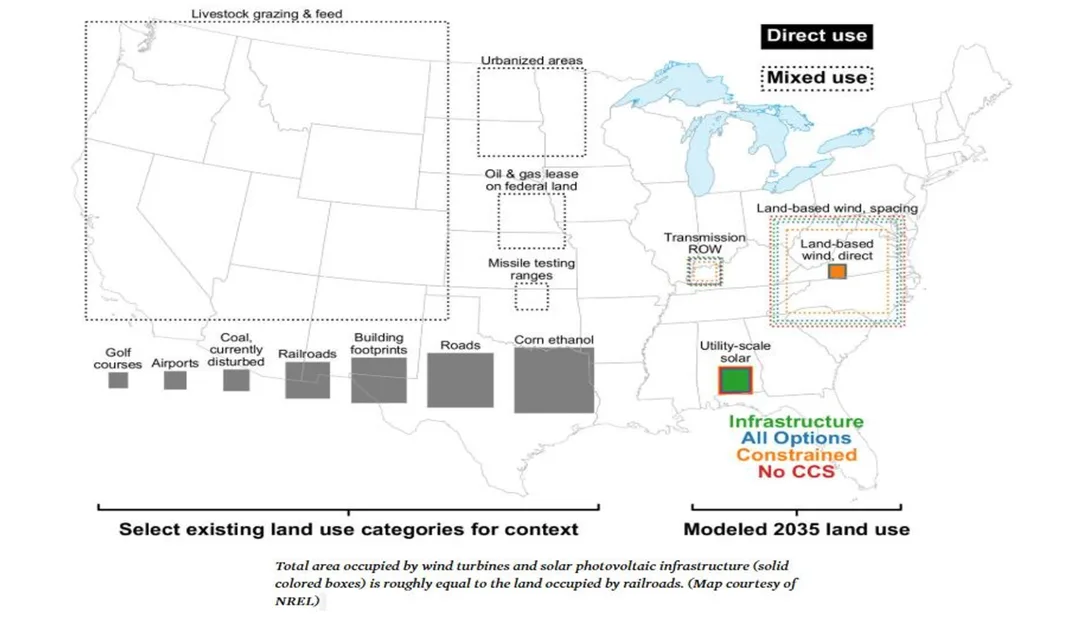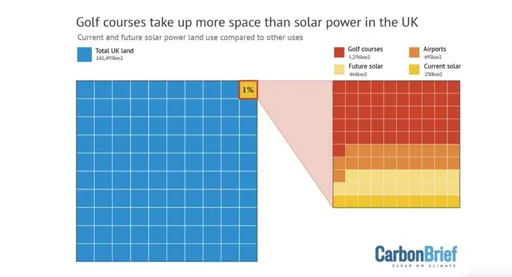
Various studies assess the space solar and wind will occupy to replace fossil fuel. The usual results, confirmed in many countries from several independent sources, give around 0.3%–1% of your national territory depending on your solar and wind resources and your decarbonization pathway (you can add biomass, hydro, nuclear to your mix).
→ 1% of the territory is generally for the high case scenario, i.e. 100% wind, solar and battery. Such a case requires other equipment to provide long term storage and flexibility, such as CCGT, but the space they take is usually not much.
There are different ways to look at this number:
- If you want to scare and misinform citizens, you can take for example a city as a reference. In France I could say: “0.3% is massive, imagine it's 10 times the size of Paris covered in solar panels and wind turbines!”
- If you want to inform citizens then you will take as a reference other infrastructures or services, such as: roads, or golf courses, or simply the current energy system based on fossil fuel. And then you will realize that actually it doesn't take much space to decarbonize our energy system. In the US, the existing energy system occupies already 1.2% of the national territory.
In the past 100 years we have massively modified our environment, for agriculture, fossil fuel, roads, trains and many different infrastructure, in a very inefficient manner, thinking that we have unlimited energy and using resources would not come with any impact. And now it's time to rationalize that: we can do way better and renewable is clearly least impactful than many of our historical practices — especially when you consider that very few land will be artificialized and you can combine RE with other activities.
You might ask: how come that solar and wind do not take much space when their capacity factor is so low, between 15% and 40%?
The answer is simple:
- Because the capacity factor does not tell you how much wind farms and solar farms you need to build: you need to conduct supply/demand simulations based on a power system with a very different profile (flexibility of the demand, complementarity solar/wind…)
- Because RE produces directly electricity which is a very efficient energy carrier, whereas our current energy system based on combustion and fossil fuel is destroying 66% of the primary energy
See more details and calculations in the sources below. Thank you Mark Jacobson, National Renewable Energy Laboratory, Carbon Brief and FracTracker Alliance.