
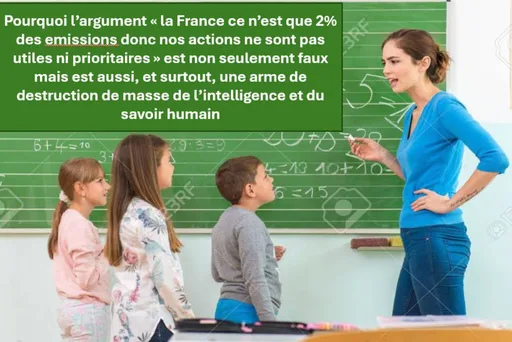
Popularizing knowledge and analytical methods to consider energy-climate challenges: this is Monday debunk.
Out of 208 countries worldwide, 200 emit less than 2% of emissions. This bloc represents 36% of emissions, that is more than one third.
Only 8 countries individually emit more than 2% of emissions, but together they represent 64% of the global total:
- China: 31%
- United States: 12%
- India: 8%
- European Union: 6%
- Russia: 5%
- Japan: 2.5%
- Indonesia and Saudi Arabia: each slightly above 2%
France is part of the European Union, of which it is the 3rd largest emitter (11%), far behind Germany (25%), just behind Italy (12%), and tied with Poland (11%).
Let’s now apply the principle “my emissions are low internationally, so there is no reason to act.”
If France does not act, other European countries, whose emissions are lower or comparable, would not act either—leading to a deadlock in European climate policies.
If Europe does not act, other large emitters would not act either, as their emissions are comparable.
In the end, applying this principle would lead to widespread inaction, except for China, which accounts for 31% of emissions—less than the bloc of 200 countries whose share of emissions is less than 2%.
So here is the true nature of this argument
- a simplistic reasoning that does not hold up to two minutes of reflection;
- it ignores issues related to international cooperation;
- it ignores differences between countries’ development stages, population sizes, wealth levels, and industrialization;
- it assumes that major emitting countries do nothing to contain their emissions;
- its effectiveness does not rely on its analytical content but on its emotional content—here the feeling of injustice: “why me and not others”;
- its purpose is clear: to support inaction.
This argument has all the characteristics of a narrative created by fossil disinformation centers. One identifies a goal (inaction), a supporting emotion (injustice), then builds a simple story.
These narratives must be considered weapons, equivalent to drones, aimed not at military targets but at citizens. They spread ignorance and stupidity and feed on negative emotions.
A person whose informational environment mainly consists of disinformation suffers violent and continuous brain assaults. Simple and false emotionally charged reasoning becomes their norm, and they will distrust the rest, amplifying their isolation.
Deep down, where there is no longer any light, they will then be welcomed with open arms by various networks. Their goal is to use the person’s status as a citizen and voter for various ends.