NetZero Citizen
Home
Transition
Decarbonization
Write to us
NetZero Citizen
"La sobriété n'est pas synonyme de décroissance" Réflexions ouvertes sur les nouveaux récits de la transition

"Sobriety is not synonymous with degrowth" Open reflections on new narratives of the transition

Karim Megherbi

Original source

[Note: this article will be updated in the future based on feedback received due to the complexity of the subject, especially since some sections are still under research and ongoing reflection]

"Sobriety is not synonymous with degrowth"

This is indeed what can be read in the synthesis note of ADEME’s work published on March 22, 2022.

I thus take this opportunity to propose an open discussion on the link between degrowth and our climate objectives. Beyond conceptual analysis, this discussion also aims to contribute to the development of desirable narratives of the energy transition.

These narratives aim notably to bring civil society together around our climate programs and make them compatible — as much as possible — with our ideological or political differences. Such an approach is in line with my other articles that try to go beyond technological divides concerning nuclear and renewable energies (EnR).

It does not seem impossible to find such unifying narratives, since many actions are imposed on us, whatever our ideals and worldviews. For example, in all cases, the fight against global warming involves stopping the combustion of fossil fuels. Of course, we could capture part of the emissions during combustion, but we already know today, with certainty, that it will not be possible to capture a significant portion by 2050. So necessarily, stopping the combustion of fossil fuels by 2050 is mandatory. This objective is imposed on us.

Our climate scenarios are all very similar in fact. This can be seen in France: RTE, ADEME, Shift Project, Negawatt — aside from the nuclear part which oscillates between its disappearance and about 50% by 2050, there is no fundamental difference between our "median" scenarios.

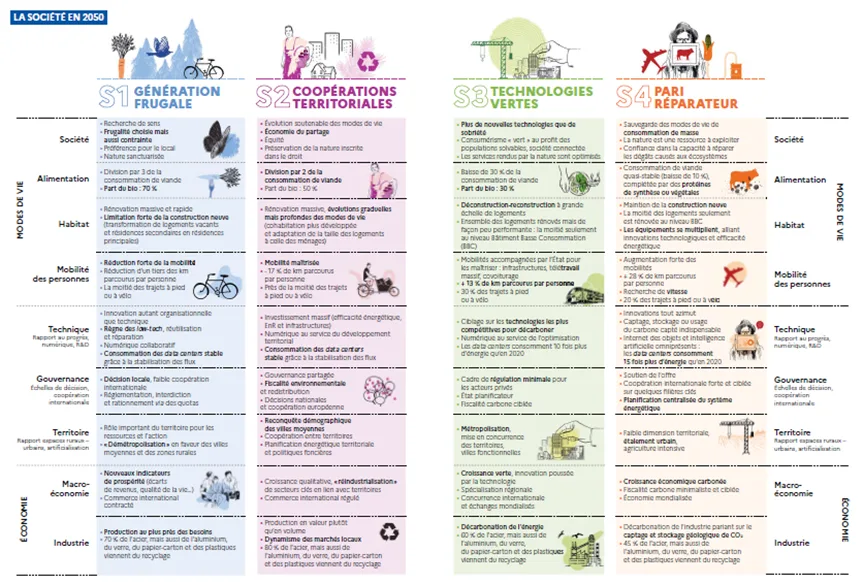
Indeed, taking the case of ADEME, we can find two “extreme” models of society: a frugal society practicing rationing (scenario S1), and an ultra-technological society continuing growth without compromise (scenario S4).

But let’s look at the description of these scenarios. For the frugal society: "chosen but also constrained frugality," "strong reduction in mobility," "prohibition and rationing by quotas." For the ultra-technological society: "preservation of mass consumption lifestyles," "innovation all around," "equipment multiplies." It seems difficult to imagine that a large part of the population voluntarily wishes to go in either extreme direction. Moreover, these scenarios both present many risks and greatly reduce our chances of reaching our climate objectives — as we will see in the article.

If we therefore exclude these two extreme visions, it should be possible to find energy transition narratives that unite since, in fact, there are no fundamentally conflicting proposals between the other scenarios. It is mostly a matter of shifting the dial on the importance of each measure — but many measures are common.

I hope this article will help some clarify the current debates. As always, my intention is not to convince anyone to take one position or another but simply to open discussions — besides, can we afford to lock ourselves into one position given our current uncertain and changing environment?  

What do we mean by degrowth?

There are practically as many definitions as people who want to promote degrowth. This movement groups several schools of thought — see later in the linked article "A Green Deal without Growth" which offers a vision of the panorama of different trends within this movement.

Here is my attempt to summarize in a few lines the general approach, inspired by a talk by T. Parrique and some readings.

The degrowth movement advocates a planned reduction of our use of the biosphere to meet our needs. It is critical of growth, which it sees as the origin of environmental destruction. It questions our social model, wants to simplify our structures while making them fairer. It is also, and more fundamentally, a critique of capitalism, a system organizing our societies and economies that would push or force us to always want more, hence to grow, hence to destroy.

From reducing inputs to reducing GDP is just a step. Less energy, fewer running machines, less production, less GDP. Although J. Hickel explicitly points this out in his book "Less is More" (where he indicates that whether GDP grows or shrinks matters little), communications are often ambiguous on this topic. Especially when degrowth criticizes "green growth," i.e., the decoupling of emissions and GDP: why criticize this relation if this indicator is of little interest?

Summary of ADEME's position

The arguments advanced by ADEME to explain that sobriety is not synonymous with degrowth are as follows:

  • "The transition essentially relies on replacing carbon energies with renewable or nuclear energies, on substituting capital and/or labor for energy, on shifting activity from energy-intensive sectors to less energy-intensive ones (from road to rail, for example), from consumption of highly carbon-intensive goods, like plastic or steel, to less intensive materials like wood, or services. It therefore does not imply an absolute reduction in activity but rather a modification of production modes and consumption habits."

  • "This study, based on the ThreeME model (Multisectoral Macroeconomic Model for the Evaluation of Energy and Environmental policies), clearly shows that a decoupling between GDP and territorial greenhouse gas emissions is possible. None of the four scenarios results in a recession over the long term relative to the current level of economic activity. Sobriety is not synonymous with degrowth."

  • "This work also highlights that the growth/degrowth debate regarding GDP is not relevant to characterize ecological transition scenarios. GDP only measures the sum of incomes distributed during the production process. It says nothing about the degree of decarbonization of production and transport, the share of services in consumption, nor the energy sobriety of buildings."

See here the note published by ADEME:

Transition(s) 2050: four scenarios and their series to achieve carbon neutrality by 2050

An inevitable degrowth?

The idea of an inevitable degrowth is based notably on a simple observation: today our societies operate consuming energy, and this energy will become scarce. The industrial activities of our society will then decline according to the rate of decrease in energy availability. We will thus have to adapt to a world where we have "less of everything."

This energy would become scarce for two reasons:

  • The first is that climate change forces us to stop emitting CO2 into the atmosphere as soon as possible, which essentially means no longer burning fossil energy. However, our current world operates with fossil fuels representing 80% of primary energy. Stopping burning fossil fuels means losing 3/4 of our current energy supply, equivalent to energy production levels of the 1950s, when the planet’s population was four times smaller. The descent will therefore be very harsh.

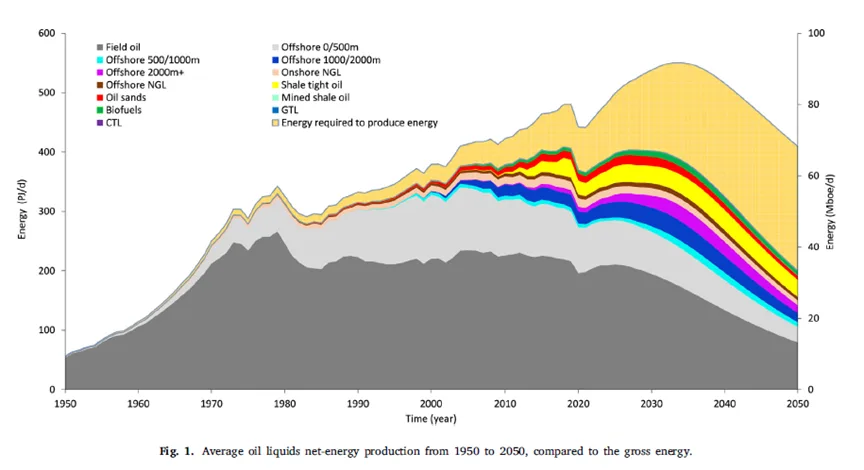
  • The second is that the quantity of fossil fuels underground will decrease over the years at a rate yet to be defined, but it is expected that after a plateau until 2030, production will gradually decline.

But energy is not the only explanatory factor. Planetary boundaries surpassed would lead us in all cases towards a declining slope, resulting in the necessary rebalancing. This is the outcome given by "The Limits to Growth" studies. Here is a video by Arthur Keller on the topic:

#Earth 🌏 Will we survive this? Amazing⚡️ #crashcourse on #collapse & #environment by #ArthurKeller

This degrowth is often characterized by a declining GDP, although this is not the reference indicator of the degrowth movement. Yet this is what it is about: a GDP that will decrease and increasingly restricted choices in our consumption and lifestyles, forcing us progressively to select what we want to keep or abandon as our energy supply decreases.

Faced with such an inevitable situation, two options remain:

  • The first is to plan this descent. We can indeed control this descent to limit the suffering endured during the period that will lead to a final state where our GDP would be greatly reduced.

  • The second is to do nothing, and this descent will then be constrained, since climate change with its crises (extreme climates, precariousness, forced migrations, war, etc.) and the end of fossil fuels will inevitably remind us to order.

In both cases, we would arrive at the same situation, but the first option presents a less painful path than the other.

The energy transition: humanity’s response to climate change

We often forget this incredible fact: our industrial growth only began to assert its exponential nature in 1950, barely 70 years ago. In 70 years, population quadrupled. Our energy demand grew fivefold. Global GDP increased by 100 times.
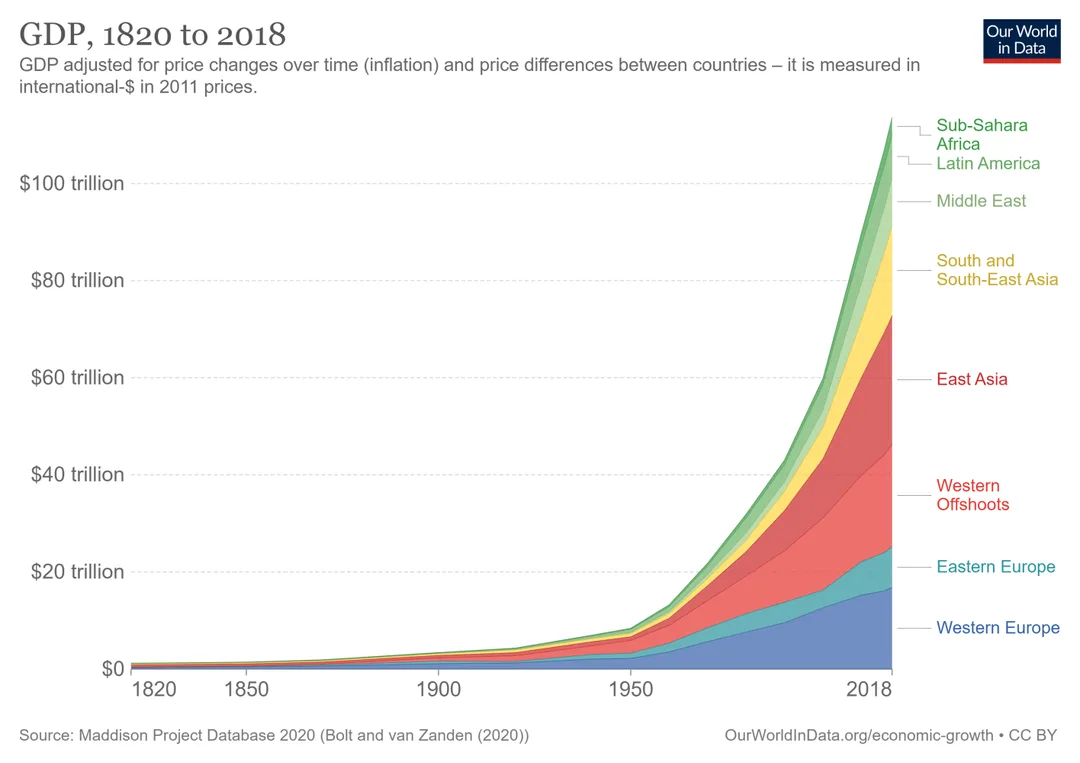
No alt text provided for this image

During this short time span, we greedily devoured all possible resources made available to us and many biosphere indicators are now in the red zone. We have also released so much CO2 into the atmosphere burning these fossils to produce our energy that the Earth is warming, and this temperature change in a few decades is equivalent to climatic processes spanning tens of thousands or even millions of years. This warming affects our climate and environment, which will become increasingly hostile to humans in the coming years.

Nonetheless, humanity has not yet given up. It has decided to wage one last battle called the energy transition. This consists in changing all our infrastructures and sectoral organizations to no longer emit CO2 into the atmosphere.

Researchers and numerous actors in energy and other environment-related sectors have since started working. Each country, international and regional institution, many associations, think tanks, industrial players, research labs, have produced or are developing scenarios called "Net Zero."

These Net Zero scenarios provide a detailed description of the evolution of our infrastructures and economic sectors (agriculture, industry, services), especially the energy sector, so that by 2050 our activities virtually no longer emit CO2 — or remaining emissions are offset by "carbon sinks," such as forests.

When analyzing these scenarios, one realizes that they do not assume the continuity of our current society and thus are not mostly "techno-solutionist" as some think.

On the contrary, they show the necessity of reducing our final energy demand, decreasing our material footprint, preserving our environment, and moving towards greater social equity. It is thus not about "doing as before but without emissions," since the scenarios show it is impossible, but proposing a new form of economic and social organization respectful of the environment.

These scenarios all converge on some key strategies, for nearly all countries regardless of the institution proposing them. Here is what they converge towards:

  1. Our final energy demand must decrease. In other words, we can no longer consume as much energy for our activities. The party is over. It was nice, some enjoyed it well. But it's over. We must now think about ways to limit our energy consumption.

  2. We will electrify many things. We must stop burning stuff. Now we will do as many things as possible with electricity.

  1. This electricity will mostly be produced from renewable energies. This is our main option today. We can do nuclear as much as possible, but we need lots of electricity, worldwide, and this technology cannot be deployed at the right scale in time. Current nuclear technologies remain complex and pose different safety, nuclear proliferation issues, etc. Hydropower has been widely developed, and although some potential remains, it is limited. Biomass remains largely to be developed, but again its potential is bounded by environmental impact depending on inputs and land use. So we only have renewables (EnR), and millions have worked for 15 years to enable their massive deployment. All energy actors know this well, and strategic plans across sectors — oil/gas/coal, nuclear, others — now position themselves in a world where renewable technologies will be dominant. These will thus penetrate our everyday life more and more. Currently, over 90% of all new electrical installations connected to grids worldwide are renewables, and this should continue throughout this decade.

  2. Biomass — excluding electricity — will provide the rest, with biofuels, biogas, solid biomass. We will still have some oil for petrochemicals, so we must quickly stop burning it and use it in its noble version, which does not waste 2/3 of its energy.

The energy transition is not optional; we have no choice but to carry it out, because sobriety is not an energy transition: on one hand sobriety is a lever with limits, on the other it means consuming less but we will still always emit and depend on fossil fuels.

Indeed, the numbers and deadlines are impressive, but that's how it is — and incidentally, we have already experienced such deployments since 1950. We have to rebuild everything now, but better.

Today, whatever ideological position is taken, it should be able to rest on a NZE scenario to translate into policies and regulations. Studies and practice confirm that this scenario will necessarily — for nearly all countries — at least rely on the 4 elements described above.

How to reduce our final energy demand?

ADEME recalls the results of our climate scenarios: all show it is possible to build a desirable society centered around environment and life.

Many doubt this possibility because they associate our need to reduce final energy demand with loss of comfort and freedom.

This decrease being the key point of our transition scenarios, which align them with collapse avoidance scenarios (since they plan an energy descent), understanding its nature is vital.

The origin of these doubts seems mostly to arise from confusion about the strategies available to reduce final energy demand. It's not about keeping the same society and doing "less," but about building a new society, which will produce and use energy differently — an energy with different properties, notably the shift from fossils to electric.

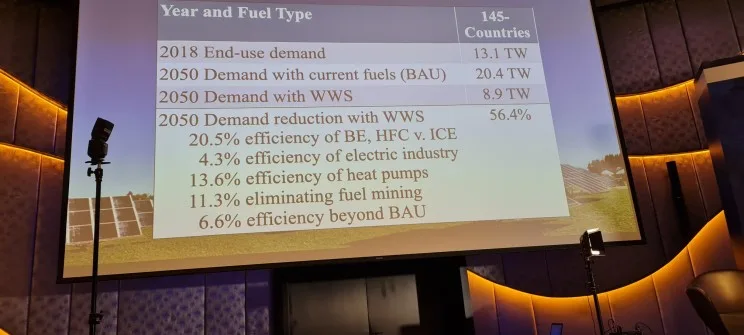
Among these strategies are energy efficiency, but especially electrification. For example, here is Mark Jacobson’s estimate of final energy reductions of over 50% following electrification in cars, heat pumps, industrial processes, and stopping fossil extraction.
No alt text provided for this image

But this alone will not suffice, partly because technological deployment carries uncertainties, and due to the scale of the challenge, all strategies must be deployed to maximize our chances of success.

We must therefore also eliminate these immense losses and promote sobriety actions. Again, many think we will have to sacrifice modern comfort. But this ignores that the structure on which our exponential growth was built in a few decades of energetic frenzy consists mainly of gaping energy holes, inefficiency, and useless usages and equipment.

Our current energy consumption is based on unprecedented wastefulness. Burning fossils is indeed the worst way possible to produce energy efficiently: two-thirds is lost as heat, only one-third recovered. We did it because these energies are practical to transport, store, and exploit. Because we had no awareness or desire to align with our environment, no concern for limits of any kind. And because dominant actors profited, profit multiplied by humanity's collective subsidizing of these energies by accepting free atmospheric CO2 storage, while populations and states pay the health and environmental consequences.

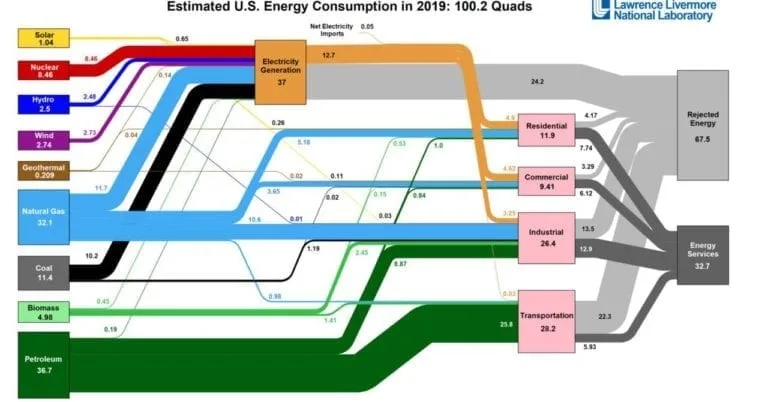
Consider the food chain: over 30% of global production is simply lost! Here is also the US energy flow chart, with inputs on the left and the small dark gray box bottom right representing what is truly utilized. How can we still imagine efficient energy use looking at such a graphic?
No alt text provided for this image

What would a society that successfully completed its energy transition look like?

Beyond energy reduction, many actions are needed to reduce our emissions. Comparing various French plans shows proposed pathways are feasible, which is great news, and the resulting societies are desirable.

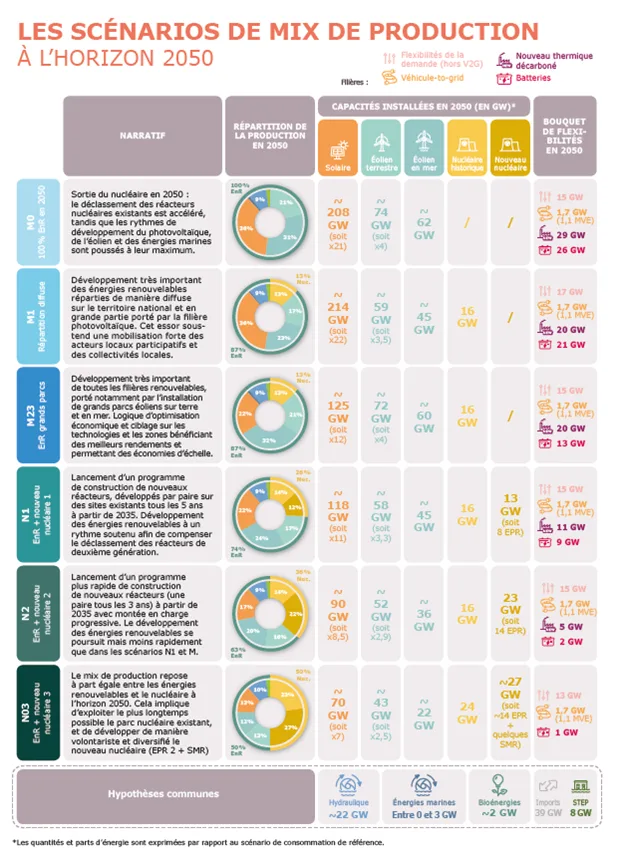
Taking ADEME as an example — other scenarios are provided in Annex 1. Here is the summary table:
No alt text provided for this image

Sure, following these scenarios, we won’t all take 50 plane trips a week between Paris and Marseille. Sure, no one is proposed to buy a 4x4 solely to accompany their child to school across the street. But another society is possible: teleconferencing, train, electric cars adapted to daily use, etc.

Our world will be more decentralized, technology integrated into everyday life to help protect the environment, energy produced more decentralized, mainly with renewables and biomass, leading to different adaptations. Very little smoke: our world is electric, we burn very little. It is digital: we prefer to transport data rather than things or people. It is optimized: energy losses are reduced. Agriculture uses less fertilizer and pesticides, and we have reduced meat consumption. It is both globalized and very local. We all share the feeling of living on the same planet. We have abandoned GDP as the guide to our policies.

Will we live in energy poverty? Not sure. To revisit the US energy sources and uses graphic, our objective is to cover the dark gray box bottom right.

Note here the importance of understanding exergy, a concept essential for analyzing the energy transition. Primary energy, final energy, and exergy: 3 concepts to know and differentiate in the context of the energy transition. The transition concerns exergy, not replacing primary energy.

Furthermore, our current society and a post-transition society will use energy differently: less energy spent on treating pollution-related diseases, climate drift ceasing to amplify, near disappearance of fossil exploitation infrastructures and activities — extraction, distribution, storage... Also, fossil fuel EROI is plummeting while renewables’ EROI is increasing yearly.

Thus, it is not about living cramped under environmental constraint, but creating a new society optimized energetically and respectful of environment and life, where our choices can naturally be expressed respecting ecological boundaries. It is an evolution toward a new, more sophisticated modernity. As for the economic and political expressions of this world, they remain to be built, and we will have to work on this together over the next three decades or more.

The energy transition is neither backward nor regression. We are not throwing ourselves into the void with the end of fossils but rising toward a better society. These solutions were found thanks to fossil energies that enabled exponential development in a very short time. They are not, as sometimes heard, a return to medieval technologies — which assumes a wind turbine and a windmill are technologically identical and ignores PV solar, CSP, and even electricity — but an expression of new modernity, research and technology emerging from many converging factors in the 21st century. Staying with fossils, on the contrary, prevents turning a page in our industrial history and drags us into the past without chance to evolve or improve.

All well and good but this energy transition story won't happen because anyway we've exhausted all resources and we're doomed.

Well... Indeed not everything is that easy. Because this excludes systemic risks we will face. These will be of different kinds: climatic, social, political, economic, and others. We are already crossing two now: material shortages and the war in Ukraine.

Here are some systemic risks we can anticipate:

1. Fossil resources will dwindle

For two reasons:

  • Resource problems, plus collapsing EROI (we consume more and more energy to extract fossils). See here
No alt text provided for this image
  • Investment problems. No oil exploration activity should occur now if we want to stay on a 1.5°C trajectory (cf. AIE’s Net Zero 1.5°C scenario). The market is uncertain, oil companies know demand will not increase. Investments become riskier, impacting future availability.

2. Fossil prices will probably be erratic

These prices heavily influence proper functioning of our societies, as seen recently with gas price surges and current energy market volatility: households are impacted, companies close. Here is a detailed argument:

Why do oil prices matter to the global economy? An expert explains

3. It would be risky to imagine material supply and demand perfectly balanced continuously over the next 30 years

Especially given the massive needs of the energy transition. We will almost certainly encounter tension periods, unrelated to the resource itself — since studies show sufficient materials exist, provided recycling increases on some, notably copper — but to exploitation.

Consider photovoltaic silicon: a shortage currently impacts PV prices (yet sector growth remains strong, prices still competitive). The industry reaction was quick: global production capacity will double (!) by 2024. But such difficulties will continue over time on various components or materials, and adjustments will have more or less long and sharp consequences.

It is thus clear the energy transition will not be a smooth ride. We will likely face energy tensions, especially if we truly want no step backward by fueling economies sometimes with fossil energy revival.

But let us not forget: some of these systemic risks are inherent to the energy transition, we cause them.

For example, reduced fossil availability is an inevitable consequence, beyond resource issues, of our climate strategies. All climate scenarios must consider this risk so much that it should be part of scenarios rather than an annex. This situation does not actually depend on resource depletion that may occur more slowly and perhaps later (debate exists).

Our fossil reductions — to stay on a 1.5°C trajectory — must be rapid: compared to 2019, oil demand in 2050 must drop 75%, coal practically vanish, and gas at least 55%. No resource projection justifies such evolution in 30 years. These are targets we must impose on ourselves to keep the least catastrophic temperature rises.

There is thus no need to panic about fossil depletion imagining imminent collapse: depletion will be caused by our policies — exactly what we seek. Keep cool as we have no choice but to face this situation if we want to solve the climate issue.

To absorb these shocks we might be tempted to compress our economy to the maximum... but the transition assumes various growth forms that invalidate this position

These systemic risks are not reasons to voluntarily lower all activities. We must select which to constrain and which to support for continued growth over the next three decades. Reasons are:

1. Climate strategies are appreciated internationally: managing growth in emerging countries and cooperation between countries

Although debates exist about OECD GDP stagnation causes — see Annex 2 for varying positions — it is hard to deny that OECD countries have reached a development stage where most citizens have basic needs covered, though inequalities and social and economic precarity are increasing and denounced.

Emerging societies, on the other hand, continue to grow strongly, due to infrastructure and population growth.

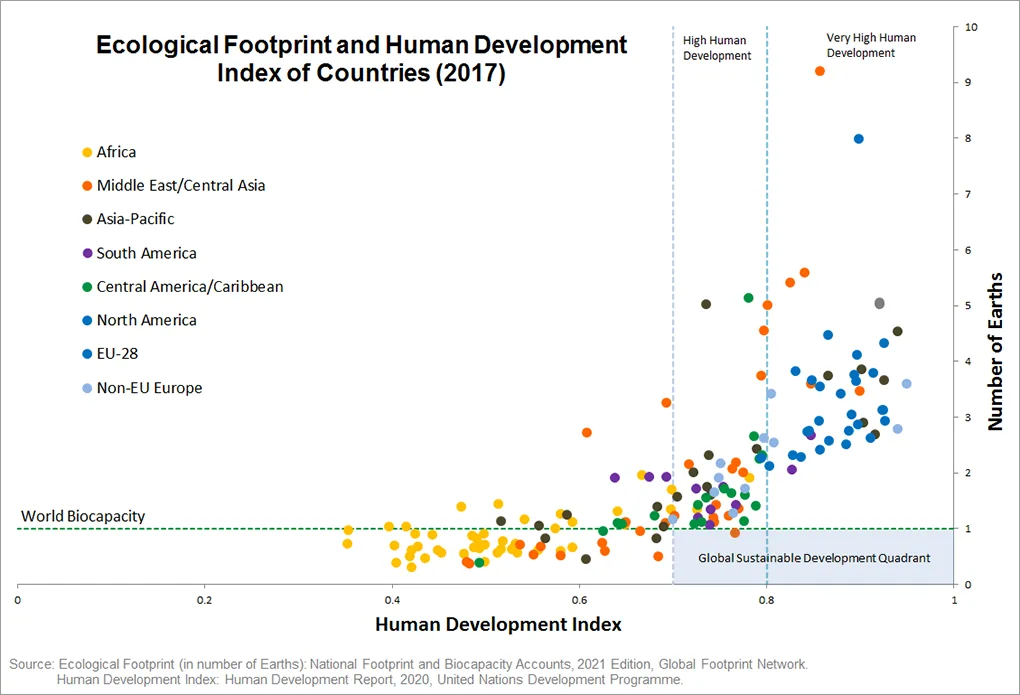
The challenge for them is not to degrow but to find a new definition of growth that prevents repeating past country trajectories. India, for example, remains among countries with the lowest per capita energy consumption.
No alt text provided for this image

Emerging countries’ growth challenge is perhaps one of the most critical for climate and our actions. Currently, two-thirds of emissions are in emerging countries, with others rising.

How to solve this equation?

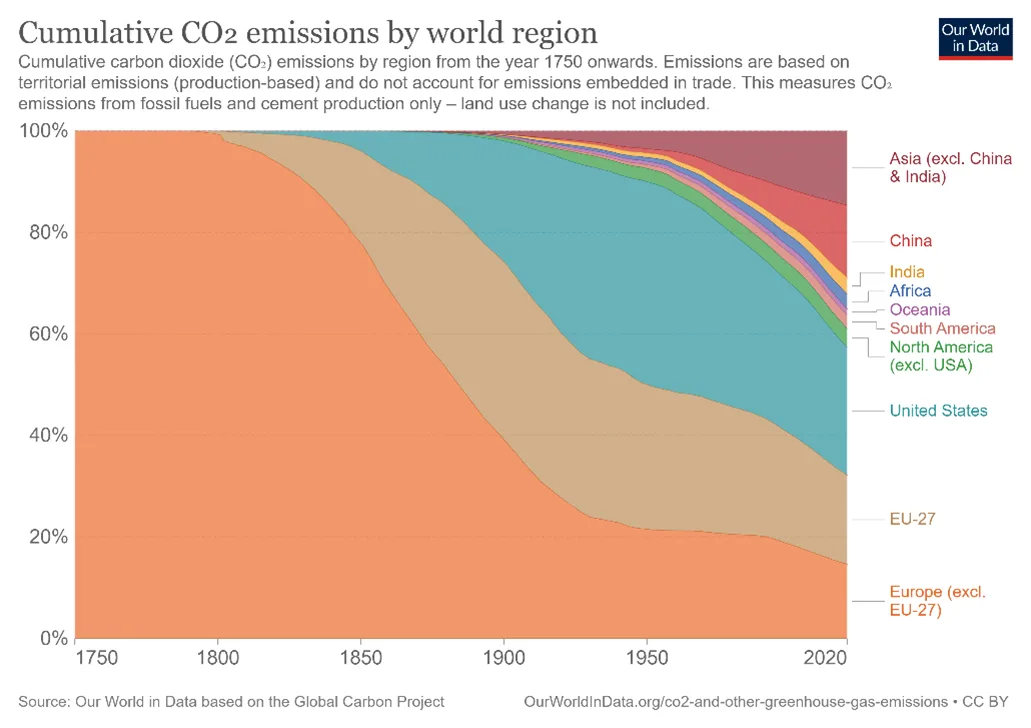
By proposing frugal lifestyles for Northern countries and promoting localism, temptation exists to isolate from other economies, preventing contributing to the climate challenge commensurate with our means and historical responsibilities — remember OECD countries have consumed a large majority of humanity's carbon budget for their growth.
No alt text provided for this image

On the contrary, without international cooperation and reflections/actions/partnerships between North and South, the energy transition will carry a much higher social cost and our success chances much slimmer.

This analysis is confirmed in the IEA 1.5°C NZE report:

"Governments must work together effectively and mutually beneficially to implement coherent cross-border measures. This includes managing domestic job creation and local commercial benefits while addressing global needs for clean energy deployment. Accelerating innovation, developing standards, and scaling clean technologies must link national markets. Cooperation must recognize development stage differences and societal variations. For many rich countries, achieving net zero is harder and costlier without international cooperation. For many developing countries, the pathway without assistance is unclear. Technical and financial support is needed to ensure deployment. Without greater cooperation, global CO2 will not fall to net zero by 2050."

We can take hydrogen as an example in the RTE report. France could produce it locally, but its cost would be at least twice that of a European approach. This sector is truly European, even beyond, including North Africa in the European plate.

No alt text provided for this image

2. Resilience strategies make reindustrialization interesting, though these involve increased economic activity

In France, a reindustrialization strategy revolves around four essential axes:

  • Bringing industries back with high added value in strategic sectors, able to compete internationally

  • Resuming high-emission industries locally to decarbonize them

  • Job development

  • Independence, adapting to systemic risks, shortening supply chains

These reindustrializations contribute to economic activity growth all else equal and increase energy demand. They increase investments required to reach net zero by 2050 since they raise decarbonized energy needs.

However, decarbonizing these industries is necessary, whether in France or where they were offshored (often emerging countries). Following the Paris Agreement principle, responsibility lies more heavily on countries historically responsible for emissions.

France, a mature economy having largely consumed humanity’s carbon budget to develop, must assume its responsibility. It is normal it participates in a more sustained investment effort.

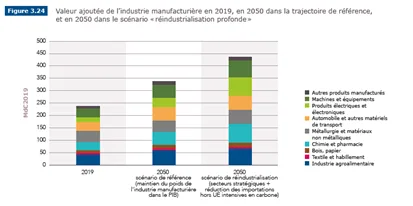
RTE proposes different reindustrialization trajectories, visible here:
No alt text provided for this image

3. Whatever sobriety efforts, no scenario exists today that does not rely on growing electricity’s share in final energy mix, with a large renewables majority within electricity.

In France, no current scenario has electricity share less than 50% of final energy demand — more than twice today’s share. Within these 50%, the minimum renewables share is 40-50%, with probable scenarios at least 60%, i.e., 6 to 7 times today’s share.

Absent tangible systemic risks reactions, the renewables share should be dominant in the electrical mix by 2050. See Annex 3 for detailed French mix proposals with comments.

All our scenarios involve strong growth in renewables sector, even those advocating greatest sobriety like Negawatt and Shift. We must also develop grid flexibility tools and technologies: smart grids, demand management, interconnections, etc. Our scenarios also rely on developing hydrogen for industry and growth in electric vehicles. These sectors will see strong growth over the next three decades.

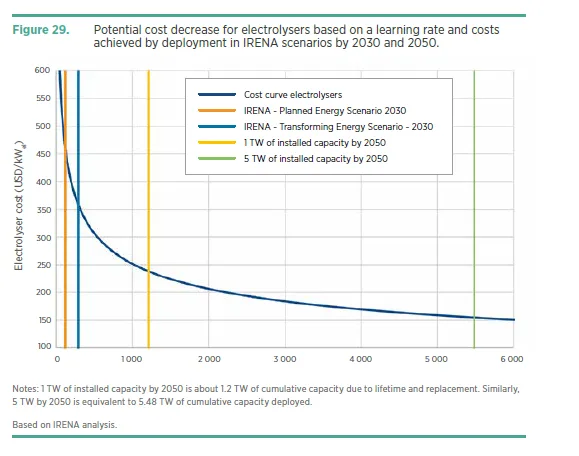
The presence of these technologies in France implies ongoing worldwide development. Equipment competitiveness evolution far exceeds French scope. For example, here are electrolyzer cost projections by market size:
No alt text provided for this image

The French market alone will not allow such cost decrease. Without cost drops, energy transition will take longer and expose vulnerable people more, requiring greater redistribution with uncertain sustainability.

Going further: France benefits from nuclear electricity base, unlike most countries. Nuclear share worldwide won’t exceed 20-30% generally, or is zero.

Globally, renewables and electrification sectors driven by renewables must grow unprecedentedly.

4. Existence of systemic risks does not invalidate scenarios but requires developing coverage strategies which can in turn impact scenario definitions

We just saw all climate scenarios rely on development of key transition technologies related to renewables and electrification. Deployment risks like material availability are inseparable from Net Zero scenarios. We can reduce but not eliminate them, so solutions exist and develop — see Annex 4 on material risks.

How to react facing systemic risks?

Taking current European crisis as example, management previews future crisis consequences.

This crisis commands governments to implement emergency measures notably to end dependence on Russian imports ASAP.

These emergency measures lead us to revisit priorities order of climate actions based on time horizon of impacts. Naturally, several sobriety actions appear top, which is excellent for climate despite this atrocious context. Indeed, sobriety actions were too neglected by policymakers and institutional climate scenarios.

Here are IEA’s proposals responding to current crisis:
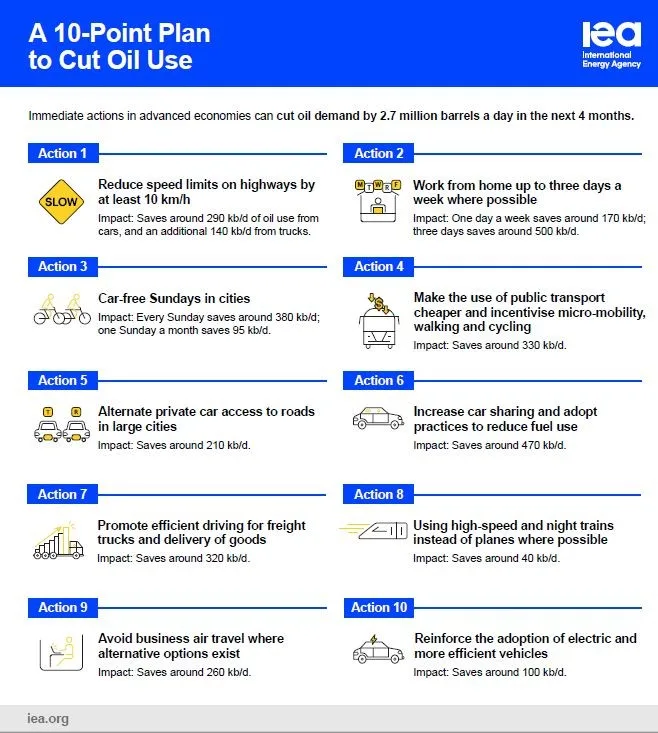
No alt text provided for this imageNo alt text provided for this image

Is a crisis good for fighting climate change?

Answer depends on outcome, but if it raises transition costs, degrades conditions so infrastructures cannot change fast enough, or slows deployment of key tech like renewables, then it hinders climate actions. It increases likelihood of missing targets. Degree of crisis matters too — higher degree means fewer solutions. These are certainly undesirable.

Okay, I get it: climate scenarios must include growth of some countries and sectors, but green growth does not exist, so we must find something else

Indeed, economic models linked to NZE scenarios all show GDP growth, with arguments similar to ADEME’s. Thus, green growth (GDP/emissions — here restricted to CO2) always appears possible.

Of course, outside the CO2 prism, green growth is impossible since activities will always impact environment — it is the "price" of growth to be minimized.

Is GDP growth fundamental in models backing climate scenarios?

Not really. For example, GDP rising or falling does not change the 4 shared points in all climate scenarios (see early article) nor weaken the energy transition imperative.

GDP results from combined actions, only valid with hypotheses and calculation mode. It does not predict real GDP during transition phase, depending on many real parameters absent in models like material availability, fossil availability in case of delayed deployment, etc.

However, some models assume exogenous GDP rise, for example in energy consumption trajectories, and indicate that GDP decline would make climate scenarios problematic as we'd have fewer means to finance the transition. This was mentioned earlier regarding systemic risks and will be reiterated in conclusion due to its importance.

GDP evolution is hard to anticipate, since green sectors will grow extraordinarly while emitting sectors will be strongly compressed.

Many critiques exist on green growth, here is an example:

A systematic review of the evidence on decoupling of GDP, resource use and GHG emissions, part II: synthesizing the insights

The critique methodology suggests transition dynamics and nature are not well understood.

  • The energy transition enables, by construction, emission-free energy production by massively developing renewables and electrification.

  • It involves shrinking fossil energy activities, strongly lowering economies. But green sector growth will be a very important economic activity source. GDP will thus move in a hard-to-predict direction.

None of the above actions occurred in the past — our climate actions mainly relied on energy efficiency. Our climate strategies just began in 2022. It's pointless to search proof for GDP/CO2 decoupling in past 30 years — why would it have happened?

So green growth or no green growth?

Everyone can now see GDP/Green Growth is not a transition critique since we have no alternative but to succeed to fight climate change and end fossil dependency which will eventually disappear.

It is rather a critique of NZE scenario construction methodologies arguing GDP may not grow during or post transition. Hence point 4 in the previous section.

In any case, a post-transition world necessarily decouples energy and CO2. This is what matters. Will we have GDP-Energy decoupling or enough energy?

We will indeed need lots of renewables globally. Models show this is possible, we can transform energy systems and have enough energy to support this new world. Studies also show sufficient materials and many technologies to succeed. So it depends on systemic shocks and how well we absorb them.

GDP variation should also be viewed by separating two phases: first, investment phase replacing infrastructures; second, post-investment phase with replaced infrastructures. These two worlds differ. GDP could rise during transition as we invest trillions and create millions of jobs, more than those destroyed per analyses.

I will reuse G. Giraud’s conclusion on green growth:

"Growing GDP matters little. Hence futility of green growth debates questioning compatibility of transition with GDP growth. The right question is: how to operate transition to ensure work for most and a democratic and prosperous lifestyle?"

Here I am lost: green growth doesn’t matter, compressing economy harms climate, emerging countries must control growth not degrow, developed countries must grow some sectors while degrowing others. So where does degrowth fit here?

Degrowth seems primarily a critique of growth, and social program addressing its excesses, as Club of Rome’s "The Limits to Growth" report well highlighted. So it is not (yet) a climate program.

This doesn’t invalidate extensive research in this movement nor proposals in principle. Many degrowth proposals are already included and essential in our climate pathways to reach net zero by 2050.

But it raises questions about degrowth concepts' adequacy to climate scenarios. I will propose some reflection avenues.

Experts forgive me in advance; I am not a degrowth scholar. My critiques are likely imprecise and possibly invalid. These comments are not hard points but aim to open discussion. Readers should critically examine this part.

1. Degrowth discourse must learn to fit within energy transition discourse.

If launched, this would have many consequences on studies to be done and its energy positioning, e.g.:

  • A more integrated vision of energy and its social and organizational implications, notably the central role of renewables and key technologies like electrification. Such society may not be simpler but rather more sophisticated.

  • The objective to shrink our economy or even its anticipation becomes less relevant. Priority remains climate program and energy transition. Economy size resulting from combining growth and degrowth actions is not pre-defined and not itself a climate/environmental objective. Many strategies reduce energy demand, including electrification. Carbon tax and fiscal reform effectively reduce demand for high-carbon goods and associated energy while promoting environmentally virtuous choices growing in consumption share. Is restricting citizens’ activities and incomes compatible with these actions?

  • A new reading of green growth and its communications/critiques is needed, not to say it is possible, but to refine arguments. Degrowth should provide a precise vision of energy transition, its financing, and managing growth in related sectors plus degrowth in others.

  • The transitional phase we experience now, with mixed growth and degrowth actions and uncertain end (around 2050 target), forces rethinking growth notion. Interesting also to separate analyses by transition phase and post-transition.

  • Considering OECD/emerging country dichotomy while recognizing global climate problem also affects views on growth and our climate actions and responsibilities as Northern citizens. This is studied further below.

Lack of degrowth–energy transition link makes measuring proposal effectiveness against climate goals difficult. Creating this link could change degrowth movement publications and arguments. For further study, here is an interesting paper:

A Green New Deal without growth?

2. If current neoliberal capitalism has shown limits it doesn’t necessarily mean capitalism must be rejected.

Neoliberalism has proven incapable of solving climate problems (not possible without state intervention and social justice goal).

But one needn’t be degrowth to criticize neoliberal capitalism and wish for an evolution from consumerist society where citizens are utility functions (see Amartya Sen critique) to fairer and environmentally respectful society.

Does capitalism necessarily imply growth desire, as J. Hickel indicates?

Not certain. Interest rates, often cited as cause, are charges levied on future income. These future incomes include a margin that is thus reduced. This margin or income need not necessarily grow. Being out of my comfort zone here, I share this remark but invite further inputs.

Hybrid approaches seem possible. Here is an interesting video for illustrating and deepening these reflections.

THOMAS PIKETTY, GAËL GIRAUD: IS CAPITALISM REFORMABLE?

3. Proper management of climate actions will probably involve social negotiations, which can’t always wait for results to move forward.

Removing social obstacles to the energy transition is now key in climate scenarios given detailed realistic action plans.

Difficult negotiations with historical actors negatively impacted by transition and benefiting from delays are probable.

Compromises must be found. A more united society around climate strategies is essential for successful climate actions. Our disagreements slow energy transition, some could simply cause policy failure.

Consider, for example, proposals for moratoriums on renewables in France or rapid nuclear phase-out by 2035. These positions make reaching climate trajectories impossible, as fully evidenced by RTE’s detailed analyses.

In such a context, rejecting growth outright as a prerequisite to action seems difficult, even if economic indicator reform is contemplated.

Conclusion: move beyond growth/degrowth framework to review climate scenarios and unite civil society around these programs

It should be possible to transcend ideological frameworks in scenario analyses and thus maximize climate action chances by integrating complementary views.

I conclude here with two major points to retain in this debate:

1. Putting GDP as a key policy indicator makes no sense anymore.

Trillions will be injected in economies, generating unprecedented growth in some sectors while entire sectors, with major companies deeply embedded, like oil companies, must practically disappear. It is thus very hard to predict GDP evolution in coming years or if it will yield exploitable information.

At minimum, GDP should be linked to CO2 emissions to guide policies, since currently energy, GDP, and emissions indices evolve similarly absent energy transition.

Crucial indicators to assess policy results are of completely different nature: temperature, emissions, biosphere, pollution, energy consumption, etc.

Until governments implement these new indicators, we must seriously doubt effective climate action management and understanding of action specifics.

Without new indicators, we are blind and unable to know if we progress rightly, and if not, why. In this new framework, decoupling notion has little interest.

Here we can cite Kate Raworth’s Doughnut methodology, offering an interesting approach aligned with scenario-building. The framework is fully rooted in the energy transition.

I present here the 7 key lessons of this analysis, sufficiently flexible for various climate scenarios. Left: traditional reflection frameworks. Right: how we should evolve (sorry for scan quality):

No alt text provided for this image

Here is the compass to locate policies (it is the "1/Change the goal" of the diagram below shown enlarged and in color):

No alt text provided for this image

2. Our scenarios must be reviewed to ensure resilience to systemic risks.

Since 2020, we see energy transition won’t be smooth. If governments and societies aren’t ready to face systemic shocks, their proposals will aim to maintain economic activity to avoid crisis (including social), causing emission rises and fossil return.

We have a perfect example in 2020 Covid recovery policies which were rarely aligned with 1.5°C trajectory, causing growth resurgence and increased energy consumption and emissions:

Global Energy Review: CO2 Emissions in 2021 – Analysis - IEA

GDP will fluctuate unpredictably during transition. Shortages and new conflicts may arise, including health, social, climate crises. Historical actors may exploit crises to delay transition. How to map scenarios addressing these?

Begin by acknowledging sobriety is not an energy transition and we must change energy infrastructures. Not changing them leads to collapse, energy poverty, and worsened climate drift. Conversely, changing infrastructures alone won’t reach targets and multiply scenario systemic risks. Technology alone is not prudent to reduce energy consumption. Sobriety/reduction and infrastructure change are inseparable and must appear jointly in transition narratives.

We know broadly what to do: renewables, biomass, smart grids, interconnection, electrification… these fundamentals won’t change. Maximize reduction of technology deployment necessity with sobriety or nuclear, but given timing and global problem, green sector growth stays strong in all scenarios.

There is no miracle plan, and we will inevitably face multiple risks during next three decades regardless of technical paths or sobriety weight. We can sometimes mitigate consequences but never eliminate risks fully.

A well-conducted systemic analysis aims not to prove transition impossible but to highlight specific risks, characterize and quantify them to find solutions in different forms.

Some proposals to outline this approach:

  • Model risks to understand impacts by type then integrate into models.

  • Focus methodologies more on "no-regret" trajectories within scenarios. No-regret means proposing trajectories tolerating many sensitivity tests, e.g., zero GDP or market tensions. Probably leading to stronger sobriety emphasis, currently weak in reference scenarios like RTE or IEA NZE 1.5°C.

  • Revise action execution speed and priority order based on deployment timing. Current European situation forces this. It doesn’t challenge climate goals but makes decision and measure calendars more detailed.

  • Early risk-specific response identification would help governments react faster if systemic risks emerge without losing climate direction.

  • Review industrial transition strategies to limit supply chain disruptions and build balanced interdependencies with some countries.

  • Also reconsider technological trajectories focusing on resilience. Initial 4 principles remain. But is direct air carbon capture serious? Can surplus renewable electricity production in Europe be realistically anticipated? Analyzing questions through resilience lens should refine and strengthen some scenarios and options like sobriety.

Ideological differences and associated debates are often healthy and enriching for democracy, reflecting societal worldview diversity. Personally, digging into degrowth arguments helped me develop a more refined critique of IEA 1.5°C scenario from resilience perspective described here. It’s a new approach I thought over for some time and will grow in my work.

But the energy transition should enrich itself from these conflicts to transcend them and propose the strongest, most desirable trajectory.

It is important for everyone to familiarize with various NZE scenarios. They underpin climate action analysis. Understanding them should make us think twice before acting contrary to these scenarios or spreading communications slowing implementation by sowing confusion. Common confusions: green growth vs energy transition, demand reduction vs degrowth, primary energy vs exergy, techno-solutionism = NZE scenario, energy transition vs sobriety, etc.

Such work could also help smooth differences and bring society together around a climate program. In practice, differences between our French scenarios are not major, although nuclear share swings from 0% to about 50%.

It is time to get serious; little time left. Our action outlines are clearly known, and it seems unwise to hinder those with documented international consensus.

Yet our scenarios remain imperfectly applied by governments, explaining emissions growth — despite some progress. An approach could be civil society learning and understanding scenarios, validating outline, then actively campaigning for implementation.

Leaving these scenarios inevitably exposes us to disinformation. Risks are also high to be convinced by anti-climate positions, even if sincere.

Annex 1

Description of scenarios and Net Zero Plans for France

ADEME 2050

4 scenarios to reach carbon neutrality

RTE Energy Futures

Energy futures 2050: studied production mix scenarios to reach carbon neutrality by 2050

Negawatt

Negawatt Scenario 2022-2050

Shift Project

Crisis(es), climate: French economy transformation plan

Annex 2

Energy-Growth link

Here are two argument examples on energy-growth link:

1. Energy explains growth rates of societies (G. Giraud, extending ideas of J-M Jancovici, M. Auzzaneau, 2014):

Gaël Giraud, CNRS: "The real role of energy will force economists to change their dogma"

2. Societies grow then stabilize after development reaches saturation (Zenon, French think tank led by Greg de Temmerman, 2021):

Powering the world: how much energy will the world need?

Annex 3

Different energy scenarios in France

ADEME

No alt text provided for this image

RTE

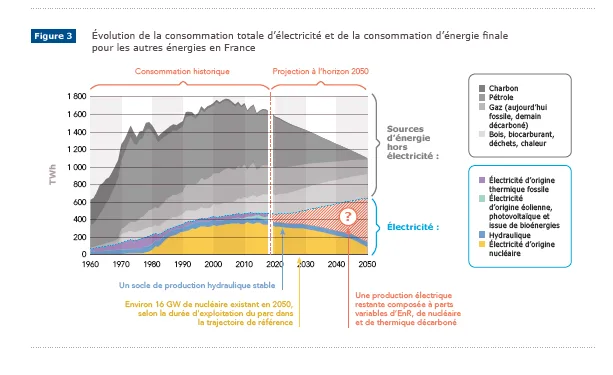
No alt text provided for this imageNo alt text provided for this image

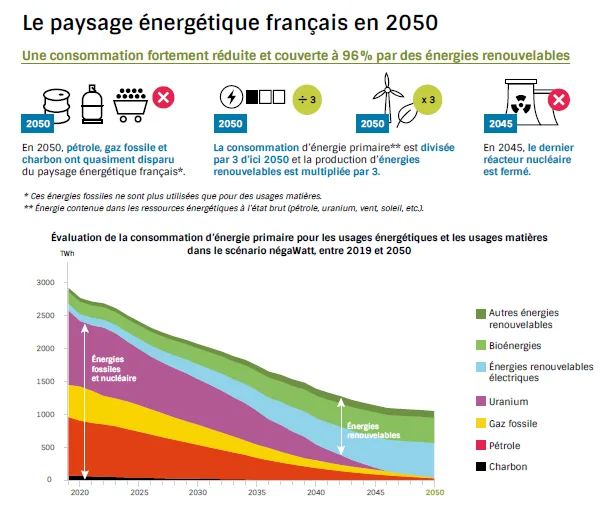
NEGAWATT

No alt text provided for this image

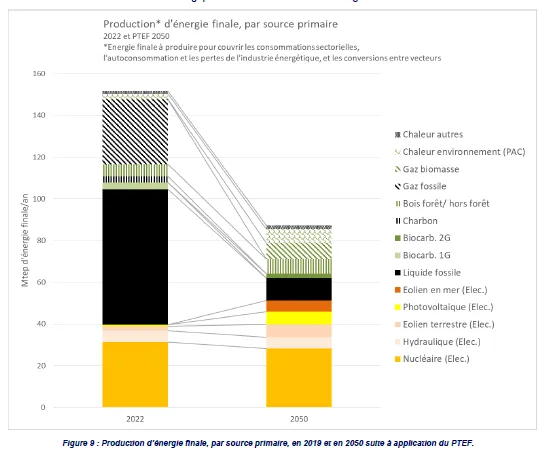
THE SHIFT PROJECT

No alt text provided for this imageNo alt text provided for this image

SFEN

No alt text provided for this image

OTHER SCENARIOS

Some nuclear associations in France work or worked on scenarios with propositions for dozens of EPRs to build by 2050. These being unvalidated by nuclear sector itself, I do not list them.

Comments

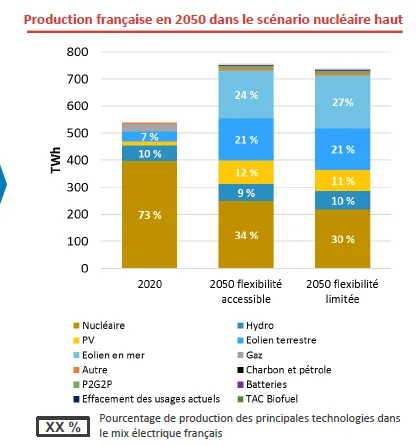
  • As can be seen, all scenarios except one (Shift) give at least 50% renewables

  • The minimum renewable scenario corresponds to RTE's N03 scenario. But RTE does not recommend it for climate goals, understandably when introducing "Time" in analysis. Defining a mix for 2050 does not mean picking demand projected for 2050 and arbitrarily assigning percentages by technology. One actually starts from today and models industrial deployment trajectories. Here are key points:

1. No new nuclear plants will be built in France before 2035-2040. So for at least 15 years, only renewables connect to network. This % must be integrated in all analyses.

2. Reactor lifetime is currently uncertain and can only be validated late. Risk must be integrated; can’t manage at last minute since a nuclear plant’s capacity is large and cannot be quickly replaced.

3. Beyond 60-year lifetime is unknown. It involves research and will take at least a decade for an opinion.

4. SMRs (small modular reactors) do not exist today and their outcomes are unknown.

5. We must launch six EPRs ready today. Before starting, nuclear sector must restructure and construction would start in 2028. More (14 EPRs or more) requires feedback on first builds.

Considering these, here is what RTE says:

"N03 scenario requires four conditions: (i) successful extension of most reactors to 60 years, (ii) some extended beyond 60 years (especially if some close at 50), (iii) build and put into service 14 EPR 2 units (8 more than the 'New Nuclear France' program), (iv) deploy 4 GW SMR capacity. Such scenario implies ensuring early feasibility of operation beyond 60 years. Generally it needs R&D effort on nuclear from new reactor design to "closed fuel cycle" tech."

"If technological and R&D challenges seem surmountable in coming decades, '100% renewable' scenarios or those based on long reactor life extensions beyond 60 years require many critical technical prerequisites fulfilled early. Nothing currently guarantees this. Choosing these scenarios now or renouncing technological diversification raises risk of missing neutrality goal by 2050."

  • Risk coverage strategies follow: nuclear uncertainties push accelerating renewables. Renewables uncertainties should also push sobriety. This explains why N03 is very unlikely. N03 risks (SMRs mandatory and lifetime beyond 60) come later. Anticipating risks leads to developing renewables, thus shifting mix away from nuclear.

Shift Project analysis

Given Shift’s particular approach, here is an analysis of its stance.

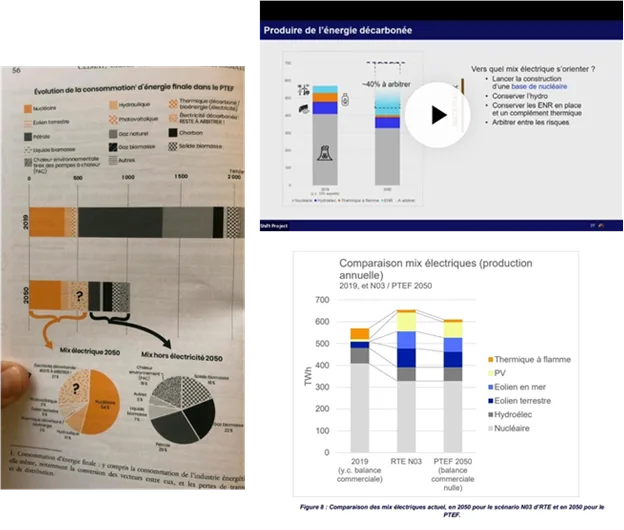
1. The image shows three versions of Shift’s electricity plan. Two have question marks, one replaces question marks with renewables.

2. Versions with question marks assume nuclear per N03 and the rest is subject to debate. But this is impossible for reasons above: the mix develops over time. Next 15 years only renewables connect. Then industrial trajectories must be produced. At every moment over 30 years, supply/demand must be balanced — key constraint explaining why mix projections need complex tools and information. One cannot arbitrarily assign renewal percentages based on preferences.

3. As noted, N03 implies risk coverage strategies ultimately leading to N03’s non-realization.

4. In the version without question marks replaced by renewables, methodology is detailed in PTEF Evaluation Energy-Climate note online, page 34:

"As mentioned in part I.D.3, we consider a mix more efficient in material consumption and liquid/gaseous energy consumption with more nuclear. We keep nuclear capacity and production per RTE: 50 GW installed for 330 TWh produced.

We also keep RTE’s hydropower: 22 GW for 63 TWh produced.

Conservatively, we hold thermal gas capacity and production from RTE scenario, even if EnR share is lower, ensuring supply security at least as good as RTE's (same level as today).

Finally, we complete mix (180 TWh) with variable renewables proportionally to RTE (~ 1/3 offshore wind, 1/3 onshore wind, 1/3 PV)."

The analysis states nuclear's advantage is apparently limited to current share:

"At around current nuclear share (<70%). Reasoning wouldn’t hold above some share where nuclear becomes less efficient at demand-following than thermal."

I won't critique Shift’s approach here, which would require many remarks, but only its mix production method: again, prorating renewables is impossible because supply-demand balance must hold every year.

Analyzing Shift reveals that solving its problems can anticipate higher renewables share, bringing us back to RTE scenario frame.

Annex 4

Comments on energy transition material risks

Links to documentation:

IFP Generate:

https://www.researchgate.net/project/GENERATE

IEA:

https://www.iea.org/reports/the-role-of-critical-minerals-in-clean-energy-transitions/executive-summary

[Note: this article will be updated in the future based on feedback received due to the complexity of the subject, especially since some sections are still under research and ongoing reflection]

"Sobriety is not synonymous with degrowth"

This is indeed what can be read in the synthesis note of ADEME’s work published on March 22, 2022.

I thus take this opportunity to propose an open discussion on the link between degrowth and our climate objectives. Beyond conceptual analysis, this discussion also aims to contribute to the development of desirable narratives of the energy transition.

These narratives aim notably to bring civil society together around our climate programs and make them compatible — as much as possible — with our ideological or political differences. Such an approach is in line with my other articles that try to go beyond technological divides concerning nuclear and renewable energies (EnR).

It does not seem impossible to find such unifying narratives, since many actions are imposed on us, whatever our ideals and worldviews. For example, in all cases, the fight against global warming involves stopping the combustion of fossil fuels. Of course, we could capture part of the emissions during combustion, but we already know today, with certainty, that it will not be possible to capture a significant portion by 2050. So necessarily, stopping the combustion of fossil fuels by 2050 is mandatory. This objective is imposed on us.

Our climate scenarios are all very similar in fact. This can be seen in France: RTE, ADEME, Shift Project, Negawatt — aside from the nuclear part which oscillates between its disappearance and about 50% by 2050, there is no fundamental difference between our "median" scenarios.

Indeed, taking the case of ADEME, we can find two “extreme” models of society: a frugal society practicing rationing (scenario S1), and an ultra-technological society continuing growth without compromise (scenario S4).

But let’s look at the description of these scenarios. For the frugal society: "chosen but also constrained frugality," "strong reduction in mobility," "prohibition and rationing by quotas." For the ultra-technological society: "preservation of mass consumption lifestyles," "innovation all around," "equipment multiplies." It seems difficult to imagine that a large part of the population voluntarily wishes to go in either extreme direction. Moreover, these scenarios both present many risks and greatly reduce our chances of reaching our climate objectives — as we will see in the article.

If we therefore exclude these two extreme visions, it should be possible to find energy transition narratives that unite since, in fact, there are no fundamentally conflicting proposals between the other scenarios. It is mostly a matter of shifting the dial on the importance of each measure — but many measures are common.

I hope this article will help some clarify the current debates. As always, my intention is not to convince anyone to take one position or another but simply to open discussions — besides, can we afford to lock ourselves into one position given our current uncertain and changing environment?  

What do we mean by degrowth?

There are practically as many definitions as people who want to promote degrowth. This movement groups several schools of thought — see later in the linked article "A Green Deal without Growth" which offers a vision of the panorama of different trends within this movement.

Here is my attempt to summarize in a few lines the general approach, inspired by a talk by T. Parrique and some readings.

The degrowth movement advocates a planned reduction of our use of the biosphere to meet our needs. It is critical of growth, which it sees as the origin of environmental destruction. It questions our social model, wants to simplify our structures while making them fairer. It is also, and more fundamentally, a critique of capitalism, a system organizing our societies and economies that would push or force us to always want more, hence to grow, hence to destroy.

From reducing inputs to reducing GDP is just a step. Less energy, fewer running machines, less production, less GDP. Although J. Hickel explicitly points this out in his book "Less is More" (where he indicates that whether GDP grows or shrinks matters little), communications are often ambiguous on this topic. Especially when degrowth criticizes "green growth," i.e., the decoupling of emissions and GDP: why criticize this relation if this indicator is of little interest?

Summary of ADEME's position

The arguments advanced by ADEME to explain that sobriety is not synonymous with degrowth are as follows:

  • "The transition essentially relies on replacing carbon energies with renewable or nuclear energies, on substituting capital and/or labor for energy, on shifting activity from energy-intensive sectors to less energy-intensive ones (from road to rail, for example), from consumption of highly carbon-intensive goods, like plastic or steel, to less intensive materials like wood, or services. It therefore does not imply an absolute reduction in activity but rather a modification of production modes and consumption habits."

  • "This study, based on the ThreeME model (Multisectoral Macroeconomic Model for the Evaluation of Energy and Environmental policies), clearly shows that a decoupling between GDP and territorial greenhouse gas emissions is possible. None of the four scenarios results in a recession over the long term relative to the current level of economic activity. Sobriety is not synonymous with degrowth."

  • "This work also highlights that the growth/degrowth debate regarding GDP is not relevant to characterize ecological transition scenarios. GDP only measures the sum of incomes distributed during the production process. It says nothing about the degree of decarbonization of production and transport, the share of services in consumption, nor the energy sobriety of buildings."

See here the note published by ADEME:

Transition(s) 2050: four scenarios and their series to achieve carbon neutrality by 2050

An inevitable degrowth?

The idea of an inevitable degrowth is based notably on a simple observation: today our societies operate consuming energy, and this energy will become scarce. The industrial activities of our society will then decline according to the rate of decrease in energy availability. We will thus have to adapt to a world where we have "less of everything."

This energy would become scarce for two reasons:

  • The first is that climate change forces us to stop emitting CO2 into the atmosphere as soon as possible, which essentially means no longer burning fossil energy. However, our current world operates with fossil fuels representing 80% of primary energy. Stopping burning fossil fuels means losing 3/4 of our current energy supply, equivalent to energy production levels of the 1950s, when the planet’s population was four times smaller. The descent will therefore be very harsh.

  • The second is that the quantity of fossil fuels underground will decrease over the years at a rate yet to be defined, but it is expected that after a plateau until 2030, production will gradually decline.

But energy is not the only explanatory factor. Planetary boundaries surpassed would lead us in all cases towards a declining slope, resulting in the necessary rebalancing. This is the outcome given by "The Limits to Growth" studies. Here is a video by Arthur Keller on the topic:

#Earth 🌏 Will we survive this? Amazing⚡️ #crashcourse on #collapse & #environment by #ArthurKeller

This degrowth is often characterized by a declining GDP, although this is not the reference indicator of the degrowth movement. Yet this is what it is about: a GDP that will decrease and increasingly restricted choices in our consumption and lifestyles, forcing us progressively to select what we want to keep or abandon as our energy supply decreases.

Faced with such an inevitable situation, two options remain:

  • The first is to plan this descent. We can indeed control this descent to limit the suffering endured during the period that will lead to a final state where our GDP would be greatly reduced.

  • The second is to do nothing, and this descent will then be constrained, since climate change with its crises (extreme climates, precariousness, forced migrations, war, etc.) and the end of fossil fuels will inevitably remind us to order.

In both cases, we would arrive at the same situation, but the first option presents a less painful path than the other.

The energy transition: humanity’s response to climate change

We often forget this incredible fact: our industrial growth only began to assert its exponential nature in 1950, barely 70 years ago. In 70 years, population quadrupled. Our energy demand grew fivefold. Global GDP increased by 100 times.

No alt text provided for this image

During this short time span, we greedily devoured all possible resources made available to us and many biosphere indicators are now in the red zone. We have also released so much CO2 into the atmosphere burning these fossils to produce our energy that the Earth is warming, and this temperature change in a few decades is equivalent to climatic processes spanning tens of thousands or even millions of years. This warming affects our climate and environment, which will become increasingly hostile to humans in the coming years.

Nonetheless, humanity has not yet given up. It has decided to wage one last battle called the energy transition. This consists in changing all our infrastructures and sectoral organizations to no longer emit CO2 into the atmosphere.

Researchers and numerous actors in energy and other environment-related sectors have since started working. Each country, international and regional institution, many associations, think tanks, industrial players, research labs, have produced or are developing scenarios called "Net Zero."

These Net Zero scenarios provide a detailed description of the evolution of our infrastructures and economic sectors (agriculture, industry, services), especially the energy sector, so that by 2050 our activities virtually no longer emit CO2 — or remaining emissions are offset by "carbon sinks," such as forests.

When analyzing these scenarios, one realizes that they do not assume the continuity of our current society and thus are not mostly "techno-solutionist" as some think.

On the contrary, they show the necessity of reducing our final energy demand, decreasing our material footprint, preserving our environment, and moving towards greater social equity. It is thus not about "doing as before but without emissions," since the scenarios show it is impossible, but proposing a new form of economic and social organization respectful of the environment.

These scenarios all converge on some key strategies, for nearly all countries regardless of the institution proposing them. Here is what they converge towards:

  1. Our final energy demand must decrease. In other words, we can no longer consume as much energy for our activities. The party is over. It was nice, some enjoyed it well. But it's over. We must now think about ways to limit our energy consumption.

  2. We will electrify many things. We must stop burning stuff. Now we will do as many things as possible with electricity.

  1. This electricity will mostly be produced from renewable energies. This is our main option today. We can do nuclear as much as possible, but we need lots of electricity, worldwide, and this technology cannot be deployed at the right scale in time. Current nuclear technologies remain complex and pose different safety, nuclear proliferation issues, etc. Hydropower has been widely developed, and although some potential remains, it is limited. Biomass remains largely to be developed, but again its potential is bounded by environmental impact depending on inputs and land use. So we only have renewables (EnR), and millions have worked for 15 years to enable their massive deployment. All energy actors know this well, and strategic plans across sectors — oil/gas/coal, nuclear, others — now position themselves in a world where renewable technologies will be dominant. These will thus penetrate our everyday life more and more. Currently, over 90% of all new electrical installations connected to grids worldwide are renewables, and this should continue throughout this decade.

  2. Biomass — excluding electricity — will provide the rest, with biofuels, biogas, solid biomass. We will still have some oil for petrochemicals, so we must quickly stop burning it and use it in its noble version, which does not waste 2/3 of its energy.

The energy transition is not optional; we have no choice but to carry it out, because sobriety is not an energy transition: on one hand sobriety is a lever with limits, on the other it means consuming less but we will still always emit and depend on fossil fuels.

Indeed, the numbers and deadlines are impressive, but that's how it is — and incidentally, we have already experienced such deployments since 1950. We have to rebuild everything now, but better.

Today, whatever ideological position is taken, it should be able to rest on a NZE scenario to translate into policies and regulations. Studies and practice confirm that this scenario will necessarily — for nearly all countries — at least rely on the 4 elements described above.

How to reduce our final energy demand?

ADEME recalls the results of our climate scenarios: all show it is possible to build a desirable society centered around environment and life.

Many doubt this possibility because they associate our need to reduce final energy demand with loss of comfort and freedom.

This decrease being the key point of our transition scenarios, which align them with collapse avoidance scenarios (since they plan an energy descent), understanding its nature is vital.

The origin of these doubts seems mostly to arise from confusion about the strategies available to reduce final energy demand. It's not about keeping the same society and doing "less," but about building a new society, which will produce and use energy differently — an energy with different properties, notably the shift from fossils to electric.

Among these strategies are energy efficiency, but especially electrification. For example, here is Mark Jacobson’s estimate of final energy reductions of over 50% following electrification in cars, heat pumps, industrial processes, and stopping fossil extraction.

No alt text provided for this image

But this alone will not suffice, partly because technological deployment carries uncertainties, and due to the scale of the challenge, all strategies must be deployed to maximize our chances of success.

We must therefore also eliminate these immense losses and promote sobriety actions. Again, many think we will have to sacrifice modern comfort. But this ignores that the structure on which our exponential growth was built in a few decades of energetic frenzy consists mainly of gaping energy holes, inefficiency, and useless usages and equipment.

Our current energy consumption is based on unprecedented wastefulness. Burning fossils is indeed the worst way possible to produce energy efficiently: two-thirds is lost as heat, only one-third recovered. We did it because these energies are practical to transport, store, and exploit. Because we had no awareness or desire to align with our environment, no concern for limits of any kind. And because dominant actors profited, profit multiplied by humanity's collective subsidizing of these energies by accepting free atmospheric CO2 storage, while populations and states pay the health and environmental consequences.

Consider the food chain: over 30% of global production is simply lost! Here is also the US energy flow chart, with inputs on the left and the small dark gray box bottom right representing what is truly utilized. How can we still imagine efficient energy use looking at such a graphic?

No alt text provided for this image

What would a society that successfully completed its energy transition look like?

Beyond energy reduction, many actions are needed to reduce our emissions. Comparing various French plans shows proposed pathways are feasible, which is great news, and the resulting societies are desirable.

Taking ADEME as an example — other scenarios are provided in Annex 1. Here is the summary table:

No alt text provided for this image

Sure, following these scenarios, we won’t all take 50 plane trips a week between Paris and Marseille. Sure, no one is proposed to buy a 4x4 solely to accompany their child to school across the street. But another society is possible: teleconferencing, train, electric cars adapted to daily use, etc.

Our world will be more decentralized, technology integrated into everyday life to help protect the environment, energy produced more decentralized, mainly with renewables and biomass, leading to different adaptations. Very little smoke: our world is electric, we burn very little. It is digital: we prefer to transport data rather than things or people. It is optimized: energy losses are reduced. Agriculture uses less fertilizer and pesticides, and we have reduced meat consumption. It is both globalized and very local. We all share the feeling of living on the same planet. We have abandoned GDP as the guide to our policies.

Will we live in energy poverty? Not sure. To revisit the US energy sources and uses graphic, our objective is to cover the dark gray box bottom right.

Note here the importance of understanding exergy, a concept essential for analyzing the energy transition. Primary energy, final energy, and exergy: 3 concepts to know and differentiate in the context of the energy transition. The transition concerns exergy, not replacing primary energy.

Furthermore, our current society and a post-transition society will use energy differently: less energy spent on treating pollution-related diseases, climate drift ceasing to amplify, near disappearance of fossil exploitation infrastructures and activities — extraction, distribution, storage... Also, fossil fuel EROI is plummeting while renewables’ EROI is increasing yearly.

Thus, it is not about living cramped under environmental constraint, but creating a new society optimized energetically and respectful of environment and life, where our choices can naturally be expressed respecting ecological boundaries. It is an evolution toward a new, more sophisticated modernity. As for the economic and political expressions of this world, they remain to be built, and we will have to work on this together over the next three decades or more.

The energy transition is neither backward nor regression. We are not throwing ourselves into the void with the end of fossils but rising toward a better society. These solutions were found thanks to fossil energies that enabled exponential development in a very short time. They are not, as sometimes heard, a return to medieval technologies — which assumes a wind turbine and a windmill are technologically identical and ignores PV solar, CSP, and even electricity — but an expression of new modernity, research and technology emerging from many converging factors in the 21st century. Staying with fossils, on the contrary, prevents turning a page in our industrial history and drags us into the past without chance to evolve or improve.

All well and good but this energy transition story won't happen because anyway we've exhausted all resources and we're doomed.

Well... Indeed not everything is that easy. Because this excludes systemic risks we will face. These will be of different kinds: climatic, social, political, economic, and others. We are already crossing two now: material shortages and the war in Ukraine.

Here are some systemic risks we can anticipate:

1. Fossil resources will dwindle

For two reasons:

  • Resource problems, plus collapsing EROI (we consume more and more energy to extract fossils). See here

No alt text provided for this image
  • Investment problems. No oil exploration activity should occur now if we want to stay on a 1.5°C trajectory (cf. AIE’s Net Zero 1.5°C scenario). The market is uncertain, oil companies know demand will not increase. Investments become riskier, impacting future availability.

2. Fossil prices will probably be erratic

These prices heavily influence proper functioning of our societies, as seen recently with gas price surges and current energy market volatility: households are impacted, companies close. Here is a detailed argument:

Why do oil prices matter to the global economy? An expert explains

3. It would be risky to imagine material supply and demand perfectly balanced continuously over the next 30 years

Especially given the massive needs of the energy transition. We will almost certainly encounter tension periods, unrelated to the resource itself — since studies show sufficient materials exist, provided recycling increases on some, notably copper — but to exploitation.

Consider photovoltaic silicon: a shortage currently impacts PV prices (yet sector growth remains strong, prices still competitive). The industry reaction was quick: global production capacity will double (!) by 2024. But such difficulties will continue over time on various components or materials, and adjustments will have more or less long and sharp consequences.

It is thus clear the energy transition will not be a smooth ride. We will likely face energy tensions, especially if we truly want no step backward by fueling economies sometimes with fossil energy revival.

But let us not forget: some of these systemic risks are inherent to the energy transition, we cause them.

For example, reduced fossil availability is an inevitable consequence, beyond resource issues, of our climate strategies. All climate scenarios must consider this risk so much that it should be part of scenarios rather than an annex. This situation does not actually depend on resource depletion that may occur more slowly and perhaps later (debate exists).

Our fossil reductions — to stay on a 1.5°C trajectory — must be rapid: compared to 2019, oil demand in 2050 must drop 75%, coal practically vanish, and gas at least 55%. No resource projection justifies such evolution in 30 years. These are targets we must impose on ourselves to keep the least catastrophic temperature rises.

There is thus no need to panic about fossil depletion imagining imminent collapse: depletion will be caused by our policies — exactly what we seek. Keep cool as we have no choice but to face this situation if we want to solve the climate issue.

To absorb these shocks we might be tempted to compress our economy to the maximum... but the transition assumes various growth forms that invalidate this position

These systemic risks are not reasons to voluntarily lower all activities. We must select which to constrain and which to support for continued growth over the next three decades. Reasons are:

1. Climate strategies are appreciated internationally: managing growth in emerging countries and cooperation between countries

Although debates exist about OECD GDP stagnation causes — see Annex 2 for varying positions — it is hard to deny that OECD countries have reached a development stage where most citizens have basic needs covered, though inequalities and social and economic precarity are increasing and denounced.

Emerging societies, on the other hand, continue to grow strongly, due to infrastructure and population growth.

The challenge for them is not to degrow but to find a new definition of growth that prevents repeating past country trajectories. India, for example, remains among countries with the lowest per capita energy consumption.

No alt text provided for this image

Emerging countries’ growth challenge is perhaps one of the most critical for climate and our actions. Currently, two-thirds of emissions are in emerging countries, with others rising.

How to solve this equation?

By proposing frugal lifestyles for Northern countries and promoting localism, temptation exists to isolate from other economies, preventing contributing to the climate challenge commensurate with our means and historical responsibilities — remember OECD countries have consumed a large majority of humanity's carbon budget for their growth.

No alt text provided for this image

On the contrary, without international cooperation and reflections/actions/partnerships between North and South, the energy transition will carry a much higher social cost and our success chances much slimmer.

This analysis is confirmed in the IEA 1.5°C NZE report:

"Governments must work together effectively and mutually beneficially to implement coherent cross-border measures. This includes managing domestic job creation and local commercial benefits while addressing global needs for clean energy deployment. Accelerating innovation, developing standards, and scaling clean technologies must link national markets. Cooperation must recognize development stage differences and societal variations. For many rich countries, achieving net zero is harder and costlier without international cooperation. For many developing countries, the pathway without assistance is unclear. Technical and financial support is needed to ensure deployment. Without greater cooperation, global CO2 will not fall to net zero by 2050."

We can take hydrogen as an example in the RTE report. France could produce it locally, but its cost would be at least twice that of a European approach. This sector is truly European, even beyond, including North Africa in the European plate.

No alt text provided for this image

2. Resilience strategies make reindustrialization interesting, though these involve increased economic activity

In France, a reindustrialization strategy revolves around four essential axes:

  • Bringing industries back with high added value in strategic sectors, able to compete internationally

  • Resuming high-emission industries locally to decarbonize them

  • Job development

  • Independence, adapting to systemic risks, shortening supply chains

These reindustrializations contribute to economic activity growth all else equal and increase energy demand. They increase investments required to reach net zero by 2050 since they raise decarbonized energy needs.

However, decarbonizing these industries is necessary, whether in France or where they were offshored (often emerging countries). Following the Paris Agreement principle, responsibility lies more heavily on countries historically responsible for emissions.

France, a mature economy having largely consumed humanity’s carbon budget to develop, must assume its responsibility. It is normal it participates in a more sustained investment effort.

RTE proposes different reindustrialization trajectories, visible here:

No alt text provided for this image

3. Whatever sobriety efforts, no scenario exists today that does not rely on growing electricity’s share in final energy mix, with a large renewables majority within electricity.

In France, no current scenario has electricity share less than 50% of final energy demand — more than twice today’s share. Within these 50%, the minimum renewables share is 40-50%, with probable scenarios at least 60%, i.e., 6 to 7 times today’s share.

Absent tangible systemic risks reactions, the renewables share should be dominant in the electrical mix by 2050. See Annex 3 for detailed French mix proposals with comments.

All our scenarios involve strong growth in renewables sector, even those advocating greatest sobriety like Negawatt and Shift. We must also develop grid flexibility tools and technologies: smart grids, demand management, interconnections, etc. Our scenarios also rely on developing hydrogen for industry and growth in electric vehicles. These sectors will see strong growth over the next three decades.

The presence of these technologies in France implies ongoing worldwide development. Equipment competitiveness evolution far exceeds French scope. For example, here are electrolyzer cost projections by market size:

No alt text provided for this image

The French market alone will not allow such cost decrease. Without cost drops, energy transition will take longer and expose vulnerable people more, requiring greater redistribution with uncertain sustainability.

Going further: France benefits from nuclear electricity base, unlike most countries. Nuclear share worldwide won’t exceed 20-30% generally, or is zero.

Globally, renewables and electrification sectors driven by renewables must grow unprecedentedly.

4. Existence of systemic risks does not invalidate scenarios but requires developing coverage strategies which can in turn impact scenario definitions

We just saw all climate scenarios rely on development of key transition technologies related to renewables and electrification. Deployment risks like material availability are inseparable from Net Zero scenarios. We can reduce but not eliminate them, so solutions exist and develop — see Annex 4 on material risks.

How to react facing systemic risks?

Taking current European crisis as example, management previews future crisis consequences.

This crisis commands governments to implement emergency measures notably to end dependence on Russian imports ASAP.

These emergency measures lead us to revisit priorities order of climate actions based on time horizon of impacts. Naturally, several sobriety actions appear top, which is excellent for climate despite this atrocious context. Indeed, sobriety actions were too neglected by policymakers and institutional climate scenarios.

Here are IEA’s proposals responding to current crisis:
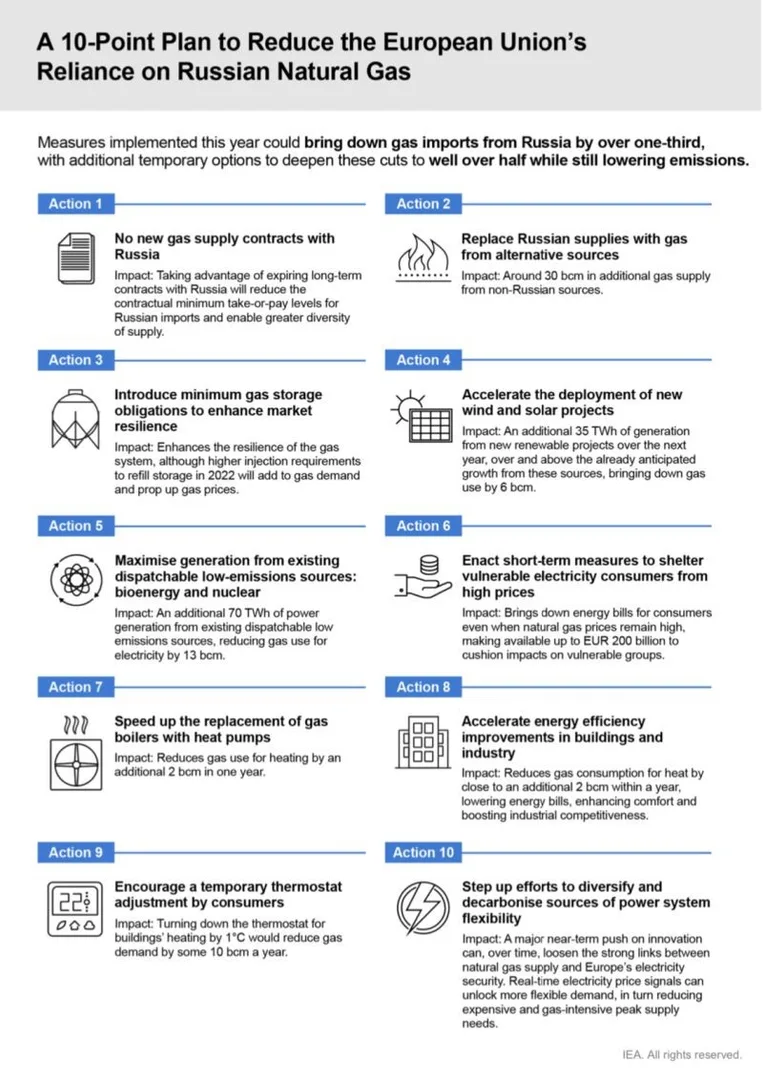
No alt text provided for this imageNo alt text provided for this image

Is a crisis good for fighting climate change?

Answer depends on outcome, but if it raises transition costs, degrades conditions so infrastructures cannot change fast enough, or slows deployment of key tech like renewables, then it hinders climate actions. It increases likelihood of missing targets. Degree of crisis matters too — higher degree means fewer solutions. These are certainly undesirable.

Okay, I get it: climate scenarios must include growth of some countries and sectors, but green growth does not exist, so we must find something else

Indeed, economic models linked to NZE scenarios all show GDP growth, with arguments similar to ADEME’s. Thus, green growth (GDP/emissions — here restricted to CO2) always appears possible.

Of course, outside the CO2 prism, green growth is impossible since activities will always impact environment — it is the "price" of growth to be minimized.

Is GDP growth fundamental in models backing climate scenarios?

Not really. For example, GDP rising or falling does not change the 4 shared points in all climate scenarios (see early article) nor weaken the energy transition imperative.

GDP results from combined actions, only valid with hypotheses and calculation mode. It does not predict real GDP during transition phase, depending on many real parameters absent in models like material availability, fossil availability in case of delayed deployment, etc.

However, some models assume exogenous GDP rise, for example in energy consumption trajectories, and indicate that GDP decline would make climate scenarios problematic as we'd have fewer means to finance the transition. This was mentioned earlier regarding systemic risks and will be reiterated in conclusion due to its importance.

GDP evolution is hard to anticipate, since green sectors will grow extraordinarly while emitting sectors will be strongly compressed.

Many critiques exist on green growth, here is an example:

A systematic review of the evidence on decoupling of GDP, resource use and GHG emissions, part II: synthesizing the insights

The critique methodology suggests transition dynamics and nature are not well understood.

  • The energy transition enables, by construction, emission-free energy production by massively developing renewables and electrification.

  • It involves shrinking fossil energy activities, strongly lowering economies. But green sector growth will be a very important economic activity source. GDP will thus move in a hard-to-predict direction.

None of the above actions occurred in the past — our climate actions mainly relied on energy efficiency. Our climate strategies just began in 2022. It's pointless to search proof for GDP/CO2 decoupling in past 30 years — why would it have happened?

So green growth or no green growth?

Everyone can now see GDP/Green Growth is not a transition critique since we have no alternative but to succeed to fight climate change and end fossil dependency which will eventually disappear.

It is rather a critique of NZE scenario construction methodologies arguing GDP may not grow during or post transition. Hence point 4 in the previous section.

In any case, a post-transition world necessarily decouples energy and CO2. This is what matters. Will we have GDP-Energy decoupling or enough energy?

We will indeed need lots of renewables globally. Models show this is possible, we can transform energy systems and have enough energy to support this new world. Studies also show sufficient materials and many technologies to succeed. So it depends on systemic shocks and how well we absorb them.

GDP variation should also be viewed by separating two phases: first, investment phase replacing infrastructures; second, post-investment phase with replaced infrastructures. These two worlds differ. GDP could rise during transition as we invest trillions and create millions of jobs, more than those destroyed per analyses.

I will reuse G. Giraud’s conclusion on green growth:

"Growing GDP matters little. Hence futility of green growth debates questioning compatibility of transition with GDP growth. The right question is: how to operate transition to ensure work for most and a democratic and prosperous lifestyle?"

Here I am lost: green growth doesn’t matter, compressing economy harms climate, emerging countries must control growth not degrow, developed countries must grow some sectors while degrowing others. So where does degrowth fit here?

Degrowth seems primarily a critique of growth, and social program addressing its excesses, as Club of Rome’s "The Limits to Growth" report well highlighted. So it is not (yet) a climate program.

This doesn’t invalidate extensive research in this movement nor proposals in principle. Many degrowth proposals are already included and essential in our climate pathways to reach net zero by 2050.

But it raises questions about degrowth concepts' adequacy to climate scenarios. I will propose some reflection avenues.

Experts forgive me in advance; I am not a degrowth scholar. My critiques are likely imprecise and possibly invalid. These comments are not hard points but aim to open discussion. Readers should critically examine this part.

1. Degrowth discourse must learn to fit within energy transition discourse.

If launched, this would have many consequences on studies to be done and its energy positioning, e.g.:

  • A more integrated vision of energy and its social and organizational implications, notably the central role of renewables and key technologies like electrification. Such society may not be simpler but rather more sophisticated.

  • The objective to shrink our economy or even its anticipation becomes less relevant. Priority remains climate program and energy transition. Economy size resulting from combining growth and degrowth actions is not pre-defined and not itself a climate/environmental objective. Many strategies reduce energy demand, including electrification. Carbon tax and fiscal reform effectively reduce demand for high-carbon goods and associated energy while promoting environmentally virtuous choices growing in consumption share. Is restricting citizens’ activities and incomes compatible with these actions?

  • A new reading of green growth and its communications/critiques is needed, not to say it is possible, but to refine arguments. Degrowth should provide a precise vision of energy transition, its financing, and managing growth in related sectors plus degrowth in others.

  • The transitional phase we experience now, with mixed growth and degrowth actions and uncertain end (around 2050 target), forces rethinking growth notion. Interesting also to separate analyses by transition phase and post-transition.

  • Considering OECD/emerging country dichotomy while recognizing global climate problem also affects views on growth and our climate actions and responsibilities as Northern citizens. This is studied further below.

Lack of degrowth–energy transition link makes measuring proposal effectiveness against climate goals difficult. Creating this link could change degrowth movement publications and arguments. For further study, here is an interesting paper:

A Green New Deal without growth?

2. If current neoliberal capitalism has shown limits it doesn’t necessarily mean capitalism must be rejected.

Neoliberalism has proven incapable of solving climate problems (not possible without state intervention and social justice goal).

But one needn’t be degrowth to criticize neoliberal capitalism and wish for an evolution from consumerist society where citizens are utility functions (see Amartya Sen critique) to fairer and environmentally respectful society.

Does capitalism necessarily imply growth desire, as J. Hickel indicates?

Not certain. Interest rates, often cited as cause, are charges levied on future income. These future incomes include a margin that is thus reduced. This margin or income need not necessarily grow. Being out of my comfort zone here, I share this remark but invite further inputs.

Hybrid approaches seem possible. Here is an interesting video for illustrating and deepening these reflections.

THOMAS PIKETTY, GAËL GIRAUD: IS CAPITALISM REFORMABLE?

3. Proper management of climate actions will probably involve social negotiations, which can’t always wait for results to move forward.

Removing social obstacles to the energy transition is now key in climate scenarios given detailed realistic action plans.

Difficult negotiations with historical actors negatively impacted by transition and benefiting from delays are probable.

Compromises must be found. A more united society around climate strategies is essential for successful climate actions. Our disagreements slow energy transition, some could simply cause policy failure.

Consider, for example, proposals for moratoriums on renewables in France or rapid nuclear phase-out by 2035. These positions make reaching climate trajectories impossible, as fully evidenced by RTE’s detailed analyses.

In such a context, rejecting growth outright as a prerequisite to action seems difficult, even if economic indicator reform is contemplated.

Conclusion: move beyond growth/degrowth framework to review climate scenarios and unite civil society around these programs

It should be possible to transcend ideological frameworks in scenario analyses and thus maximize climate action chances by integrating complementary views.

I conclude here with two major points to retain in this debate:

1. Putting GDP as a key policy indicator makes no sense anymore.

Trillions will be injected in economies, generating unprecedented growth in some sectors while entire sectors, with major companies deeply embedded, like oil companies, must practically disappear. It is thus very hard to predict GDP evolution in coming years or if it will yield exploitable information.

At minimum, GDP should be linked to CO2 emissions to guide policies, since currently energy, GDP, and emissions indices evolve similarly absent energy transition.

Crucial indicators to assess policy results are of completely different nature: temperature, emissions, biosphere, pollution, energy consumption, etc.

Until governments implement these new indicators, we must seriously doubt effective climate action management and understanding of action specifics.

Without new indicators, we are blind and unable to know if we progress rightly, and if not, why. In this new framework, decoupling notion has little interest.

Here we can cite Kate Raworth’s Doughnut methodology, offering an interesting approach aligned with scenario-building. The framework is fully rooted in the energy transition.

I present here the 7 key lessons of this analysis, sufficiently flexible for various climate scenarios. Left: traditional reflection frameworks. Right: how we should evolve (sorry for scan quality):
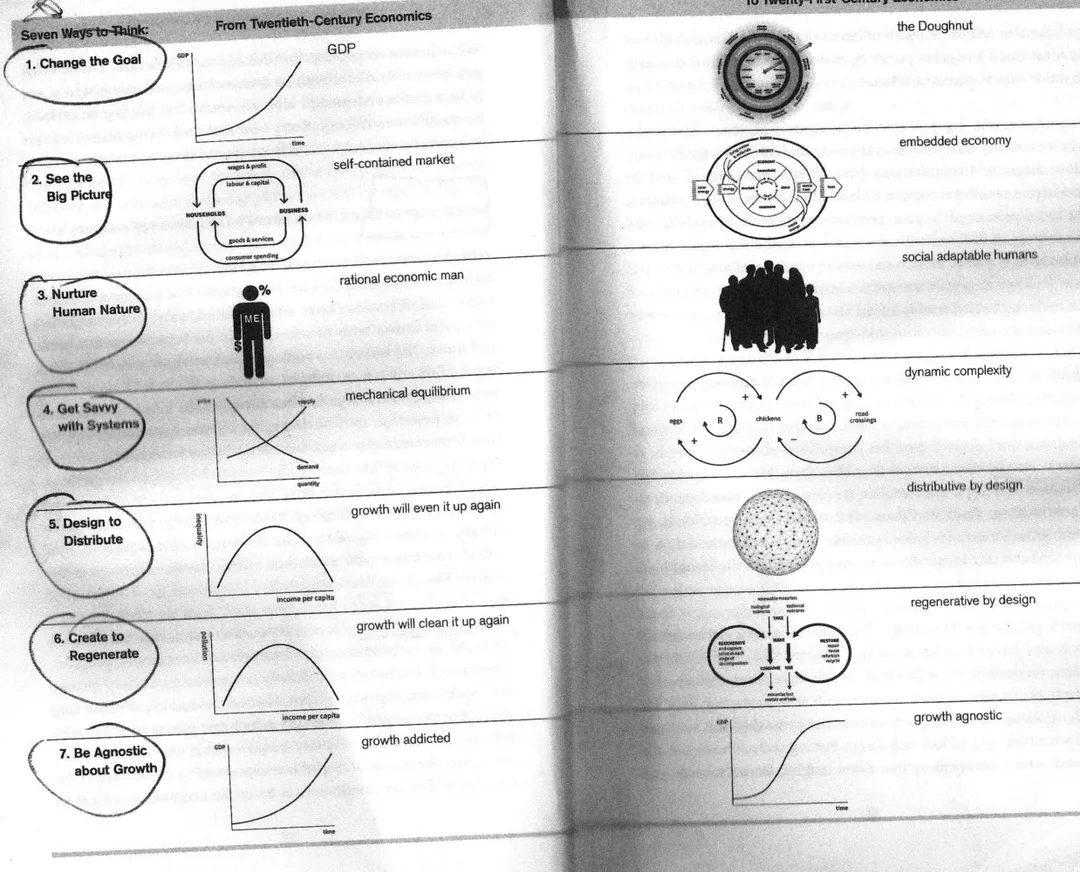
No alt text provided for this image

Here is the compass to locate policies (it is the "1/Change the goal" of the diagram below shown enlarged and in color):
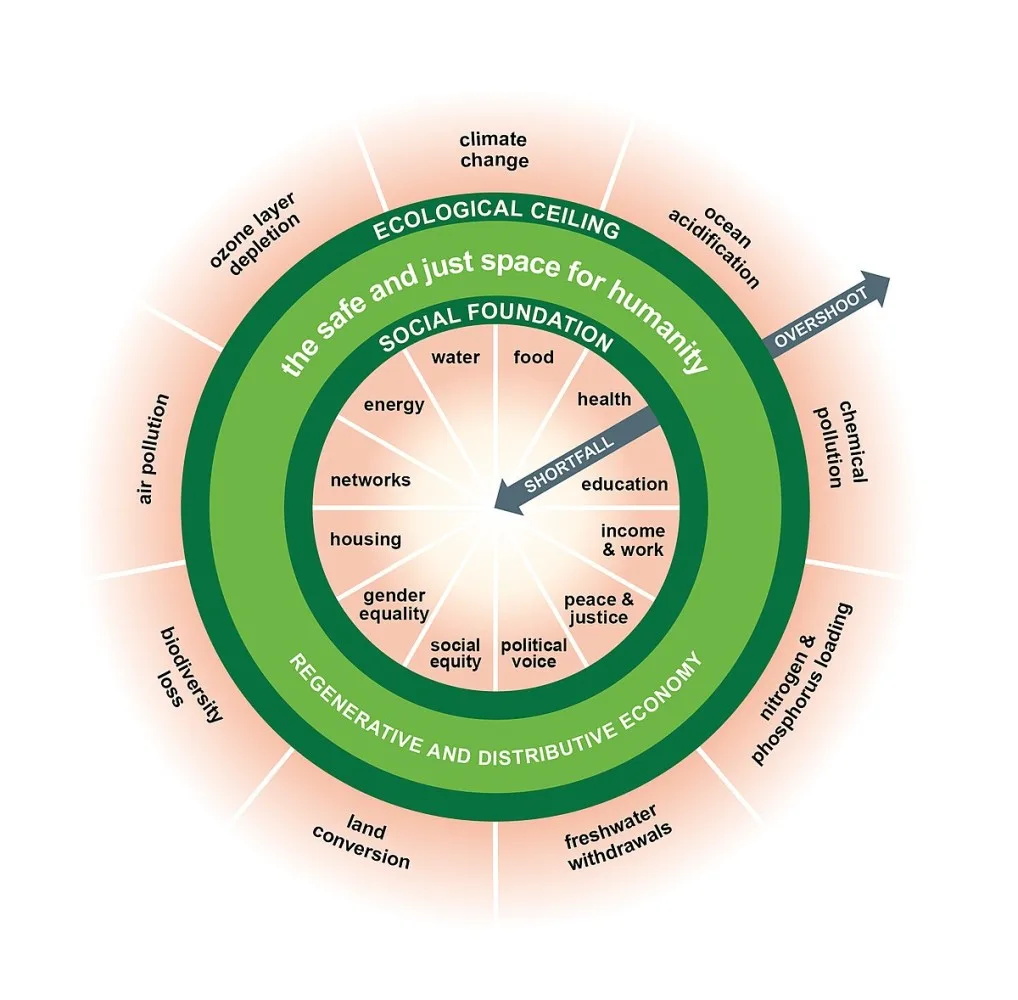
No alt text provided for this image

2. Our scenarios must be reviewed to ensure resilience to systemic risks.

Since 2020, we see energy transition won’t be smooth. If governments and societies aren’t ready to face systemic shocks, their proposals will aim to maintain economic activity to avoid crisis (including social), causing emission rises and fossil return.

We have a perfect example in 2020 Covid recovery policies which were rarely aligned with 1.5°C trajectory, causing growth resurgence and increased energy consumption and emissions:

Global Energy Review: CO2 Emissions in 2021 – Analysis - IEA

GDP will fluctuate unpredictably during transition. Shortages and new conflicts may arise, including health, social, climate crises. Historical actors may exploit crises to delay transition. How to map scenarios addressing these?

Begin by acknowledging sobriety is not an energy transition and we must change energy infrastructures. Not changing them leads to collapse, energy poverty, and worsened climate drift. Conversely, changing infrastructures alone won’t reach targets and multiply scenario systemic risks. Technology alone is not prudent to reduce energy consumption. Sobriety/reduction and infrastructure change are inseparable and must appear jointly in transition narratives.

We know broadly what to do: renewables, biomass, smart grids, interconnection, electrification… these fundamentals won’t change. Maximize reduction of technology deployment necessity with sobriety or nuclear, but given timing and global problem, green sector growth stays strong in all scenarios.

There is no miracle plan, and we will inevitably face multiple risks during next three decades regardless of technical paths or sobriety weight. We can sometimes mitigate consequences but never eliminate risks fully.

A well-conducted systemic analysis aims not to prove transition impossible but to highlight specific risks, characterize and quantify them to find solutions in different forms.

Some proposals to outline this approach:

  • Model risks to understand impacts by type then integrate into models.

  • Focus methodologies more on "no-regret" trajectories within scenarios. No-regret means proposing trajectories tolerating many sensitivity tests, e.g., zero GDP or market tensions. Probably leading to stronger sobriety emphasis, currently weak in reference scenarios like RTE or IEA NZE 1.5°C.

  • Revise action execution speed and priority order based on deployment timing. Current European situation forces this. It doesn’t challenge climate goals but makes decision and measure calendars more detailed.

  • Early risk-specific response identification would help governments react faster if systemic risks emerge without losing climate direction.

  • Review industrial transition strategies to limit supply chain disruptions and build balanced interdependencies with some countries.

  • Also reconsider technological trajectories focusing on resilience. Initial 4 principles remain. But is direct air carbon capture serious? Can surplus renewable electricity production in Europe be realistically anticipated? Analyzing questions through resilience lens should refine and strengthen some scenarios and options like sobriety.

Ideological differences and associated debates are often healthy and enriching for democracy, reflecting societal worldview diversity. Personally, digging into degrowth arguments helped me develop a more refined critique of IEA 1.5°C scenario from resilience perspective described here. It’s a new approach I thought over for some time and will grow in my work.

But the energy transition should enrich itself from these conflicts to transcend them and propose the strongest, most desirable trajectory.

It is important for everyone to familiarize with various NZE scenarios. They underpin climate action analysis. Understanding them should make us think twice before acting contrary to these scenarios or spreading communications slowing implementation by sowing confusion. Common confusions: green growth vs energy transition, demand reduction vs degrowth, primary energy vs exergy, techno-solutionism = NZE scenario, energy transition vs sobriety, etc.

Such work could also help smooth differences and bring society together around a climate program. In practice, differences between our French scenarios are not major, although nuclear share swings from 0% to about 50%.

It is time to get serious; little time left. Our action outlines are clearly known, and it seems unwise to hinder those with documented international consensus.

Yet our scenarios remain imperfectly applied by governments, explaining emissions growth — despite some progress. An approach could be civil society learning and understanding scenarios, validating outline, then actively campaigning for implementation.

Leaving these scenarios inevitably exposes us to disinformation. Risks are also high to be convinced by anti-climate positions, even if sincere.

Annex 1

Description of scenarios and Net Zero Plans for France

ADEME 2050

4 scenarios to reach carbon neutrality

RTE Energy Futures

Energy futures 2050: studied production mix scenarios to reach carbon neutrality by 2050

Negawatt

Negawatt Scenario 2022-2050

Shift Project

Crisis(es), climate: French economy transformation plan

Annex 2

Energy-Growth link

Here are two argument examples on energy-growth link:

1. Energy explains growth rates of societies (G. Giraud, extending ideas of J-M Jancovici, M. Auzzaneau, 2014):

Gaël Giraud, CNRS: "The real role of energy will force economists to change their dogma"

2. Societies grow then stabilize after development reaches saturation (Zenon, French think tank led by Greg de Temmerman, 2021):

Powering the world: how much energy will the world need?

Annex 3

Different energy scenarios in France

ADEME
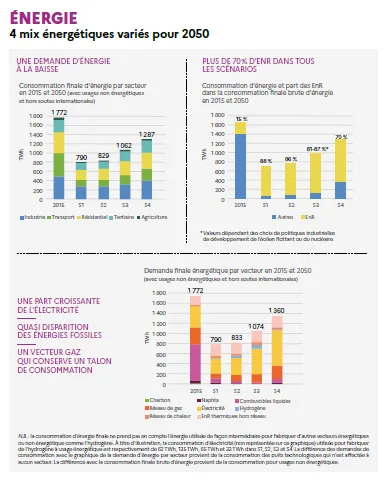
No alt text provided for this image

RTE

No alt text provided for this imageNo alt text provided for this image

NEGAWATT

No alt text provided for this image

THE SHIFT PROJECT

No alt text provided for this image

SFEN

No alt text provided for this image

OTHER SCENARIOS

Some nuclear associations in France work or worked on scenarios with propositions for dozens of EPRs to build by 2050. These being unvalidated by nuclear sector itself, I do not list them.

Comments

  • As can be seen, all scenarios except one (Shift) give at least 50% renewables

  • The minimum renewable scenario corresponds to RTE's N03 scenario. But RTE does not recommend it for climate goals, understandably when introducing "Time" in analysis. Defining a mix for 2050 does not mean picking demand projected for 2050 and arbitrarily assigning percentages by technology. One actually starts from today and models industrial deployment trajectories. Here are key points:

1. No new nuclear plants will be built in France before 2035-2040. So for at least 15 years, only renewables connect to network. This % must be integrated in all analyses.

2. Reactor lifetime is currently uncertain and can only be validated late. Risk must be integrated; can’t manage at last minute since a nuclear plant’s capacity is large and cannot be quickly replaced.

3. Beyond 60-year lifetime is unknown. It involves research and will take at least a decade for an opinion.

4. SMRs (small modular reactors) do not exist today and their outcomes are unknown.

5. We must launch six EPRs ready today. Before starting, nuclear sector must restructure and construction would start in 2028. More (14 EPRs or more) requires feedback on first builds.

Considering these, here is what RTE says:

"N03 scenario requires four conditions: (i) successful extension of most reactors to 60 years, (ii) some extended beyond 60 years (especially if some close at 50), (iii) build and put into service 14 EPR 2 units (8 more than the 'New Nuclear France' program), (iv) deploy 4 GW SMR capacity. Such scenario implies ensuring early feasibility of operation beyond 60 years. Generally it needs R&D effort on nuclear from new reactor design to "closed fuel cycle" tech."

"If technological and R&D challenges seem surmountable in coming decades, '100% renewable' scenarios or those based on long reactor life extensions beyond 60 years require many critical technical prerequisites fulfilled early. Nothing currently guarantees this. Choosing these scenarios now or renouncing technological diversification raises risk of missing neutrality goal by 2050."

  • Risk coverage strategies follow: nuclear uncertainties push accelerating renewables. Renewables uncertainties should also push sobriety. This explains why N03 is very unlikely. N03 risks (SMRs mandatory and lifetime beyond 60) come later. Anticipating risks leads to developing renewables, thus shifting mix away from nuclear.

Shift Project analysis

Given Shift’s particular approach, here is an analysis of its stance.

1. The image shows three versions of Shift’s electricity plan. Two have question marks, one replaces question marks with renewables.

2. Versions with question marks assume nuclear per N03 and the rest is subject to debate. But this is impossible for reasons above: the mix develops over time. Next 15 years only renewables connect. Then industrial trajectories must be produced. At every moment over 30 years, supply/demand must be balanced — key constraint explaining why mix projections need complex tools and information. One cannot arbitrarily assign renewal percentages based on preferences.

3. As noted, N03 implies risk coverage strategies ultimately leading to N03’s non-realization.

4. In the version without question marks replaced by renewables, methodology is detailed in PTEF Evaluation Energy-Climate note online, page 34:

"As mentioned in part I.D.3, we consider a mix more efficient in material consumption and liquid/gaseous energy consumption with more nuclear. We keep nuclear capacity and production per RTE: 50 GW installed for 330 TWh produced.

We also keep RTE’s hydropower: 22 GW for 63 TWh produced.

Conservatively, we hold thermal gas capacity and production from RTE scenario, even if EnR share is lower, ensuring supply security at least as good as RTE's (same level as today).

Finally, we complete mix (180 TWh) with variable renewables proportionally to RTE (~ 1/3 offshore wind, 1/3 onshore wind, 1/3 PV)."

The analysis states nuclear's advantage is apparently limited to current share:

"At around current nuclear share (<70%). Reasoning wouldn’t hold above some share where nuclear becomes less efficient at demand-following than thermal."

I won't critique Shift’s approach here, which would require many remarks, but only its mix production method: again, prorating renewables is impossible because supply-demand balance must hold every year.

Analyzing Shift reveals that solving its problems can anticipate higher renewables share, bringing us back to RTE scenario frame.

Annex 4

Comments on energy transition material risks

Links to documentation:

IFP Generate:

https://www.researchgate.net/project/GENERATE

IEA:

https://www.iea.org/reports/the-role-of-critical-minerals-in-clean-energy-transitions/executive-summary