NetZero Citizen
Home
Transition
Decarbonization
Write to us
NetZero Citizen
My 6 commandments to Degrowth to stop the diffusion of Fossil Fuel propaganda within environmental groups

My 6 commandments to Degrowth to stop the diffusion of Fossil Fuel propaganda within environmental groups

Karim Megherbi

Original source

Introduction and context

Finally I found the time and the right opportunity to write this important article.

Few days ago a Degrowth activist published his works on LinkedIn, a quite extensive report about key degrowth concepts and their potential real life application to the building industry.

His post generated hundreds of likes within his community, whose profiles were fairly diversified.

I read it and realized that 1/ the report is very useful as I've been dying to find a document where all the key misinformation narratives diffused by Degrowth are listed and 2/ it's bad because all the misinformation narratives are in the same document and as the report was warmly welcomed by the author's community the impact may be disastrous.

So why do I call them misinformation narratives and can Degrowth be reduced to these narratives? Let's clarify few ideas and definitions to make sure there won't be any misunderstanding about my intents:

  • Misinformation narratives discussed here are the ones created by the fossil fuel industry to delay our climate actions and generate chaos. They all contain fake or biased analysis and data. It's possible to debunk them using our latest knowledge about the energy transition

  • There is no homogenous degrowth movement: some are somehow fine with capitalism, some want to get rid of it, some focus on the energy implication of degrowth, some are anarchists, some want to decrease our energy and material consumption to the extreme and live in small communities. So please apologize, in this article I'll just use the term Degrowth as if all movements commit these 6 sins, but if you have some remarks it would be great to share your views in the comment section

  • Degrowth is not about the climate or the energy but about the environmental and social pressures of our industrial societies on citizen and our planet, fueled by an insatiable desire to grow. It's a political, economic and social approach of the environment. Unfortunately the movement lacks fundamental knowledge about energy, the energy transition, Net Zero scenarios and the science behind them, which is why it has absorbed misinformation communications from the fossil fuel industry. The good news is that Degrowth can keep its overall narrative without using fossil fuel misinformation: not only it won't impact their objectives, but I believe it will be highly beneficial to their actions

  • Climate change denial in this article refers to the PR strategy of the Fossil Fuel (FF) industry to delay the energy transition. It can take various forms: denying climate change, denying the role of humans in climate change, denying net zero actions...

This article is not a criticism of Degrowth. I simply focus on a very specific point: to justify its conclusion that we need to degrow - whatever it means depending on the source - the movement sometimes uses improper methodologies and even rely on fossil fuel propaganda.

This situation makes numerous climate and energy experts feel frustrated: the very people you would expect to support the energy transition, are diffusing fossil fuel disinformation and conflicts within our societies against our key climate actions.

Some Degrowth followers actively fight AGAINST climate policies as they believe their main purpose is economic growth. Many don't believe in the Net Zero target, perceived as an industrial, capitalist movement and think that our focus should be to reduce our energy consumption. Last but not least, many Degrowth activists diffuse actively the fossil fuel propaganda they learnt from their reference sources as they feel they contribute to a better world through this action.

Not only some fight against the energy transition, but they also place an extra-focus on the few negative impacts of the energy transition - although some of these impacts would materialize only in few decades and can't be compared with today's externalities. They barely mention the impacts of fossil fuel and never give proper orders of magnitude by comparing them to the remaining impacts of a decarbonized world.

Overall, while you can't avoid some misunderstandings between your audience and you, there are also obvious parts in the Degrowth narratives on which the audience can rely to give up on the energy transition and our climate actions. This is what the movement needs to correct urgently and the purpose of this article.

You'll find below 5 sections:

  1. Introduction and context

  2. Our climate and environmental narratives must evolve and answer to citizen's priority concerns

  3. The energy transition is the heart of a long awaited mutation of our industrial world. We must capitalize on its success and "ride the wave"

  4. My 6 commandments to Degrowth

  5. Conclusion: a possible collaboration between energy transition experts and Degrowth around the Net Zero could create a powerful force

I hope that many Degrowth supporters will read this article with a constructive mindset. Please don't hesitate to share a feedback in the comment section of this post, negative or positive both are fine as long as you add a proper analysis ideally with sources and references.

Our climate and environmental narratives must evolve and answer to citizen's priority concerns

As far right movements are getting traction in Europe and Trump is busy destroying the US to somehow protect the O&G demand, it's time for all professionals, experts, researchers and politics who care about the climate to cast aside their disagreements and focus on their numerous common objectives, values and proposals.

The energy transition is a no-brainer: trillions of investments generating massive job opportunities, clean air, more efficiency and less wastes, less impact on the environment, more economic stability as electricity prices can be fixed for 25 - 35 years.

Not only you have great upsides, but the downsides of not doing it are now getting out of control. Climate change will impact our food supply, hundreds of millions of people will leave their homes to relocate somewhere else, access to fresh water will be very challenging in some regions, our infrastructure will need much more maintenance, wild fires and floods will be more frequent...

The direct and indirect externalities of fossil fuel amount already to 7 trillion / y in 2023, which our societies somehow accept to bear - and it's increasing every year. To put this number in perspective: the global Net Profit of the O&G industry is between 2-4 trillion/y, and the entire budget for Europe to have a Net Zero grid including hydrogen and electrification is 5-7 trillion until 2050.

And yet, these two facts - the immense advantages to transit away from fossil fuel and the dead end of a fossil fuel future - how many citizens know about them? How many are able to describe a Net Zero society and a decarbonized energy system?

On the contrary, for many it's easier to explain why the energy transition is not happening (although it's really happening) and why they think fossil fuel are the greatest energies possible and that we won't be able to replace them without great sacrifices.

There are two main reasons for that:

1/ In the wake of the misinformation playbook of the tobacco industry, the O&G sector launched decades ago a global disinformation campaign, increasingly complex and sophisticated as time goes by.

Its goal is to delay any transition away from fossil fuel as well as our climate policies, by manipulating citizen through fake or biased information, stimulating informational chaos, creating fake grassroot and environmental associations, and trying to take control of some civil associations (veterans, students, black, woman, seniors...) to influence the public debate

In the US, more than 100 misinformation think tanks financed by wealthy ultra-conservative, ultra liberal families diffuse fake information about the climate 24/7. They've created a global network of misinformation, Atlas with ties to far right and conservative politics publicly denying climate change as they prioritize the interests of wealthy families against the society's.

In the past 10 years, Koch only has injected more 150m USD in these think tanks. In parallel, some of these billionaires have bought public media with large audience (Fox News in the US, CNews in France) to take control of our information environment

2/ Our communications related to the energy transition were so far mainly addressed to professionals and to institutions and governments to focus on the growth of installations. Citizen have been left behind during this first critical phase which transformed RE from a niche market into the n°1 technology of the energy transition globally

We write reports, papers, publish studies. The vast majority of citizen don't have the time to read them, especially given their repulsive formats for most: anyone who has read the Net Zero scenario of the IEA should understands what I mean.

Communication channels are also no longer the same. In many countries you have social, geographical fractures and different social groups use different channels (podcast, You tube channels, talk show...). The institutional information is often regarded with suspicion.

Topics also should be adapted: for many, their daily concerned is their family, their job, their wallet, their security. So they want to know what answers the energy transition has for them, and are less concerned by the emissions

-> the energy transition has now reached another milestone and must evolve to reconnect with citizen. With the publication of the NZE road map by the IEA in 2021, our world went from having a Climate issue to a Net Zero issue. We've entered into the Net Zero era and we need to give to the citizen all the necessary tools to embark in this journey

The energy transition is the heart of a long awaited mutation of our industrial world. We must capitalize on its success and "ride the wave"

The main reason why our world has finally decided to tackle the climate challenge is our capacity to produce, thanks to renewable, super cheap electricity which then can be used to electrify our energy systems.

All Net Zero scenarios around the world are today very similar, with 4 core groups of actions:

  1. Reducing our energy and material demand and footprint

  2. Electrification

  3. RE

  4. Biomass, synthetic fuel and gas, and oil for petrochemicals*

If you want to add the other key planetary boundaries in the Net Zero trajectories, you mainly need to add the transformation of our agriculture: the way we produce our food is responsible for most of the overshoot (soil and water pollution, biodiversity, deforestation..)

Today 95% of ALL power plants newly connected in the world are renewable! Many citizen don't realized that our world is being filled continuously with renewable, as it works well and is cheap.

The international framework where countries discuss regulations, strategies, and financial support, is called the COP. Each year, countries are to send their updated NDC, ie report which explains how they will reach Net Zero. You also have the G20, and the Energy Minister conferences.

Most countries in the world work on their NDC, although the level of details depends on its human and financial resources, and if they are in Annex 1 or Annex 2. They also work on their policies, laws and regulatory frameworks to translate these action plans into real actions. In the end, the energy transition is an unprecedent change of our laws.

Millions of people around the world work everyday to make the energy transition progress. Researchers, industrials, financial institutions, international agencies, national administrations. There's a very large, organized network whose aim is to get rid of fossil fuel as fast as possible and reach a Net Zero situation.

Decades of climate fights led to today's acknowledgment of the Net Zero (NZE) target. This concept took off and was able to mobilize everyone on this planet. Thanks to that environmental issues can get more attention today: as we're going to spend trillions and mobilize lots of human resources, and as all sectors have to evolve, we can definitely add elements here and there.

Is it perfect? far from it.

As we have now most of the technologies required to reach Net Zero within few decades, the energy transition became a social negotiation whose aim is to transform our regulatory framework. [Take note of this key analysis as we will use it in different sections of the article].

This is exactly why Project 2025 emerged in the US: Joe Biden did a fantastic job with the IRA, and he put the US on a climate trajectory which certainly could have been more aggressive, but was already the best compromise possible with the conservative parties. Beneficial to the climate, the environment, the citizen, the industry... but not for the fossil fuel industry which decided to counter attack with Project 2025, published by the Heritage Foundation, a top 5 US misinformation think tank financed by the fossil fuel industry and rich ultra-conservative figures. The goal: destruct as many social and environmental protections as possible, while making misinformation mainstream and banning science.

The example of the US shows how important is our social organization to pass and implement the right policies. And why misinformation directed toward citizen is a key strategy of the FF conservative groups.

They use the same narratives everywhere in the world. It's simple. It's easy to remember. It's diffused by numerous groups and channels across our societies. It's well financed.

If we want to fight against that, people pushing for the climate and the Net Zero should also organized themselves in global communication networks and harmonize their narratives. The more citizen are divided, the less power their voices have, especially in comparison with the lobbies.

-> Net Zero is the goal the humanity has set for 2050-2070 and it mobilizes a gigantic amount of financial and human resources. After decades of fight for the climate, this is a major success which we need to cherish and protect, while progressing further on our trajectories. People in favor of the environment should not complain that humanity has decided to collaborate around the Net Zero but rather integrate this network, provide additional expertise and contribute to transform/improve our scenarios

My 6 commandments to Degrowth

The 2 precedent sections described the way many people involved in the energy transition and climate negotiations see the world. Although some of the points seem obvious, it's still possible to have a discussion about it and share different ideas.

Still, it was important to explain this context for you to better understand why we should NEVER diffuse FF disinformation - whatever the reasons you have, it's always wrong - and why we should protect dearly the energy transition, despite all the justified criticisms we can have and which should lead to concrete proposals and corrective actions. Remember that we're all learning and that we have time to correct our mistakes.

For example, EV won't magically replace ALL existing ICE vehicles in one night. So we can at the same time grow exponentially the sales AND fighting for more environmental friendly models and review the whole transportation strategy.

You need to picture the energy transition as a process which will last few decades, during which all actors will see their negotiation positions evolve. Imagine the leverage we can get by already decreasing simply by 40% our emissions.

This section is different from the 2 precedent and is the real meat of this article: we'll identify several conceptual sins often present in the Degrowth narratives and propose the corrections. All the material below are taken from the Degrowth report Reduction Roadmap shared in Introduction.

Let's do it!

1. Never take world aggregated numbers to conduct analysis on raw material, energy and emissions. Don't oversimplify situations and explain the specific dynamics for each topic (energy, raw material, emissions)

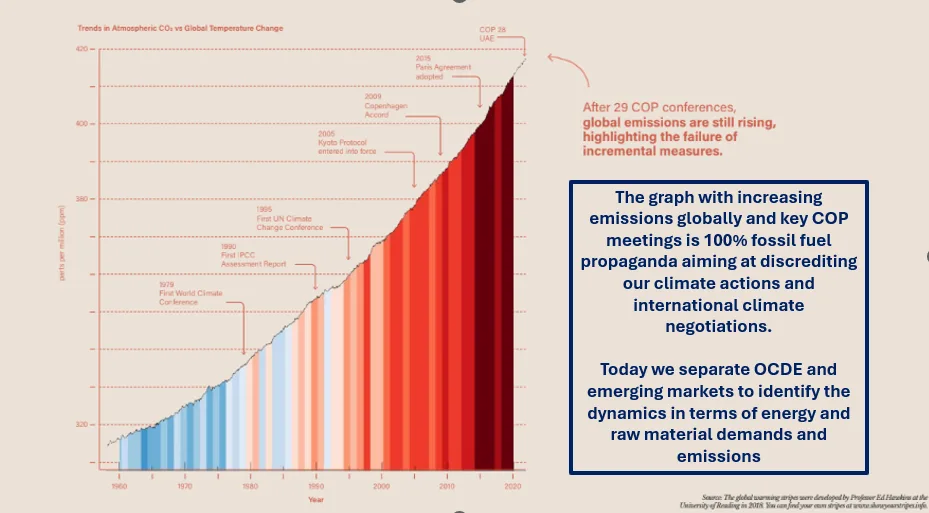
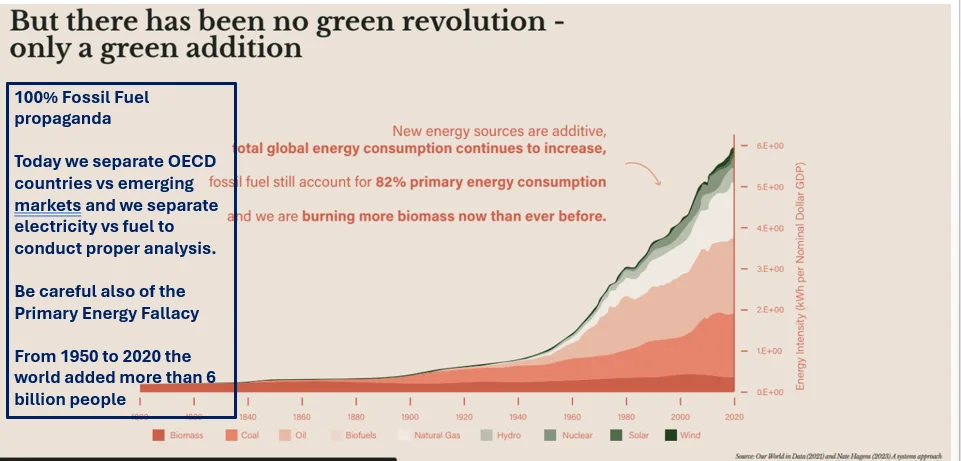
Below you'll find 3 very classic climate change denial narratives:

👉 Emissions keep increasing despite COP and climate actions

👉 There has never been historically any transition and all energies are simply piling up

👉 Controlling the demand should be a condition to develop renewable: without this condition they don't replace fossil fuel and will increase environmental pressure
Contenu de l’articleContenu de l’articleContenu de l’article

To correct these three biased analysis, you need to use the following methodologies:

  • Separate countries into 2 groups: emerging markets and OCDE countries.

The economy and demography of the first group are still growing, some countries even at an insane rate: China for example grew twice bigger twice faster in the last 15 years than Europe during the great acceleration. India 1.5x.

In the process they absorb significant amounts of energy and raw material. As the process of urbanization is still on-going in India, if the country continues its trend 2/3 of the building in Indian cities by 2040 are yet to be built.

They don't over consumed: together they're close to 3 billion people, and their energy use/capita remains below European level - India's level even way below.

Meanwhile, the 2nd group of countries no longer really grows. Our energy and raw material consumptions are actually decreasing. We're now saturated with infrastructure and there's a limit to the number of cars one family can buy

-> While it's important to see the aggregated global emissions to understand where we're going as this is what matters for the climate, the numbers hide two very different dynamics and different types of challenges from 2 groups of countries. And China by itself creates global trends. Ex: 70% of the global coal demand is located in India and China. 50% of steel produced globally go to China.

  • Separate energy into 2 categories: fuel and electricity

Going to Net Zero means that our energy mix will go from 20/80 (electricity/fuel) to 55/45. Electricity will be produced mainly by renewable, and fuel will be different forms of biomass, oil for petrochemicals and synthetic gas/fuel.

Now follow me in this set of technical explanations:

🔹 Renewables produce electricity. If you install them today in OECD you will decarbonize the existing electricity systems as the demand is not growing. However, in emerging markets, you will mostly absorb all or a portion of the growth of the power demand

🔹 To replace fossil fuel in the fuel section, you need to electrify combustion processes. Simply this action will drastically reduce our primary energy, as electricity is much more efficient than combustion processes.

🔹 To electrify you need a cheap way to produce electricity with minimum environmental impacts. Renewables are today the only candidates (solar and wind), and only since 2021 (when LCOE really became very competitive), and not yet everywhere. In fact we're still at the beginning of our transition, so let's not get stuck.

🔹Net Zero relies on numerous strategies to decrease our energy and material demand and footprint but much work needs to be done on this field. What's more, there is a lack of political commitment to prioritize these recommendations: this is where Degrowth can help.

-> When you understand these dynamics then you realize that there is almost no situation in which a country can justify to slow down the development of renewables, unless for example they did not anticipate correctly the grid needs or have difficulties to finance them, or have to correct some flaws in their regulation, or don't have the money to electrify as costs can go up to several billions for a single large steel factory. Then you need to find solutions to unlock the NZE trajectories

  • Never ever forget that the energy transition is a social negotiation. It cannot happen by itself, we need to force its speed by transforming our regulatory frameworks

Numerous Degrowth publications in scientific journals use the same methodology to show that decoupling is not possible: they look at historical data - the greatest minds will start in the Middle Age - and for the future they take the recent trends. Then they take macro-economic projections of PIB for the future

Why these papers pass the screening process and get published is a complete mystery to me. At least this shows that not all papers appearing in peer review scientific journals can be considered as science. It's similar to publish a report about the Egyptian pyramids proving that they didn't use any computer and AI for the blueprint.

There are 3 mistakes in this methodology:

1/ as explained before only through regulations can you replace fossil fuel, especially since we've disconnected their production costs from their environmental and climate impacts, de facto heavily subsidizing these energies

-> as an historian, if you want to help, you need to look for such regulations in the past, or explore other sectors than energy to see if such transformations happened - like when we abolish slavery

2/ It's the same for future projections: they're based on whether or not we continue, improve, or liked Trump destroyed our climate policies. Some of the green sectors see exponential growth and are not linear. You have there a concrete example with the analysis by Carbon Brief of the potential consequences of a new mandate of D. Trump.

3/ On PIB you need to factor the trillions of investments we will inject into our societies to achieve our energy transition.

-> the decoupling is a useless academic debate: today we need to lay out Net Zero plans, implement them, and monitor their impacts on our economies and environment to recalibrate them if need be

In conclusion:

-> international climate negotiations participates in the global diffusion of the energy transition and the best practices. It also provides a framework to work on NDCs, follow up our progress and compare our actions to others. It also gives ideas to governments by exchanges with everyone

-> when you understand that the energy transition is a social negotiation, then you already know that there is no sign of it in our past. Never in mankind's history did we try to entirely replace our energy system

-> conditioning the deployment of RE to [put here whatever you want here, Bjorn Dumborg for example claims that we need further R&D, others more improvements in battery storage, degrowth says better policies to regulate our demand] is a typical misinformation strategy used by the fossil fuel industry to delay our climate actions. The condition proposed depends on the profile of the social group targeted: it must be something they see as a top 5 priorities

2. Remain factual. Stop being pessimistic. Stop inflating the challenges - it's already bad enough. Don't make 30y previsions unless you're a direct descendant of Nostradamus

See below 2 usual narratives which are very counter-productive at a time when we should all assemble and fight:

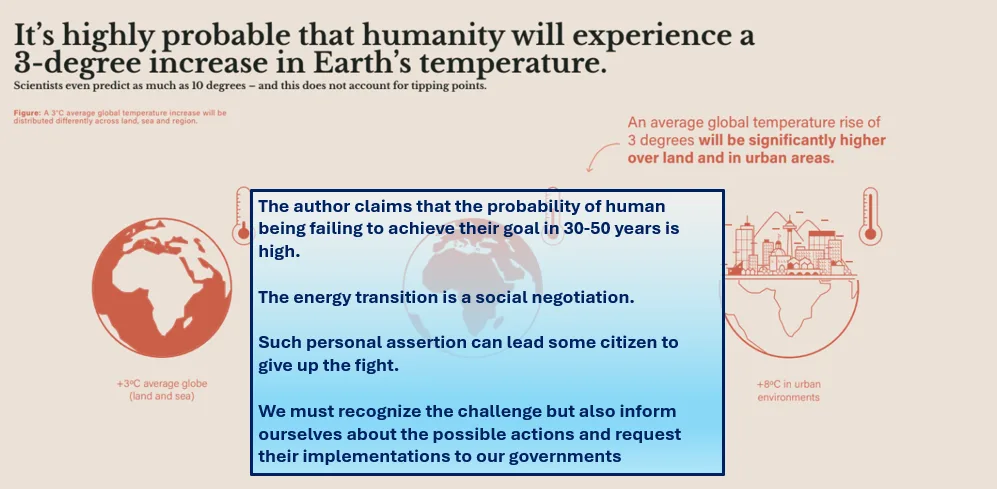
👉 We're heading towards the end of the world

👉 It's highly probably that all our climate actions will fail

Contenu de l’articleContenu de l’article

Here this section is self explanatory I believe.

The last Emission Gap Report was indeed very disappointing and we could potentially head towards +3oC IF we implement our climate policies, which the US for example won't do.

But we're still 25y away from our objectives in OECD, a lot can happen and we need to keep fighting. Remember: the energy transition is a social negotiation to transform our regulatory framework!

Regarding the mistakes in the projection, the author did not cancel the impact of the recent energy crisis and took historical emission decreases instead of projecting new policies.

3. Never discredit climate actions to promote your narrative, especially when your supportive analysis is wrong. Don't dilute our climate actions within a infinite list of topics.

Degrowth is frequently diffusing 2 analysis to differentiate themselves from other researchers:

👉 Our vision of the climate challenge is limited as our minds are imprisoned in a carbon tunnel

👉 The climate is a tiny problem and only one of the numerous symptoms of a much complex challenge which includes absolutely all problems humanity is facing on this planet, from the hives of your cat to the conflict between India and Pakistan

Contenu de l’articleContenu de l’article

▪️The first narrative comes from Jan Konietzko, Manager of sustainability services at Cognizant, a consultancy firms which helps companies to adapt their business models to our new environment (climate change + Net Zero policies) by transforming their processes and capitalizing on available new technologies. The carbon tunnel is the pitch he used with his clients to explain why they should have a broader vision than simply their emissions.

Frankly I very much like the pitch, I find it very powerful, but then it was diffused everywhere and progressively the message and its uses evolve. Now degrowth activists are using it to discredit the work on Net Zero scenarios, thinking that the millions of professionals and researchers did not realize that different crisis and topics are connected.

While the narrative is correct when you pitch a CEO of a company as a sustainable consultant, it becomes very wrong when addressed to people working on Net Zero scenarios. In fact it even shows a deep misunderstanding of the necessary actions to build a Net Zero world:

-> capitalism must be regulated

-> forest, mangroves and similar carbon sinks must be preserved and revitalized

-> we need to better handle our wastes (collection, recycling, storage)

-> we need to collect products at their end of life and drastically increase the recycling rates

-> tax regimes must change as the richest consumes more, emit more, and can potentially afford extra costs

-> financing the energy transition can make us review our whole finance system, including banks and central banks and the role of our money

-> we probably need to transform the way our democracies are organized as we're way to weak to protect ourselves against misinformation. That also includes equity, social measures

The list is long and I could continue.

In no way reaching Net Zero will be an easy walk. We won't get there without deep transformative actions - which are feasible and have great positive impacts to our societies, but again we have to negotiate with the parties who don't want to change - if we don't, then they'll retaliate by pushing far right parties or you'll get a Project 2025

▪️ The second analysis is called the polycrisis. It became a scientific subject and I do have some very smart friends working in it. However, it's almost always badly used by Degrowth activists: the main objectives of the Polycrisis are to improve our Net Zero scenarios, their resilience and their acceptability. Some of the findings might even contribute to the social negotiation. So these research are not conducted to downplay the climate crisis or suggest that we should not follow Net Zero trajectories.

The risk of this narrative if misused is to generate an extreme confusion: you no longer know what to do, and your actions might become too indirect to really have effects on the climate. The n°1 direct cause by far of climate change is the combustion of fossil fuel to produce our energy and whatever angle you take that won't change. You need to transform entirely your energy system, whatever future society you would like to build.

Some narratives include also the necessity to change our relationship to our environment and take psychological approaches. While they can have very positive impacts and all possible strategies must be deployed, we need also to cknowledge the diversity of values and cultures, even within one country, so be careful of too radical, exclusive speeches.

4. Explain the real scientific causes of why we're transgressing the planetary boundaries. Never discredit climate action (again). Read Net Zero Scenarios and understand their impacts on the planetary boundaries. Never use climate change denial propaganda. Make reference to net Zero Scenarios and IPBES work - your solution (either imaginary like here or relevant) will most likely complement these works, not replace them

  • The fossil fuel industry today invests heavily on specific propaganda targeting environmental groups and on anti-NZE narratives:

👉 climate change is not a major challenge, there are others which deserve more attention

👉 fixing climate change will destroy the environment so it's useless

👉 Net Zero should not be our priority. It's also impossible to reach this target within the time framework. It's not even desirable

👉 Instead of Net Zero, we should rather [put here anything you want which would act as a distraction]

  • See below the narrative we find in the Degrowth report 👇🏼It certainly could have been written by Exxon Mobile.

Contenu de l’articleContenu de l’articleContenu de l’article

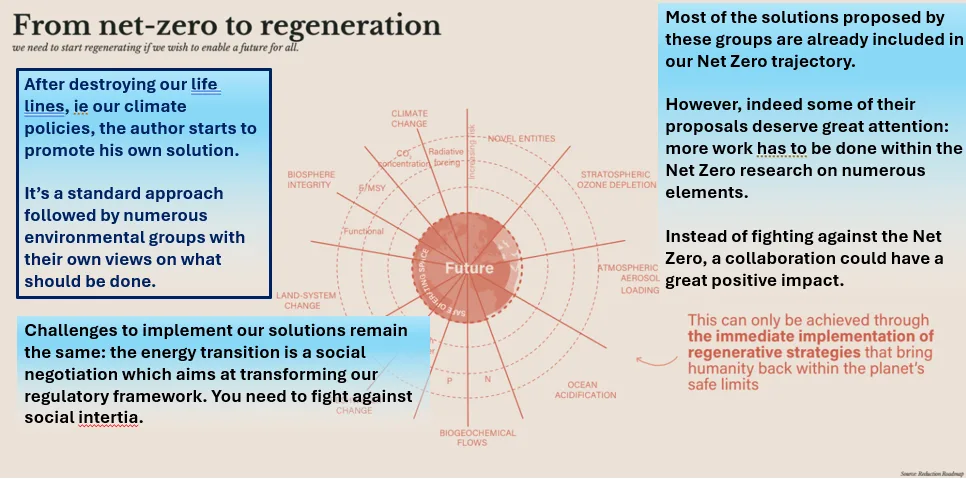
One of the strategies of the fossil fuel industry is to divert our attention from the climate crisis towards other crisis, like plastic pollution. They even create fake environmental associations, which will focus on everything but the climate, while diffusing from time to time climate denial narratives (ie: human are not responsible) and anti-RE propaganda. Like The Blue Ocean Program

Another of their key strategies is to discredit the Net Zero objective: it's useless, it cannot be achieved, it's costly, it will bring back the deads which will eat our brains...

Here you'll find 6 suggestions to fight against these strategies

▪️Climate change is the symptom of us burning fossil fuel to produce our energy. Any other claim is a dangerous distraction

▪️I've already explained that to deal with the climate crisis you need numerous, various actions. Implementing them is probably one of the greatest challenge ever faced by mankind. We need to relentlessly inform citizen about it and adapt the formats and channels to the audience

▪️As for the planetary boundaries, you need to be more specific about the main causes. Degrowth tells you that the source is capitalism, or growth, or over-consumption. But that is not a scientific narrative supported by anyone familiar with these concepts. The No1 cause is agriculture and fishery: 40% of all surfaces on Earth are dedicated to agriculture - we've destroyed half of the world to produce our food, and continue to do so like in Brazil. Pesticides are n°1 cause of the death of bees, n°1 cause of water pollution. The sector consumes 70% of all fresh water takings globally. Fishery is the n°1 cause of biodiversity losses in the ocean. And soon the climate is catching up as an increasing major cause

▪️While there are connections between all these crisis, the climate crisis has its own specificity: it cannot be addressed simply by local regulations and the list of actions is complex and very large, impacting all sectors of our economies and daily lives. This is why it's possible to insert sub-objectives in our Net Zero scenarios, but the contrary is not possible - let alone the question of the international support from which the Net Zero benefits

▪️Net Zero is a result of climate science, WGAR1. It's the unavoidable consequence of our remaining carbon budgets: depending on the maximum increase of the average temperature you set as a cap and the associated error margin expressed in probability, then you need to stop your emissions within a certain period of time. This is the reason while all countries in the world must set a Net Zero target and a time limit.

▪️The report suggests to drop the Net Zero ambitions and replace them by regenerative strategies - which is actually a Net Zero scenario dealing with agriculture and tighter environmental goals, but without any content... The general impression is that the urgency and the complexity of climate change and net zero are not well understood: more communications are needed about our Net Zero trajectories and the science behind them

5. Use appropriate methodologies to conduct complex analysis

One of the disinformation strategies of the fossil fuel industry is to explain that our world will crumble without fossil fuels. They use different approaches to convince us:

👉 GDP is linked to energy

👉 Energy = fossil fuel: nothing can replace them, all alternatives have been tried since the beginning of our industrial world and they didn't work, only nuclear can pass this test (the fossil fuel industry and conservative parties push for nuclear as its potential is limited and it will come anyway in decades so they can pretend they do something to clean the energy mix while selling fossil fuels like there's no tomorrow)

👉 Yes we impact our world as we consume energy but this is the unavoidable consequence of human development: if you want less impact then you need to live like in the middle age

See below a graph which perfectly supports this narrative:

Contenu de l’article

Degrowth is unfortunately playing in the middle of this conceptual field laid out by the fossil fuel industry, which I call "oil fetichism". Famous spokesmen of the Degrowth movement, like Dennis Meadows, fell for this narrative and have given all hopes to find a solution to the climate crisis.

This narrative is at the center today of large misinformation campaigns, like the one led by Alex Eipsten. It's therefore of the utmost importance to identify its flaws and diffuse largely today's knowledge about this question.

  • There is a correlation between GDP and exergy, not primary energy!

Be careful of the primary energy fallacy: a fossil fuel energy system wastes 2/3 of the energy we inject in our society in useless heat. Today everyone on this planet MUST know and understand the graph below:

Contenu de l’article
  • Above a certain level of energy/capita then the situations between countries are very much distributed and depends on their social/industrial organizations

Contenu de l’article
  • No one has set the goal to decorrelate raw material consumption from growth as it's impossible. However we absolutely need to optimize our material footprint as mush as we can: it's impossible to reach Net Zero without such strategies. Again, we need to look at the numbers, trends, causes, sectors to design specific strategies and avoid falling for misinformation tricks. For example, the construction industry is by far the n°1 consumer of raw material (50%). Which means 50% of all the raw material we consume are linked to our needs of building and infrastructure, and the way we build it. Then you need to go deeper in the other 50%, to see exactly where and how much you can save, by designing specific strategies. you can't simply say "we need to lower our production of x or y" simply because reducing a consumption will reduce the environmental impacts of our societies.

  • Contrary to raw material, our objective is to make emissions DISAPPEAR. If you believe that the correlation between GDP-Emissions cannot be changed by switching to clean energy, like Dennis Meadows, then you will lose all hopes to save humanity - and these are the exact words pronounced by Jason Hickel during the conference "Degrowth vs Green Growth"

Degrowth calling for dropping the GDP reference is right, but for some reasons it puts it back to analyze the decoupling. What's more, it sets specific conditions to validate the possibility to decouple: it should be global, and allow us to reach our Net Zero target. Which means basically we should succeed in our energy transition to validate this possibility...

But that won't happen this way: different countries are at different development stages, GDP will be influenced by different factors. Again, we can see that the methodology proposed includes numerous conceptual mistakes which can only support the fossil fuel propaganda. It does not serve the real objective: alerting about the impact of growth and trigger a healthy discussion about how we use our energy.

The world we're living in is full of wastes and some benefit from it. Think about the oil and gas industry: we waste the 2/3 of the O&G products we buy, and we pay more that twice the net results of the sector in externalities. It's an insane situation, which has created giga-billionaires like the Koch brothers. No wonder they fight like crazy to keep this situation going on as much as they can, and they have large resources to invest in all possible delay strategies.

In conclusion:

  • The gap between the reality and the fossil fuel propaganda is getting wider and wider: very large capacities of renewables are added every day in our systems globally. They work fine and produce cheap electricity. Now we need to go to next phase of the energy transition: electrify our systems and optimize each pieces, on the demand and supply sides, while continuing to installing renewable

  • Degrowth is not helping at all by diffusing misleading conceptual frameworks coming straight from the fossil fuel industry. However, one of its the key messages "we need to think about how we use our energy as growth has various impacts" is worth spreading, so they need to find the right framework to diffuse it. Going deeper into Net Zero research could help the movement -> again, a collaboration makes more sense than a conflict.

6. Don't share climate change denial misinformation (please, really, don't do that)

The fossil fuel industry is trying to convince us that the energy transition won't change anything on the impacts we have on our planet - in fact it could even get worth. For that they have designed several narratives

👉 The energy transition requires an enormous amount of raw material which means extractive activities will grow drastically and so their impacts: biodiversity, water, people... And we will still be dependent on export countries

👉 Solar panels need space and will occupy the fields where we're supposed to grow our food so we'll die from hunger. They create heat which destroys the soil and the biodiversity. They reflect the light and can bling pilots and create aircraft accidents (they might even be responsible for the 9/11). Wind farms are bio-diversity killing machines: worms, whales, bats, birds, even humans, cows... no one can escape from their Warth

See below the graph in line with this misinformation campaign:

Contenu de l’article

Honestly, do we still need to debunk again and again this propaganda?

Well, Degrowth reminds us that yes, we need to, since even groups who care about our planet will fall for these tricks.

However, the fact that it's still there, means that we don't use the right communication channels and the right formats. In fact we don't reach the very people that needs the most to hear the correct information. Many of us don't have the time to verify the information we receive, to use various sources to crosscheck the information, and behave passively in front of the information: we simply take what comes to us as long as we feel some connection with the sources.

So rather than complaining and keeping doing the same things, we may need to acknowledge the lack of efficiency of our communication strategies and find new, creative ways to address this challenge.

As for this graph:

The methodology used - taking the raw material to build the plants and ignoring the GT of fossil fuels which are then necessary to produce power in case of FF generators - is directly taken from misinformation sources like Mark P. Mills from the Manhattan Institute. No one today is using such method, as the gap between the numbers is really insane. See below

Contenu de l’article

What's more, although there are challenges (collection, co-existence of various industrial norms, changing designs), raw material can be recycled, and recycling activities can be relocalized outside of export countries.

About land and biodiversity, you'll find plenty of information on the Internet. Ex:

I don't want to over-simplified the raw material issue, and the article is already very long, so here you'll find good information:

https://www.irena.org/Digital-Report/Geopolitics-of-the-Energy-Transition-Critical-Materials

https://www.iea.org/reports/global-critical-minerals-outlook-2024

https://www.energy-transitions.org/publications/material-and-resource-energy-transition/

https://www.ifpenergiesnouvelles.com/brief/raw-materials-markets-heart-energy-challenges

Conclusion: a possible collaboration between energy transition experts and Degrowth around the Net Zero could create a powerful force

Degrowth diffuses some important messages that we all need to be reminded and which can influence positively the society as a whole and energy transition, climate professionals and researchers:

  • watch out of energy and material consumptions

  • think about what really matters to the societies and prioritize the basic needs

  • inequities have reached an insane level and we won't be able to build our future society in such a imbalanced context

However, to diffuse these ideas Degrowth uses a lot of inappropriate methodologies and conceptual frameworks directly issued from fossil fuel propaganda. They also cut themselves from the Net Zero and climate negotiations.

In doing so, Degrowth participates in diffusing misinformation in our societies and environmental circles. It diverts citizen's potential engagement from existing, impactful actions and offers "something else" which in the end comes down to Net Zero trajectories with way less substance and numerous fundamental gaps and flaws.

At the same time, the emissions globally are still increasing and some governments can no longer hide the social fractures our economic and social organizations have created. Our weaknesses are now used by groups which want to take control of them for their own benefits while protecting historical positions. So we need to find ways to avoid such meaningless conflicts between people who share similar values and objectives.

Our world has reached a new stage in the climate war. We now have the solutions, but the implementation relies on a complex social negotiations, for which our existing democratic organization may not be adapted.

We need to create healthy spaces for discussions and be ready to accept some compromises.

Introduction and context

Finally I found the time and the right opportunity to write this important article.

Few days ago a Degrowth activist published his works on LinkedIn, a quite extensive report about key degrowth concepts and their potential real life application to the building industry.

His post generated hundreds of likes within his community, whose profiles were fairly diversified.

I read it and realized that 1/ the report is very useful as I've been dying to find a document where all the key misinformation narratives diffused by Degrowth are listed and 2/ it's bad because all the misinformation narratives are in the same document and as the report was warmly welcomed by the author's community the impact may be disastrous.

So why do I call them misinformation narratives and can Degrowth be reduced to these narratives? Let's clarify few ideas and definitions to make sure there won't be any misunderstanding about my intents:

  • Misinformation narratives discussed here are the ones created by the fossil fuel industry to delay our climate actions and generate chaos. They all contain fake or biased analysis and data. It's possible to debunk them using our latest knowledge about the energy transition

  • There is no homogenous degrowth movement: some are somehow fine with capitalism, some want to get rid of it, some focus on the energy implication of degrowth, some are anarchists, some want to decrease our energy and material consumption to the extreme and live in small communities. So please apologize, in this article I'll just use the term Degrowth as if all movements commit these 6 sins, but if you have some remarks it would be great to share your views in the comment section

  • Degrowth is not about the climate or the energy but about the environmental and social pressures of our industrial societies on citizen and our planet, fueled by an insatiable desire to grow. It's a political, economic and social approach of the environment. Unfortunately the movement lacks fundamental knowledge about energy, the energy transition, Net Zero scenarios and the science behind them, which is why it has absorbed misinformation communications from the fossil fuel industry. The good news is that Degrowth can keep its overall narrative without using fossil fuel misinformation: not only it won't impact their objectives, but I believe it will be highly beneficial to their actions

  • Climate change denial in this article refers to the PR strategy of the Fossil Fuel (FF) industry to delay the energy transition. It can take various forms: denying climate change, denying the role of humans in climate change, denying net zero actions...

This article is not a criticism of Degrowth. I simply focus on a very specific point: to justify its conclusion that we need to degrow - whatever it means depending on the source - the movement sometimes uses improper methodologies and even rely on fossil fuel propaganda.

This situation makes numerous climate and energy experts feel frustrated: the very people you would expect to support the energy transition, are diffusing fossil fuel disinformation and conflicts within our societies against our key climate actions.

Some Degrowth followers actively fight AGAINST climate policies as they believe their main purpose is economic growth. Many don't believe in the Net Zero target, perceived as an industrial, capitalist movement and think that our focus should be to reduce our energy consumption. Last but not least, many Degrowth activists diffuse actively the fossil fuel propaganda they learnt from their reference sources as they feel they contribute to a better world through this action.

Not only some fight against the energy transition, but they also place an extra-focus on the few negative impacts of the energy transition - although some of these impacts would materialize only in few decades and can't be compared with today's externalities. They barely mention the impacts of fossil fuel and never give proper orders of magnitude by comparing them to the remaining impacts of a decarbonized world.

Overall, while you can't avoid some misunderstandings between your audience and you, there are also obvious parts in the Degrowth narratives on which the audience can rely to give up on the energy transition and our climate actions. This is what the movement needs to correct urgently and the purpose of this article.

You'll find below 5 sections:

  1. Introduction and context

  2. Our climate and environmental narratives must evolve and answer to citizen's priority concerns

  3. The energy transition is the heart of a long awaited mutation of our industrial world. We must capitalize on its success and "ride the wave"

  4. My 6 commandments to Degrowth

  5. Conclusion: a possible collaboration between energy transition experts and Degrowth around the Net Zero could create a powerful force

I hope that many Degrowth supporters will read this article with a constructive mindset. Please don't hesitate to share a feedback in the comment section of this post, negative or positive both are fine as long as you add a proper analysis ideally with sources and references.

Our climate and environmental narratives must evolve and answer to citizen's priority concerns

As far right movements are getting traction in Europe and Trump is busy destroying the US to somehow protect the O&G demand, it's time for all professionals, experts, researchers and politics who care about the climate to cast aside their disagreements and focus on their numerous common objectives, values and proposals.

The energy transition is a no-brainer: trillions of investments generating massive job opportunities, clean air, more efficiency and less wastes, less impact on the environment, more economic stability as electricity prices can be fixed for 25 - 35 years.

Not only you have great upsides, but the downsides of not doing it are now getting out of control. Climate change will impact our food supply, hundreds of millions of people will leave their homes to relocate somewhere else, access to fresh water will be very challenging in some regions, our infrastructure will need much more maintenance, wild fires and floods will be more frequent...

The direct and indirect externalities of fossil fuel amount already to 7 trillion / y in 2023, which our societies somehow accept to bear - and it's increasing every year. To put this number in perspective: the global Net Profit of the O&G industry is between 2-4 trillion/y, and the entire budget for Europe to have a Net Zero grid including hydrogen and electrification is 5-7 trillion until 2050.

And yet, these two facts - the immense advantages to transit away from fossil fuel and the dead end of a fossil fuel future - how many citizens know about them? How many are able to describe a Net Zero society and a decarbonized energy system?

On the contrary, for many it's easier to explain why the energy transition is not happening (although it's really happening) and why they think fossil fuel are the greatest energies possible and that we won't be able to replace them without great sacrifices.

There are two main reasons for that:

1/ In the wake of the misinformation playbook of the tobacco industry, the O&G sector launched decades ago a global disinformation campaign, increasingly complex and sophisticated as time goes by.

Its goal is to delay any transition away from fossil fuel as well as our climate policies, by manipulating citizen through fake or biased information, stimulating informational chaos, creating fake grassroot and environmental associations, and trying to take control of some civil associations (veterans, students, black, woman, seniors...) to influence the public debate

In the US, more than 100 misinformation think tanks financed by wealthy ultra-conservative, ultra liberal families diffuse fake information about the climate 24/7. They've created a global network of misinformation, Atlas with ties to far right and conservative politics publicly denying climate change as they prioritize the interests of wealthy families against the society's.

In the past 10 years, Koch only has injected more 150m USD in these think tanks. In parallel, some of these billionaires have bought public media with large audience (Fox News in the US, CNews in France) to take control of our information environment

2/ Our communications related to the energy transition were so far mainly addressed to professionals and to institutions and governments to focus on the growth of installations. Citizen have been left behind during this first critical phase which transformed RE from a niche market into the n°1 technology of the energy transition globally

We write reports, papers, publish studies. The vast majority of citizen don't have the time to read them, especially given their repulsive formats for most: anyone who has read the Net Zero scenario of the IEA should understands what I mean.

Communication channels are also no longer the same. In many countries you have social, geographical fractures and different social groups use different channels (podcast, You tube channels, talk show...). The institutional information is often regarded with suspicion.

Topics also should be adapted: for many, their daily concerned is their family, their job, their wallet, their security. So they want to know what answers the energy transition has for them, and are less concerned by the emissions

-> the energy transition has now reached another milestone and must evolve to reconnect with citizen. With the publication of the NZE road map by the IEA in 2021, our world went from having a Climate issue to a Net Zero issue. We've entered into the Net Zero era and we need to give to the citizen all the necessary tools to embark in this journey

The energy transition is the heart of a long awaited mutation of our industrial world. We must capitalize on its success and "ride the wave"

The main reason why our world has finally decided to tackle the climate challenge is our capacity to produce, thanks to renewable, super cheap electricity which then can be used to electrify our energy systems.

All Net Zero scenarios around the world are today very similar, with 4 core groups of actions:

  1. Reducing our energy and material demand and footprint

  2. Electrification

  3. RE

  4. Biomass, synthetic fuel and gas, and oil for petrochemicals*

If you want to add the other key planetary boundaries in the Net Zero trajectories, you mainly need to add the transformation of our agriculture: the way we produce our food is responsible for most of the overshoot (soil and water pollution, biodiversity, deforestation..)

Today 95% of ALL power plants newly connected in the world are renewable! Many citizen don't realized that our world is being filled continuously with renewable, as it works well and is cheap.

The international framework where countries discuss regulations, strategies, and financial support, is called the COP. Each year, countries are to send their updated NDC, ie report which explains how they will reach Net Zero. You also have the G20, and the Energy Minister conferences.

Most countries in the world work on their NDC, although the level of details depends on its human and financial resources, and if they are in Annex 1 or Annex 2. They also work on their policies, laws and regulatory frameworks to translate these action plans into real actions. In the end, the energy transition is an unprecedent change of our laws.

Millions of people around the world work everyday to make the energy transition progress. Researchers, industrials, financial institutions, international agencies, national administrations. There's a very large, organized network whose aim is to get rid of fossil fuel as fast as possible and reach a Net Zero situation.

Decades of climate fights led to today's acknowledgment of the Net Zero (NZE) target. This concept took off and was able to mobilize everyone on this planet. Thanks to that environmental issues can get more attention today: as we're going to spend trillions and mobilize lots of human resources, and as all sectors have to evolve, we can definitely add elements here and there.

Is it perfect? far from it.

As we have now most of the technologies required to reach Net Zero within few decades, the energy transition became a social negotiation whose aim is to transform our regulatory framework. [Take note of this key analysis as we will use it in different sections of the article].

This is exactly why Project 2025 emerged in the US: Joe Biden did a fantastic job with the IRA, and he put the US on a climate trajectory which certainly could have been more aggressive, but was already the best compromise possible with the conservative parties. Beneficial to the climate, the environment, the citizen, the industry... but not for the fossil fuel industry which decided to counter attack with Project 2025, published by the Heritage Foundation, a top 5 US misinformation think tank financed by the fossil fuel industry and rich ultra-conservative figures. The goal: destruct as many social and environmental protections as possible, while making misinformation mainstream and banning science.

The example of the US shows how important is our social organization to pass and implement the right policies. And why misinformation directed toward citizen is a key strategy of the FF conservative groups.

They use the same narratives everywhere in the world. It's simple. It's easy to remember. It's diffused by numerous groups and channels across our societies. It's well financed.

If we want to fight against that, people pushing for the climate and the Net Zero should also organized themselves in global communication networks and harmonize their narratives. The more citizen are divided, the less power their voices have, especially in comparison with the lobbies.

-> Net Zero is the goal the humanity has set for 2050-2070 and it mobilizes a gigantic amount of financial and human resources. After decades of fight for the climate, this is a major success which we need to cherish and protect, while progressing further on our trajectories. People in favor of the environment should not complain that humanity has decided to collaborate around the Net Zero but rather integrate this network, provide additional expertise and contribute to transform/improve our scenarios

My 6 commandments to Degrowth

The 2 precedent sections described the way many people involved in the energy transition and climate negotiations see the world. Although some of the points seem obvious, it's still possible to have a discussion about it and share different ideas.

Still, it was important to explain this context for you to better understand why we should NEVER diffuse FF disinformation - whatever the reasons you have, it's always wrong - and why we should protect dearly the energy transition, despite all the justified criticisms we can have and which should lead to concrete proposals and corrective actions. Remember that we're all learning and that we have time to correct our mistakes.

For example, EV won't magically replace ALL existing ICE vehicles in one night. So we can at the same time grow exponentially the sales AND fighting for more environmental friendly models and review the whole transportation strategy.

You need to picture the energy transition as a process which will last few decades, during which all actors will see their negotiation positions evolve. Imagine the leverage we can get by already decreasing simply by 40% our emissions.

This section is different from the 2 precedent and is the real meat of this article: we'll identify several conceptual sins often present in the Degrowth narratives and propose the corrections. All the material below are taken from the Degrowth report Reduction Roadmap shared in Introduction.

Let's do it!

1. Never take world aggregated numbers to conduct analysis on raw material, energy and emissions. Don't oversimplify situations and explain the specific dynamics for each topic (energy, raw material, emissions)

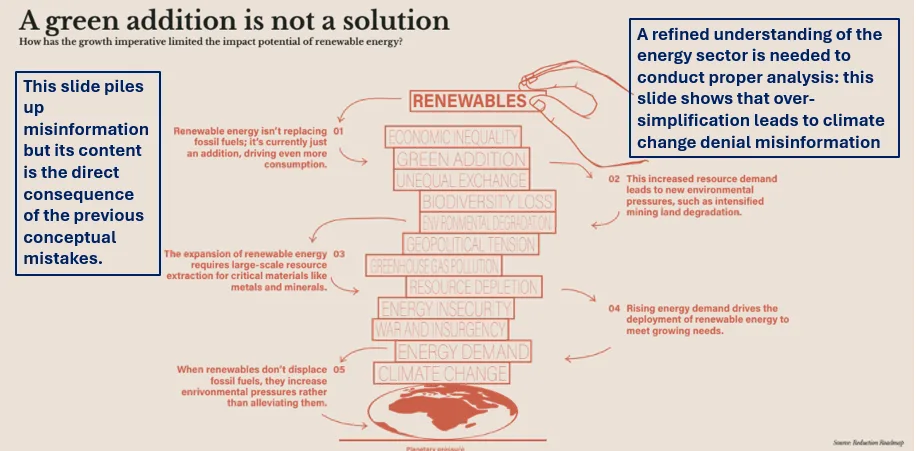
Below you'll find 3 very classic climate change denial narratives:

👉 Emissions keep increasing despite COP and climate actions

👉 There has never been historically any transition and all energies are simply piling up

👉 Controlling the demand should be a condition to develop renewable: without this condition they don't replace fossil fuel and will increase environmental pressure
Contenu de l’articleContenu de l’articleContenu de l’article

To correct these three biased analysis, you need to use the following methodologies:

  • Separate countries into 2 groups: emerging markets and OCDE countries.

The economy and demography of the first group are still growing, some countries even at an insane rate: China for example grew twice bigger twice faster in the last 15 years than Europe during the great acceleration. India 1.5x.

In the process they absorb significant amounts of energy and raw material. As the process of urbanization is still on-going in India, if the country continues its trend 2/3 of the building in Indian cities by 2040 are yet to be built.

They don't over consumed: together they're close to 3 billion people, and their energy use/capita remains below European level - India's level even way below.

Meanwhile, the 2nd group of countries no longer really grows. Our energy and raw material consumptions are actually decreasing. We're now saturated with infrastructure and there's a limit to the number of cars one family can buy

-> While it's important to see the aggregated global emissions to understand where we're going as this is what matters for the climate, the numbers hide two very different dynamics and different types of challenges from 2 groups of countries. And China by itself creates global trends. Ex: 70% of the global coal demand is located in India and China. 50% of steel produced globally go to China.

  • Separate energy into 2 categories: fuel and electricity

Going to Net Zero means that our energy mix will go from 20/80 (electricity/fuel) to 55/45. Electricity will be produced mainly by renewable, and fuel will be different forms of biomass, oil for petrochemicals and synthetic gas/fuel.

Now follow me in this set of technical explanations:

🔹 Renewables produce electricity. If you install them today in OECD you will decarbonize the existing electricity systems as the demand is not growing. However, in emerging markets, you will mostly absorb all or a portion of the growth of the power demand

🔹 To replace fossil fuel in the fuel section, you need to electrify combustion processes. Simply this action will drastically reduce our primary energy, as electricity is much more efficient than combustion processes.

🔹 To electrify you need a cheap way to produce electricity with minimum environmental impacts. Renewables are today the only candidates (solar and wind), and only since 2021 (when LCOE really became very competitive), and not yet everywhere. In fact we're still at the beginning of our transition, so let's not get stuck.

🔹Net Zero relies on numerous strategies to decrease our energy and material demand and footprint but much work needs to be done on this field. What's more, there is a lack of political commitment to prioritize these recommendations: this is where Degrowth can help.

-> When you understand these dynamics then you realize that there is almost no situation in which a country can justify to slow down the development of renewables, unless for example they did not anticipate correctly the grid needs or have difficulties to finance them, or have to correct some flaws in their regulation, or don't have the money to electrify as costs can go up to several billions for a single large steel factory. Then you need to find solutions to unlock the NZE trajectories

  • Never ever forget that the energy transition is a social negotiation. It cannot happen by itself, we need to force its speed by transforming our regulatory frameworks

Numerous Degrowth publications in scientific journals use the same methodology to show that decoupling is not possible: they look at historical data - the greatest minds will start in the Middle Age - and for the future they take the recent trends. Then they take macro-economic projections of PIB for the future

Why these papers pass the screening process and get published is a complete mystery to me. At least this shows that not all papers appearing in peer review scientific journals can be considered as science. It's similar to publish a report about the Egyptian pyramids proving that they didn't use any computer and AI for the blueprint.

There are 3 mistakes in this methodology:

1/ as explained before only through regulations can you replace fossil fuel, especially since we've disconnected their production costs from their environmental and climate impacts, de facto heavily subsidizing these energies

-> as an historian, if you want to help, you need to look for such regulations in the past, or explore other sectors than energy to see if such transformations happened - like when we abolish slavery

2/ It's the same for future projections: they're based on whether or not we continue, improve, or liked Trump destroyed our climate policies. Some of the green sectors see exponential growth and are not linear. You have there a concrete example with the analysis by Carbon Brief of the potential consequences of a new mandate of D. Trump.

3/ On PIB you need to factor the trillions of investments we will inject into our societies to achieve our energy transition.

-> the decoupling is a useless academic debate: today we need to lay out Net Zero plans, implement them, and monitor their impacts on our economies and environment to recalibrate them if need be

In conclusion:

-> international climate negotiations participates in the global diffusion of the energy transition and the best practices. It also provides a framework to work on NDCs, follow up our progress and compare our actions to others. It also gives ideas to governments by exchanges with everyone

-> when you understand that the energy transition is a social negotiation, then you already know that there is no sign of it in our past. Never in mankind's history did we try to entirely replace our energy system

-> conditioning the deployment of RE to [put here whatever you want here, Bjorn Dumborg for example claims that we need further R&D, others more improvements in battery storage, degrowth says better policies to regulate our demand] is a typical misinformation strategy used by the fossil fuel industry to delay our climate actions. The condition proposed depends on the profile of the social group targeted: it must be something they see as a top 5 priorities

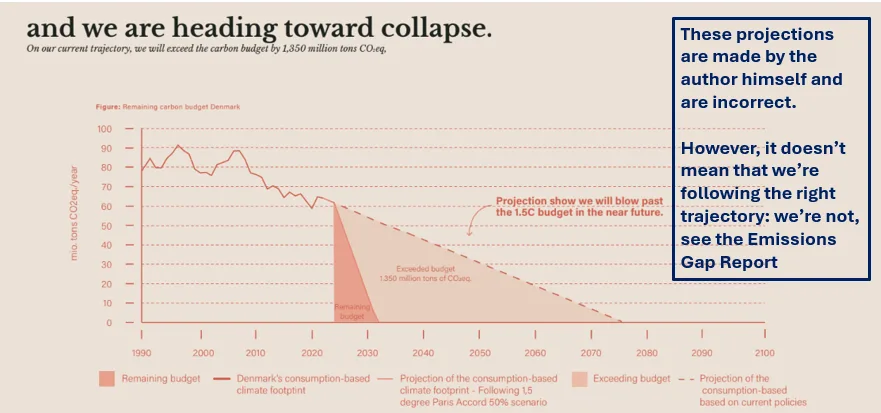
2. Remain factual. Stop being pessimistic. Stop inflating the challenges - it's already bad enough. Don't make 30y previsions unless you're a direct descendant of Nostradamus

See below 2 usual narratives which are very counter-productive at a time when we should all assemble and fight:

👉 We're heading towards the end of the world

👉 It's highly probably that all our climate actions will fail
Contenu de l’articleContenu de l’article

Here this section is self explanatory I believe.

The last Emission Gap Report was indeed very disappointing and we could potentially head towards +3oC IF we implement our climate policies, which the US for example won't do.

But we're still 25y away from our objectives in OECD, a lot can happen and we need to keep fighting. Remember: the energy transition is a social negotiation to transform our regulatory framework!

Regarding the mistakes in the projection, the author did not cancel the impact of the recent energy crisis and took historical emission decreases instead of projecting new policies.

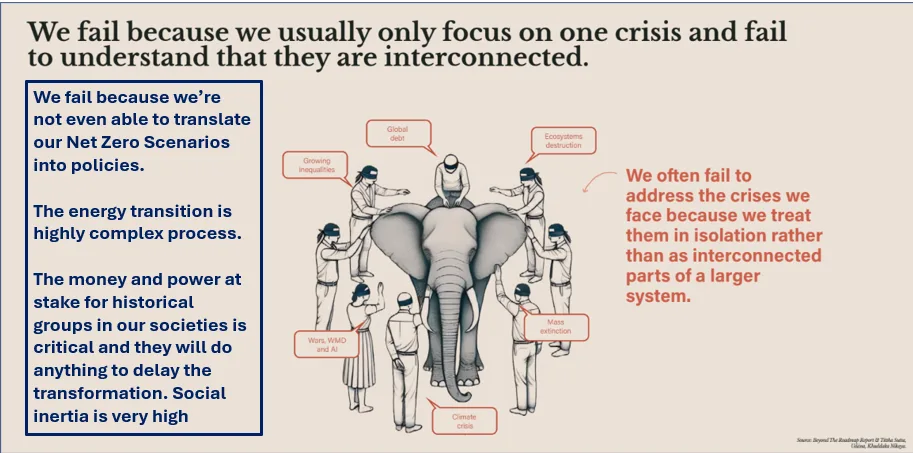
3. Never discredit climate actions to promote your narrative, especially when your supportive analysis is wrong. Don't dilute our climate actions within a infinite list of topics.

Degrowth is frequently diffusing 2 analysis to differentiate themselves from other researchers:

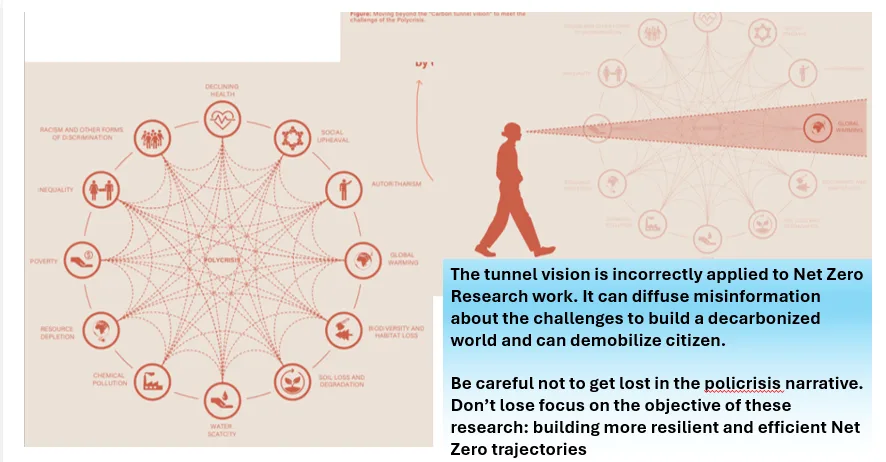
👉 Our vision of the climate challenge is limited as our minds are imprisoned in a carbon tunnel

👉 The climate is a tiny problem and only one of the numerous symptoms of a much complex challenge which includes absolutely all problems humanity is facing on this planet, from the hives of your cat to the conflict between India and Pakistan
Contenu de l’articleContenu de l’article

▪️The first narrative comes from Jan Konietzko, Manager of sustainability services at Cognizant, a consultancy firms which helps companies to adapt their business models to our new environment (climate change + Net Zero policies) by transforming their processes and capitalizing on available new technologies. The carbon tunnel is the pitch he used with his clients to explain why they should have a broader vision than simply their emissions.

Frankly I very much like the pitch, I find it very powerful, but then it was diffused everywhere and progressively the message and its uses evolve. Now degrowth activists are using it to discredit the work on Net Zero scenarios, thinking that the millions of professionals and researchers did not realize that different crisis and topics are connected.

While the narrative is correct when you pitch a CEO of a company as a sustainable consultant, it becomes very wrong when addressed to people working on Net Zero scenarios. In fact it even shows a deep misunderstanding of the necessary actions to build a Net Zero world:

-> capitalism must be regulated

-> forest, mangroves and similar carbon sinks must be preserved and revitalized

-> we need to better handle our wastes (collection, recycling, storage)

-> we need to collect products at their end of life and drastically increase the recycling rates

-> tax regimes must change as the richest consumes more, emit more, and can potentially afford extra costs

-> financing the energy transition can make us review our whole finance system, including banks and central banks and the role of our money

-> we probably need to transform the way our democracies are organized as we're way to weak to protect ourselves against misinformation. That also includes equity, social measures

The list is long and I could continue.

In no way reaching Net Zero will be an easy walk. We won't get there without deep transformative actions - which are feasible and have great positive impacts to our societies, but again we have to negotiate with the parties who don't want to change - if we don't, then they'll retaliate by pushing far right parties or you'll get a Project 2025

▪️ The second analysis is called the polycrisis. It became a scientific subject and I do have some very smart friends working in it. However, it's almost always badly used by Degrowth activists: the main objectives of the Polycrisis are to improve our Net Zero scenarios, their resilience and their acceptability. Some of the findings might even contribute to the social negotiation. So these research are not conducted to downplay the climate crisis or suggest that we should not follow Net Zero trajectories.

The risk of this narrative if misused is to generate an extreme confusion: you no longer know what to do, and your actions might become too indirect to really have effects on the climate. The n°1 direct cause by far of climate change is the combustion of fossil fuel to produce our energy and whatever angle you take that won't change. You need to transform entirely your energy system, whatever future society you would like to build.

Some narratives include also the necessity to change our relationship to our environment and take psychological approaches. While they can have very positive impacts and all possible strategies must be deployed, we need also to cknowledge the diversity of values and cultures, even within one country, so be careful of too radical, exclusive speeches.

4. Explain the real scientific causes of why we're transgressing the planetary boundaries. Never discredit climate action (again). Read Net Zero Scenarios and understand their impacts on the planetary boundaries. Never use climate change denial propaganda. Make reference to net Zero Scenarios and IPBES work - your solution (either imaginary like here or relevant) will most likely complement these works, not replace them

  • The fossil fuel industry today invests heavily on specific propaganda targeting environmental groups and on anti-NZE narratives:

👉 climate change is not a major challenge, there are others which deserve more attention

👉 fixing climate change will destroy the environment so it's useless

👉 Net Zero should not be our priority. It's also impossible to reach this target within the time framework. It's not even desirable

👉 Instead of Net Zero, we should rather [put here anything you want which would act as a distraction]

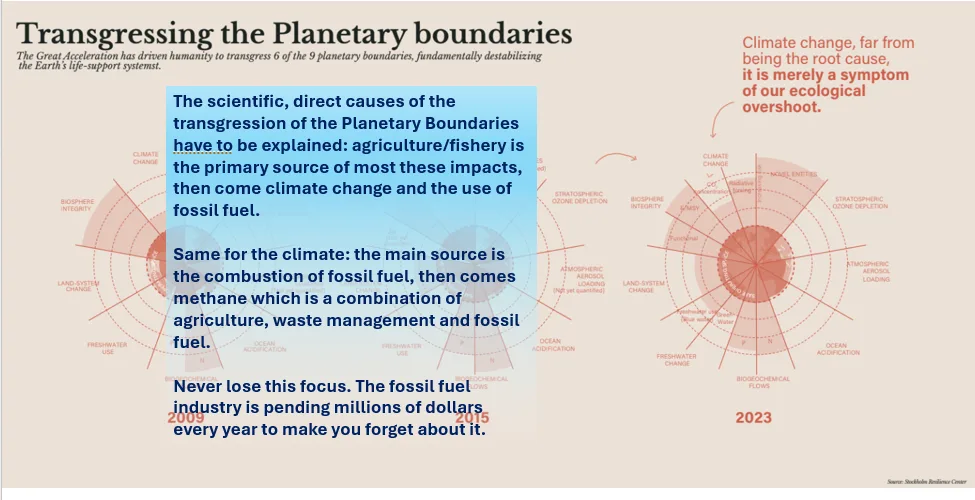
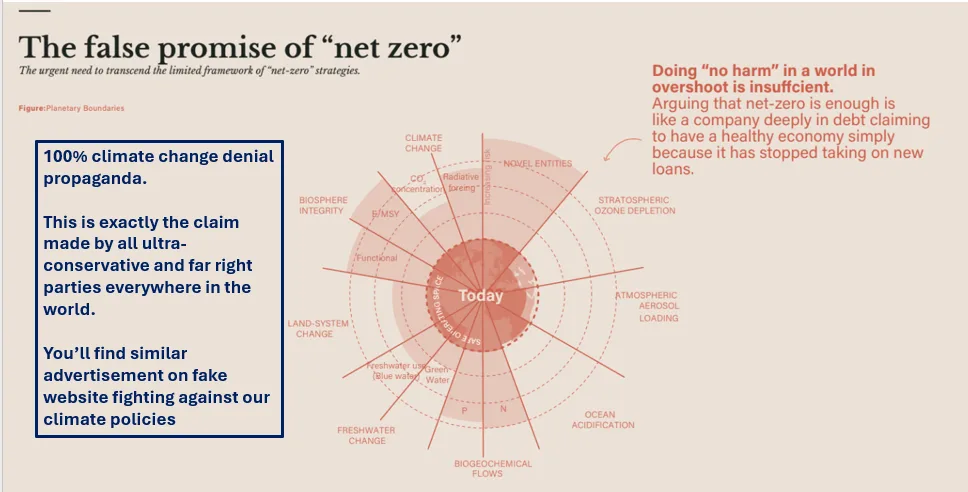
  • See below the narrative we find in the Degrowth report 👇🏼It certainly could have been written by Exxon Mobile.
Contenu de l’articleContenu de l’articleContenu de l’article

One of the strategies of the fossil fuel industry is to divert our attention from the climate crisis towards other crisis, like plastic pollution. They even create fake environmental associations, which will focus on everything but the climate, while diffusing from time to time climate denial narratives (ie: human are not responsible) and anti-RE propaganda. Like The Blue Ocean Program

Another of their key strategies is to discredit the Net Zero objective: it's useless, it cannot be achieved, it's costly, it will bring back the deads which will eat our brains...

Here you'll find 6 suggestions to fight against these strategies

▪️Climate change is the symptom of us burning fossil fuel to produce our energy. Any other claim is a dangerous distraction

▪️I've already explained that to deal with the climate crisis you need numerous, various actions. Implementing them is probably one of the greatest challenge ever faced by mankind. We need to relentlessly inform citizen about it and adapt the formats and channels to the audience

▪️As for the planetary boundaries, you need to be more specific about the main causes. Degrowth tells you that the source is capitalism, or growth, or over-consumption. But that is not a scientific narrative supported by anyone familiar with these concepts. The No1 cause is agriculture and fishery: 40% of all surfaces on Earth are dedicated to agriculture - we've destroyed half of the world to produce our food, and continue to do so like in Brazil. Pesticides are n°1 cause of the death of bees, n°1 cause of water pollution. The sector consumes 70% of all fresh water takings globally. Fishery is the n°1 cause of biodiversity losses in the ocean. And soon the climate is catching up as an increasing major cause

▪️While there are connections between all these crisis, the climate crisis has its own specificity: it cannot be addressed simply by local regulations and the list of actions is complex and very large, impacting all sectors of our economies and daily lives. This is why it's possible to insert sub-objectives in our Net Zero scenarios, but the contrary is not possible - let alone the question of the international support from which the Net Zero benefits

▪️Net Zero is a result of climate science, WGAR1. It's the unavoidable consequence of our remaining carbon budgets: depending on the maximum increase of the average temperature you set as a cap and the associated error margin expressed in probability, then you need to stop your emissions within a certain period of time. This is the reason while all countries in the world must set a Net Zero target and a time limit.

▪️The report suggests to drop the Net Zero ambitions and replace them by regenerative strategies - which is actually a Net Zero scenario dealing with agriculture and tighter environmental goals, but without any content... The general impression is that the urgency and the complexity of climate change and net zero are not well understood: more communications are needed about our Net Zero trajectories and the science behind them

5. Use appropriate methodologies to conduct complex analysis

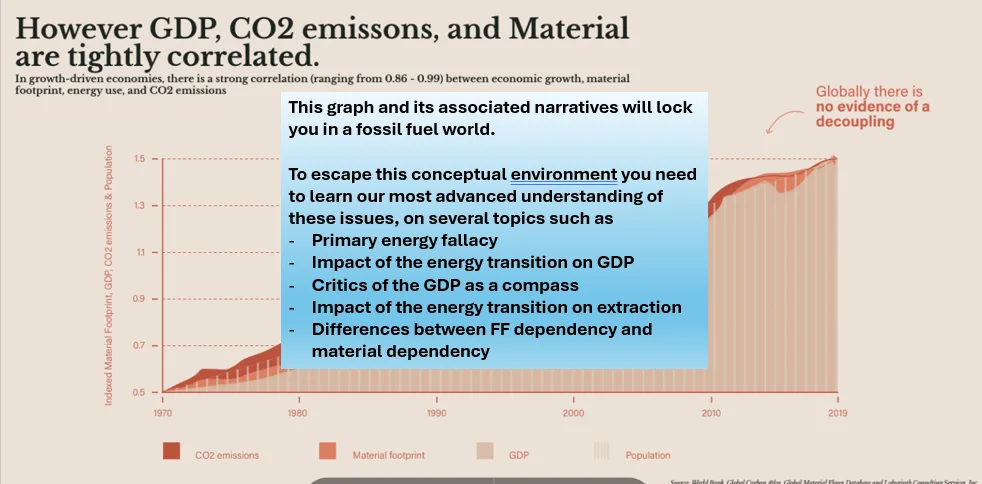
One of the disinformation strategies of the fossil fuel industry is to explain that our world will crumble without fossil fuels. They use different approaches to convince us:

👉 GDP is linked to energy

👉 Energy = fossil fuel: nothing can replace them, all alternatives have been tried since the beginning of our industrial world and they didn't work, only nuclear can pass this test (the fossil fuel industry and conservative parties push for nuclear as its potential is limited and it will come anyway in decades so they can pretend they do something to clean the energy mix while selling fossil fuels like there's no tomorrow)

👉 Yes we impact our world as we consume energy but this is the unavoidable consequence of human development: if you want less impact then you need to live like in the middle age

See below a graph which perfectly supports this narrative:
Contenu de l’article

Degrowth is unfortunately playing in the middle of this conceptual field laid out by the fossil fuel industry, which I call "oil fetichism". Famous spokesmen of the Degrowth movement, like Dennis Meadows, fell for this narrative and have given all hopes to find a solution to the climate crisis.

This narrative is at the center today of large misinformation campaigns, like the one led by Alex Eipsten. It's therefore of the utmost importance to identify its flaws and diffuse largely today's knowledge about this question.

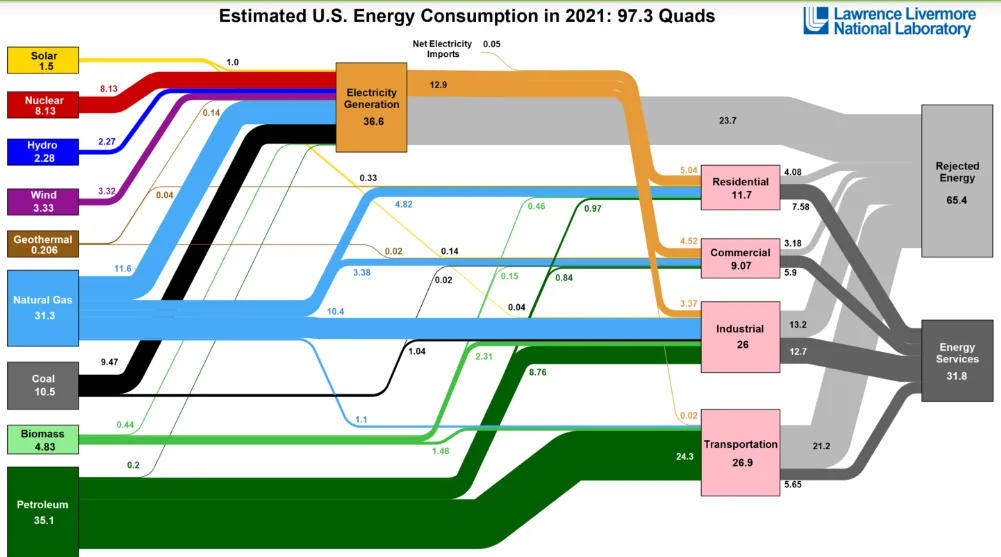
  • There is a correlation between GDP and exergy, not primary energy!

Be careful of the primary energy fallacy: a fossil fuel energy system wastes 2/3 of the energy we inject in our society in useless heat. Today everyone on this planet MUST know and understand the graph below:
Contenu de l’article
  • Above a certain level of energy/capita then the situations between countries are very much distributed and depends on their social/industrial organizations
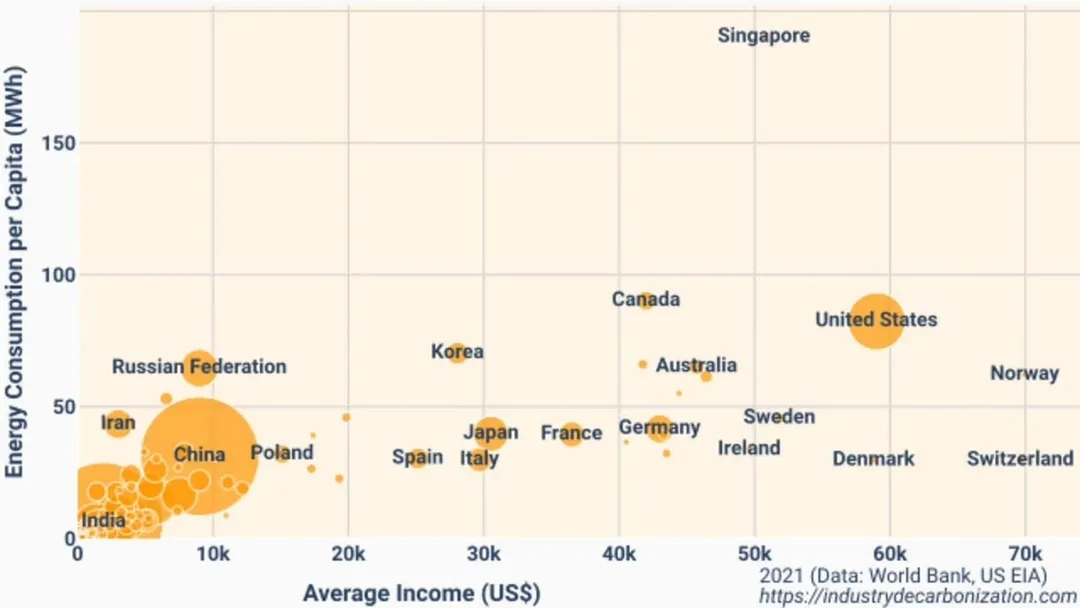
Contenu de l’article
  • No one has set the goal to decorrelate raw material consumption from growth as it's impossible. However we absolutely need to optimize our material footprint as mush as we can: it's impossible to reach Net Zero without such strategies. Again, we need to look at the numbers, trends, causes, sectors to design specific strategies and avoid falling for misinformation tricks. For example, the construction industry is by far the n°1 consumer of raw material (50%). Which means 50% of all the raw material we consume are linked to our needs of building and infrastructure, and the way we build it. Then you need to go deeper in the other 50%, to see exactly where and how much you can save, by designing specific strategies. you can't simply say "we need to lower our production of x or y" simply because reducing a consumption will reduce the environmental impacts of our societies.

  • Contrary to raw material, our objective is to make emissions DISAPPEAR. If you believe that the correlation between GDP-Emissions cannot be changed by switching to clean energy, like Dennis Meadows, then you will lose all hopes to save humanity - and these are the exact words pronounced by Jason Hickel during the conference "Degrowth vs Green Growth"

Degrowth calling for dropping the GDP reference is right, but for some reasons it puts it back to analyze the decoupling. What's more, it sets specific conditions to validate the possibility to decouple: it should be global, and allow us to reach our Net Zero target. Which means basically we should succeed in our energy transition to validate this possibility...

But that won't happen this way: different countries are at different development stages, GDP will be influenced by different factors. Again, we can see that the methodology proposed includes numerous conceptual mistakes which can only support the fossil fuel propaganda. It does not serve the real objective: alerting about the impact of growth and trigger a healthy discussion about how we use our energy.

The world we're living in is full of wastes and some benefit from it. Think about the oil and gas industry: we waste the 2/3 of the O&G products we buy, and we pay more that twice the net results of the sector in externalities. It's an insane situation, which has created giga-billionaires like the Koch brothers. No wonder they fight like crazy to keep this situation going on as much as they can, and they have large resources to invest in all possible delay strategies.

In conclusion:

  • The gap between the reality and the fossil fuel propaganda is getting wider and wider: very large capacities of renewables are added every day in our systems globally. They work fine and produce cheap electricity. Now we need to go to next phase of the energy transition: electrify our systems and optimize each pieces, on the demand and supply sides, while continuing to installing renewable

  • Degrowth is not helping at all by diffusing misleading conceptual frameworks coming straight from the fossil fuel industry. However, one of its the key messages "we need to think about how we use our energy as growth has various impacts" is worth spreading, so they need to find the right framework to diffuse it. Going deeper into Net Zero research could help the movement -> again, a collaboration makes more sense than a conflict.

6. Don't share climate change denial misinformation (please, really, don't do that)

The fossil fuel industry is trying to convince us that the energy transition won't change anything on the impacts we have on our planet - in fact it could even get worth. For that they have designed several narratives

👉 The energy transition requires an enormous amount of raw material which means extractive activities will grow drastically and so their impacts: biodiversity, water, people... And we will still be dependent on export countries

👉 Solar panels need space and will occupy the fields where we're supposed to grow our food so we'll die from hunger. They create heat which destroys the soil and the biodiversity. They reflect the light and can bling pilots and create aircraft accidents (they might even be responsible for the 9/11). Wind farms are bio-diversity killing machines: worms, whales, bats, birds, even humans, cows... no one can escape from their Warth

See below the graph in line with this misinformation campaign:
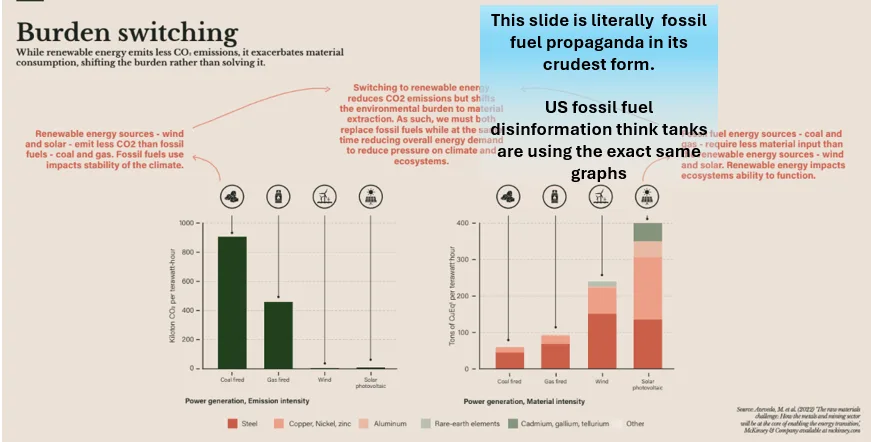
Contenu de l’article

Honestly, do we still need to debunk again and again this propaganda?

Well, Degrowth reminds us that yes, we need to, since even groups who care about our planet will fall for these tricks.

However, the fact that it's still there, means that we don't use the right communication channels and the right formats. In fact we don't reach the very people that needs the most to hear the correct information. Many of us don't have the time to verify the information we receive, to use various sources to crosscheck the information, and behave passively in front of the information: we simply take what comes to us as long as we feel some connection with the sources.

So rather than complaining and keeping doing the same things, we may need to acknowledge the lack of efficiency of our communication strategies and find new, creative ways to address this challenge.

As for this graph:

The methodology used - taking the raw material to build the plants and ignoring the GT of fossil fuels which are then necessary to produce power in case of FF generators - is directly taken from misinformation sources like Mark P. Mills from the Manhattan Institute. No one today is using such method, as the gap between the numbers is really insane. See below
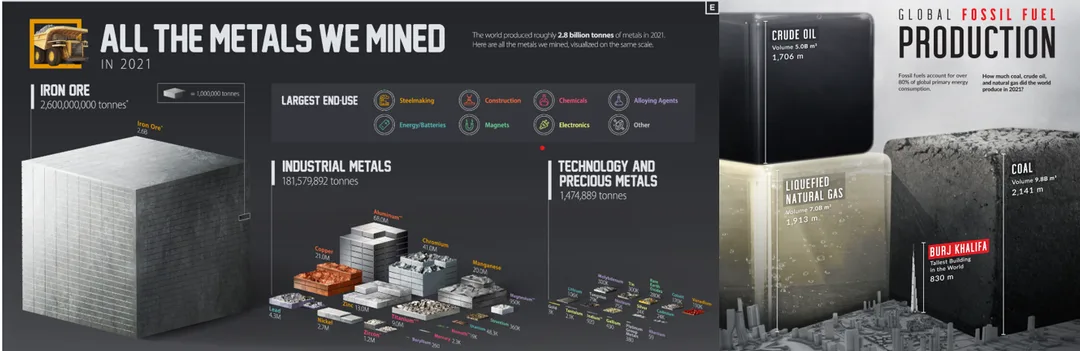
Contenu de l’article

What's more, although there are challenges (collection, co-existence of various industrial norms, changing designs), raw material can be recycled, and recycling activities can be relocalized outside of export countries.

About land and biodiversity, you'll find plenty of information on the Internet. Ex:

I don't want to over-simplified the raw material issue, and the article is already very long, so here you'll find good information:

https://www.irena.org/Digital-Report/Geopolitics-of-the-Energy-Transition-Critical-Materials

https://www.iea.org/reports/global-critical-minerals-outlook-2024

https://www.energy-transitions.org/publications/material-and-resource-energy-transition/

https://www.ifpenergiesnouvelles.com/brief/raw-materials-markets-heart-energy-challenges

Conclusion: a possible collaboration between energy transition experts and Degrowth around the Net Zero could create a powerful force

Degrowth diffuses some important messages that we all need to be reminded and which can influence positively the society as a whole and energy transition, climate professionals and researchers:

  • watch out of energy and material consumptions

  • think about what really matters to the societies and prioritize the basic needs

  • inequities have reached an insane level and we won't be able to build our future society in such a imbalanced context

However, to diffuse these ideas Degrowth uses a lot of inappropriate methodologies and conceptual frameworks directly issued from fossil fuel propaganda. They also cut themselves from the Net Zero and climate negotiations.

In doing so, Degrowth participates in diffusing misinformation in our societies and environmental circles. It diverts citizen's potential engagement from existing, impactful actions and offers "something else" which in the end comes down to Net Zero trajectories with way less substance and numerous fundamental gaps and flaws.

At the same time, the emissions globally are still increasing and some governments can no longer hide the social fractures our economic and social organizations have created. Our weaknesses are now used by groups which want to take control of them for their own benefits while protecting historical positions. So we need to find ways to avoid such meaningless conflicts between people who share similar values and objectives.

Our world has reached a new stage in the climate war. We now have the solutions, but the implementation relies on a complex social negotiations, for which our existing democratic organization may not be adapted.

We need to create healthy spaces for discussions and be ready to accept some compromises.