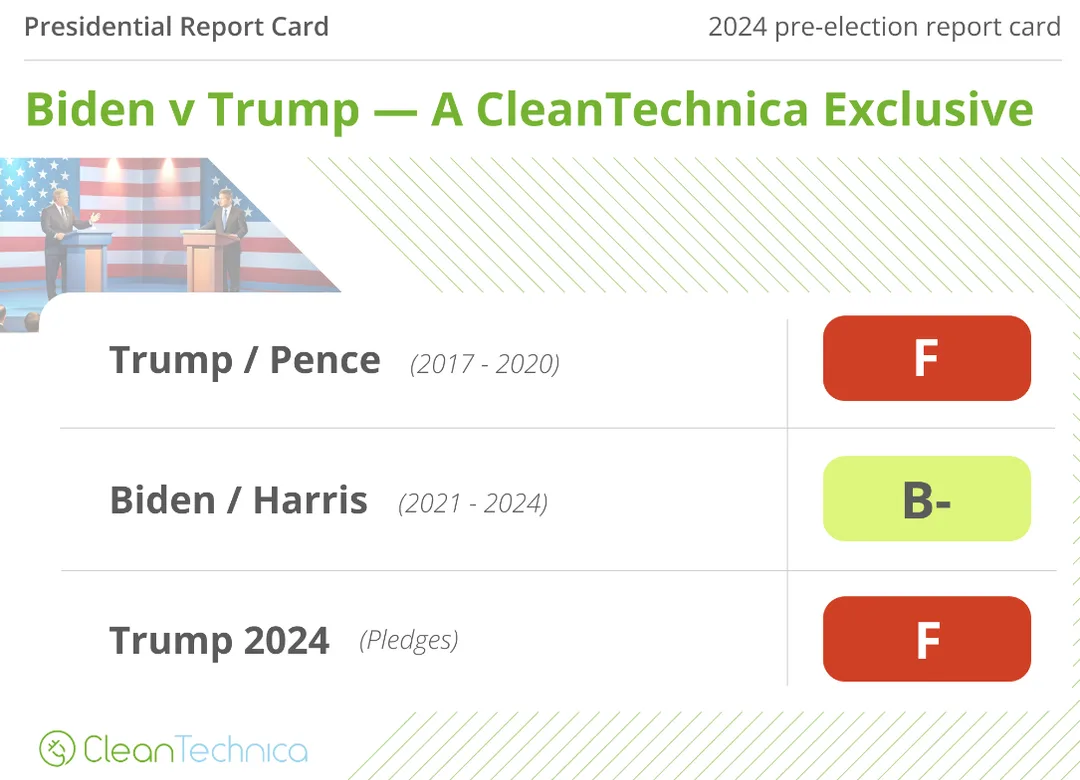
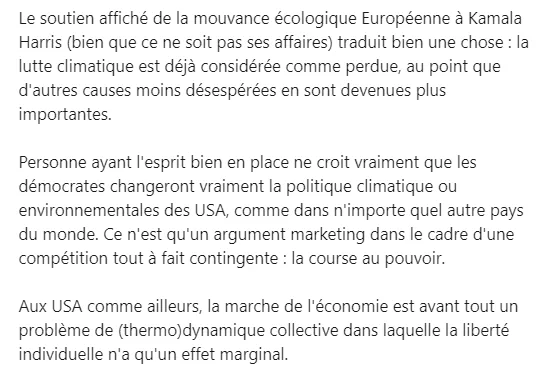
In his RTL column, Jean-Marc Jancovici discussed the American situation and incorrectly stated that voting for K. Harris or D. Trump is practically the same for the climate.
If this claim, which downplays voting for Trump, a fundamentally climate-skeptical candidate wishing to stop climate policies, seems to be based solely on major analysis errors that we will unpack in this article, in reality it stems from a deeper ideological position: our modern world will end without fossil fuels.
This oil fetishism indeed makes us see the energy world in a very particular way: nothing can replace fossil fuels, except nuclear because it is very dense and controllable, and since it cannot be deployed on the right scale, we will witness an energy crash. To prepare for this world, where GDPs will be divided by 10x and the prices of our products multiplied by 30x, extreme sobriety is necessary.
Applying this view to the United States, the absolute antithesis of sobriety, the country would therefore be doomed, and whether we vote Trump or Harris, it ultimately matters little.
Yet, without being an expert, everyone realizes well that there is a significant difference between voting Trump or Harris: on one side, you have a fossil fuel representative carrying a climate-skeptical discourse, and on the other, you have an administration that passed the IRA, the most ambitious climate policy the country has ever seen.
So we can realize the real wreck towards which this worldview leads us: it traps us in a fossil imaginary incompatible with the struggle for the necessary social transformations to achieve Net Zero between 2050 and 2070, the only way to stay below a 2°C rise.
In this article we will analyse the American situation and the positions of the 2 candidates, review JMJ's analytical errors, discuss the role of sobriety within the framework of our climate policies, and then conclude on the climate discourse in France and propose solutions.
Throughout the article, you will find analytical tools to enable you to reconstruct the reasoning yourself. This is a key point of the article: citizens should no longer just ingest information but critical thinking tools, so they can filter information and analyses circulating in our public space, thus escaping manipulations of all kinds and participate in citizen debate.
I hope everyone can, in their own way, integrate these tools into their reflections to think about tomorrow's world. Getting out of the oil fetishism, imposed on us by fossil societies through their disinformation think tanks to sow confusion and division, leading to inaction and the strengthening of conservative parties, is a sine qua non condition to achieving our climate objectives.
Our current world burns fossil fuels to produce energy two thirds of which is wasted during combustion processes, costing our societies $7 trillion per year in direct and indirect fossil subsidies, which are ultimately mostly captured by the top 1% richest.
Not imagining that another world is possible is even stranger than imagining that solutions exist. And fortunately, solutions exist, they are well documented, they are the subject of thousands of publications, and millions of people worldwide work on their deployment.
The energy transition, or ecological transition to integrate planetary boundaries, is underway. Let us not be distracted; on the contrary, we must now do everything to accelerate these changes.
Let's go, let’s decrypt all these questions together!
Let’s start by describing the situation of the United States: American policy is still not aligned with a trajectory below 2°C, even with the IRA, and the Democratic platform published by Harris lacks ambition.
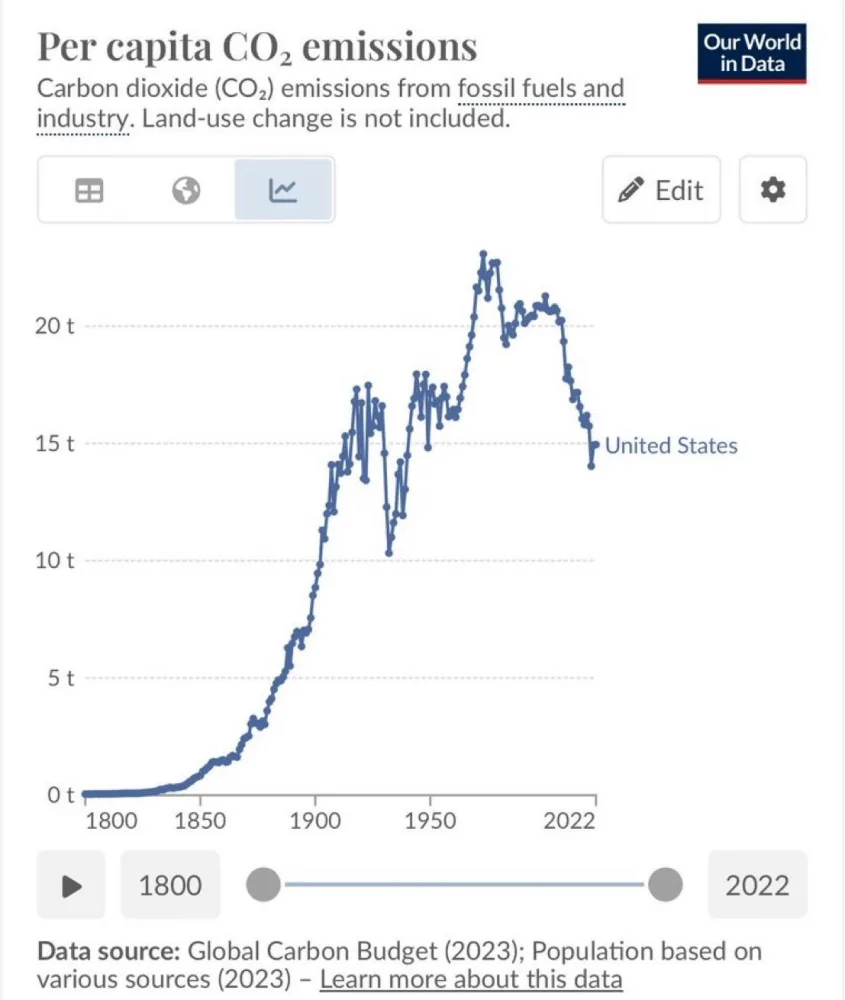
It would be easy to have an optimistic view of the situation, for example by taking the evolution of country emissions per capita, which have returned to their post-war level:
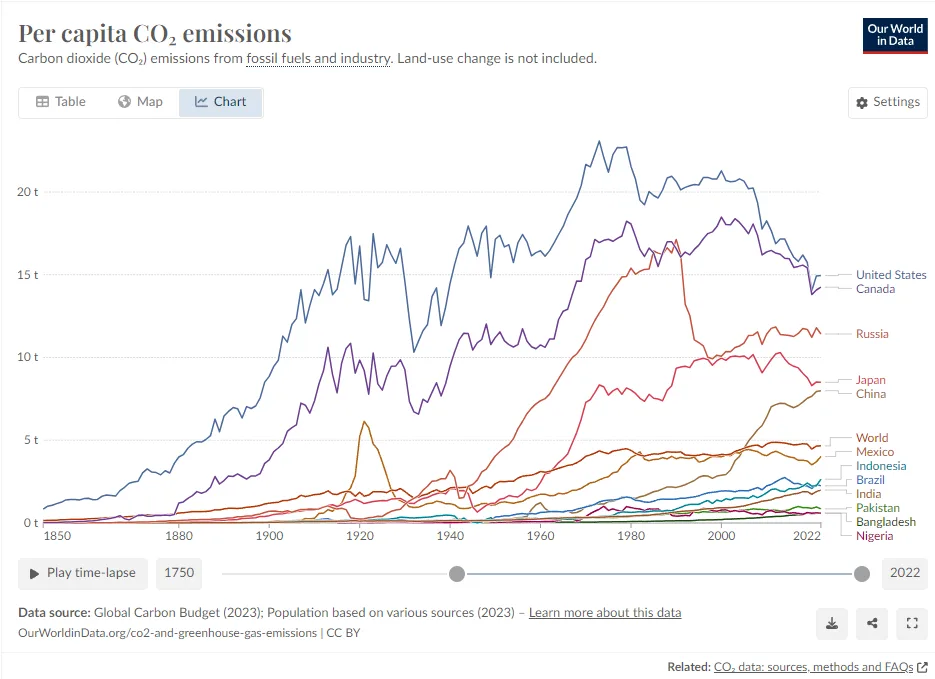
But even on this point, let’s zoom out a little. The country remains:
the 1st highest emitter per capita among countries with more than 100m inhabitants
the 2nd largest CO2 emitter in the world
the 1st historical contributor to emissions
the 1st exporter of gas, and the 1st emitter of methane
In detail, we can outline the following situation regarding US decarbonation challenges, which Michael Barnard calls the "free ride": the country would rely on European and Chinese climate actions and not contribute equally to emission reductions.
Among the causes, the presence of an oil/gas sector totally intertwined in the social and political organization of the country is significant. The sector finances over a hundred think tanks that produce 24/7 disinformation on climate and public policies; it is closely linked with universities and research centers like MIT, as well as media. Moreover, many regulations are controlled by the states, limiting impulses from the federal government.
Of course, the physical presence of gas and oil reserves plays a big role: historically, each country built its economy using primarily its national resources. The companies exploiting them acquired strategic positions, whose voice significantly weighs in social and political negotiations. This is the case for coal in Australia and India, for example. These elements are social nodes contributing to social inertia and represent the real, unavoidable climate challenge: every climate solution must account for these nodes.
Thus the US benefits from low on-site oil and gas prices, limiting interest in energy efficiency policies and demand reduction strategies (sobriety, discussed below). The carbon market does not exist, and fossil fuels still enjoy subsidies.
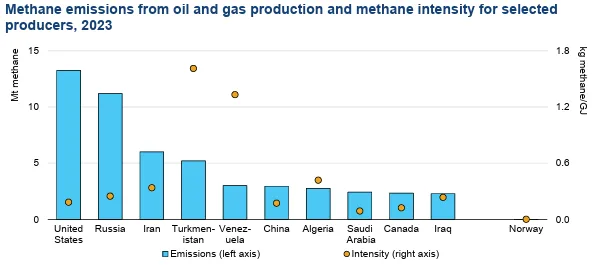
CO2 is not the only greenhouse gas: methane also matters. The IEA estimates that reducing methane emissions by 2030 could be the main contribution to slowing climate drift, showing the crucial nature of the topic, why an international task force was created:
The United States are the largest emitter of methane, with considerable oil/gas sector leaks on their territory.
In some sectors like housing, complex regulations slow down decarbonation and make it very costly. American culture of big cars also complicates decarbonation of transport, knowing that the desire to support the domestic car industry by taxing Chinese imports, coupled with the American industry’s long struggle to make profits on EVs even large SUVs, delays transport electrification, as most citizens cannot afford an EV.
Fortunately, the IRA arrived to try to unravel all these knots. The Inflation Reduction Act (IRA) is the most ambitious climate policy ever passed in the US, which Joe Biden had to wrestle through a generally conservative Senate - and to do so he had to retract some proposals, notably those directly regulating fossil fuel demand and production. In short, IRA says: "OK to invest in transition but do not constrain the fossil sector."
This intervention by John Kerry, interviewed by MIT and a masked spokesperson for fossil companies, shows the importance of climate issues in Joe Biden's policies: reference to the IPCC, aid to emerging countries, massive investments in decarbonation, many topics are handled at the highest political level.
For a more complete view of the IRA, here is the explanatory video made by Avenirs Energétiques
Are these challenges a reason to say voting for Trump or Harris is the same for the climate? Analyses by all energy-climate experts, the opposite of the Bueno sphere, leave no doubt: these elections are indeed a major climate issue with a huge gap between the two candidates.
Unfortunately, since the climate challenge is primarily a social negotiation, given that we have today all the solutions to drastically reduce emissions, well below 50% of current global emissions in 10 years, we must also accept to follow the least bad trajectories, which will never be perfect, while continuing to advocate, inform, negotiate to accelerate progress and normalize the idea that no going back is possible: on the contrary, accelerating climate policies is an immense source of positive benefits for all citizens.
In contrast to the IRA, Trump requested two years ago that Heritage Foundation, one of the worst US think tanks, pro-fossil, anti-environment, anti-climate, ultra-liberal and highly conservative - incidentally Trump's closest - help him build a policy for America, resulting in Project 2025, a document straight out of the brain of the Final Boss in a Marvel movie – the 'Dark MAGA' meme is very popular in the US, a term created by far-right American circles and taken up by Trump supporters (recently Elon Musk called himself Dark MAGA).
Project 2025 includes:
dismantling or placing under guardianship environmental and climate bodies
exit from COPs
replacing climate targets with commitments to increase energy production and maintain energy security (translation: restart hydrocarbon production)
As for Harris administration's announcements for IRA’s future, the Democratic Party Platform analysis shows that ambitions do not yet meet the stakes, but some progress is noticeable, notably on social justice, a key element of the transition too often forgotten by our politicians, as shown in France by the Yellow Vests protests, RN rise, and our country’s political and social implosion.
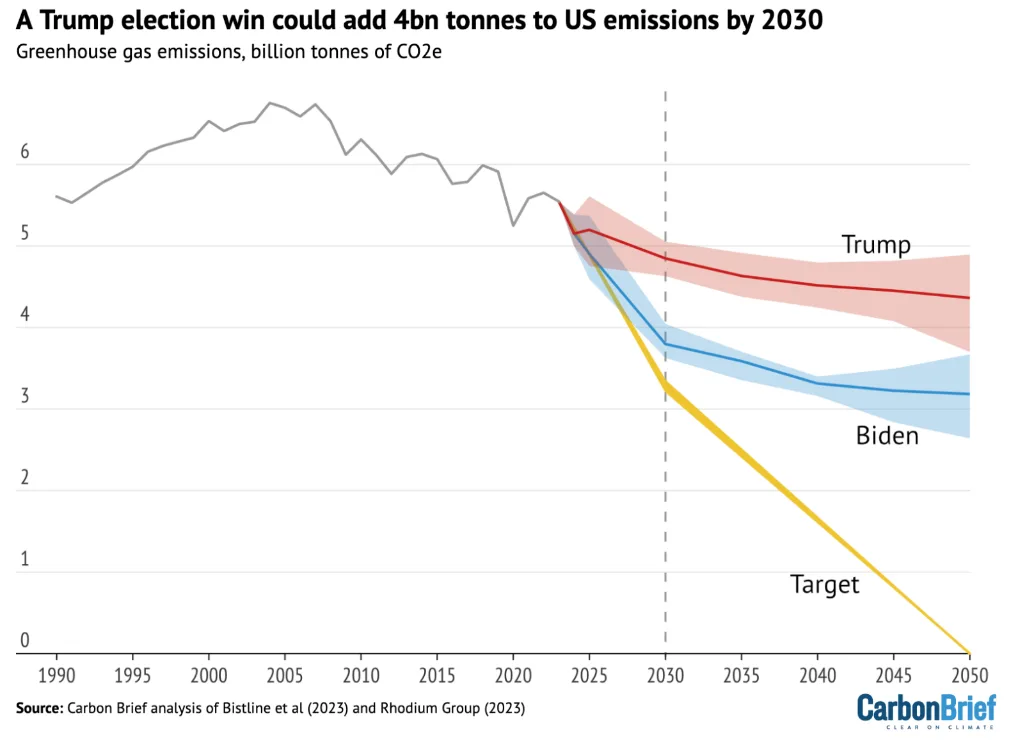
The chart below is based on Carbon Brief's analysis of the policies proposed by the two parties, translated into emissions. As you can see (look at the curves until 2030; afterward projections are not covered by policies but are 'business as usual'), the climate trajectories are nowhere near similar, hence the alert signal from the community of climate-environment experts in the US and globally.
The American election could almost be summarized as Project 2025 vs IRA, an important difference in vision and engagement for the climate. So why does JMJ say there is practically no difference?
The Jancovicist ship amid conservative wreck
JMJ becomes more conservative with age, or at least hides it less. He is not alone; many experience such a wreck:
Vaclav Smil now writes for the Fraser Institute, a liberal conservative think tank funded by fossils including Koch Industry, explaining why we will not reach Net Zero
Dennis Meadows now claims our world will perish with the end of fossils and says humans can’t organize to face climate drift. He recommends self-managed autonomous citizen groups… which might save a few million people
Since Dennis M. and Vaclav S. both inspire JMJ, it’s no surprise the Jancovicist ship is also drifting.
Thus his analyses on nuclear and renewables, unchanged for 20 years, contributed widely in France to the recent takeover of our energy and climate policies by conservative nuclear circles, leading to their dismantling
For those unconvinced, just read the reports of the 2 inquiry commissions requested by the LR party in 2019 and 2023, where JMJ’s energy analyses appear verbatim, including on sobriety:
The first concerned "the economic, industrial and environmental impact of renewables, transparency of financing and social acceptability of energy transition policies"
The second, the climax of conservative disinformation strategy and their LR frontman, aimed to "establish the reasons for France's loss of energy sovereignty and independence"
This last commission, widely relayed in our public space by conservative and far-right media during its 6 months, was the origin not only of the implosion of the social agreement – unexpectedly found after the RTE report and concretized by Macron’s Belfort speech – but also of the PPE and SNBC. It largely contributed to the RN’s rise.
For further reading, here is a detailed analysis of the second inquiry commission:
It is therefore impossible today to deny the very negative impact of part of JMJ’s discourse, which paradoxically, despite his commitment for the climate cause, contributes to the destruction of our climate policies and the rise of conservative circles.
After the anti-renewables discourse, here comes the inaction discourse: vote for anyone, nothing will change
JMJ has had a column on RTL for many months where he speaks freely. Disinformation reigns supreme and reaches a wide audience.
In September 2024, a new low was reached: in his column on the American election, he claimed that voting Kamala Harris or Donald Trump was practically the same for the climate.
To understand the seriousness of this claim, we must first identify who in our public space propagates such an analysis:
In the United States, no climate-linked source, no energy expert would propose it. On the contrary, all warn about the climate and energy stakes of this election and about the risk posed by D. Trump. The only sources saying it's the same are exclusively climate-skeptical and fossil-origin. Actually, these same sources used this communication strategy during the 2016 US presidential election leading to Trump's election. Michael E. Mann discusses this in his book Climate War: "not voting for D. Trump is not equivalent to voting for Hillary Clinton, contrary to what conservative circles claim, aided by Russian bots".
In France, you find the exact same claims from the far right: "Macronism or Marine Le Pen, it’s the same, neither disinforms more than the other". The goal of these communications is to normalize the extremes to reach more citizens.
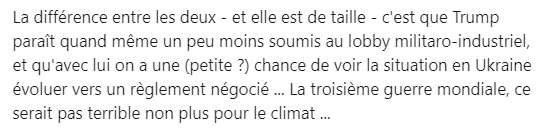
Now let’s look at supporting comments from JMJ’s LinkedIn followers under his post summarizing his intervention (fortunately many disagree; here are only those validating his analysis, sorted by type)
Pro-Trump/conservative disinformation discourse:
Nihilistic discourses
Discourses associating right, far right, exit from Europe...
These signals identified should put our critical eye in maximum alert, even before conducting detailed analysis. The risk zone where this discourse belongs is "Apocalypse", "Armageddon" or "Ragnarok" according to your term:
a discourse carried only by fossil conservative circles
a discourse criticized by the entire climate and energy expert community
a discourse prompting reactions strengthening far-right ideals and climate-skeptic circles
Now let’s see if the substance explains these signals.
The arguments put forward show a deep misunderstanding of transition dynamics and climate policies
Here are 3 arguments brought by JMJ to say Harris and Trump are essentially the same for the climate:
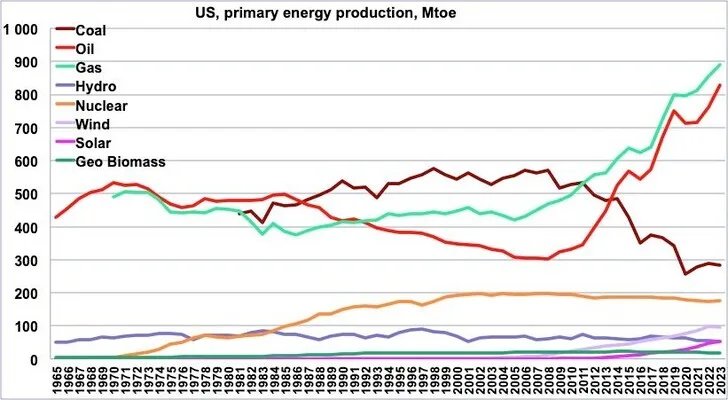
The evolution of energy consumption since 1970 in the US shows that although coal decreased, oil and gas increased most, not decarbonated energies. And no Democrat vs Republican specificity is visible.
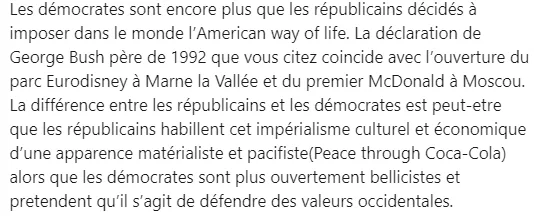
For neither candidate is the American Way of Life negotiable. So sobriety is “out” and thus climate “out”.
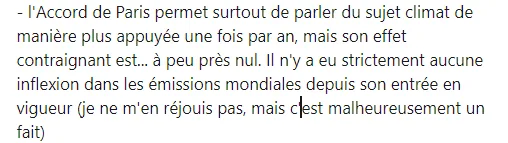
The Paris agreements and more generally international climate negotiations would have no impact on climate.
We will decipher these one by one – now begins the more complex part of the article, involving sometimes sophisticated knowledge and concepts, progressing step by step, highlighting major methodological principles for everyone to identify and integrate as appropriate in their own reflections.
These analyses, as always, are unfortunately more complex than the initial disinformation discourse which by nature is built as simply as possible (and ideally shockingly) to facilitate diffusion.
So stay strong and don’t hesitate to take your time to progress in the arguments: there’s no rush!
1. The analysis of the chart used by JMJ to support his thinking shows a reality very different from the claims he spreads – so they are not sourced.
Look carefully at the chart shown by JMJ to claim nothing changes in the US
It shows a significant nuclear share, tiny renewables, declining coal, and rising gas and oil. Any reader without prior training would conclude:
1/ transition is not progressing
2/ whatever the ruling politicians, nothing changes
-> Chart referenced, correct data: could JMJ be right this time, making his argument worthy of citizen debate since perfectly sourced?
Unfortunately, no, as we will explain:
1st principle to integrate: Energy transition is a social negotiation whose purpose focuses on regulatory transformations
To replace our current energy system with a decarbonated one, studies show 4 major action families related to energy
control energy demands using a range of strategies (discussed next)
electrify uses
develop renewables (and nuclear where possible)
non-electrifiable parts covered by biomass and synthetic gases/fuels
But these actions cannot happen organically, by market laws alone, because in reality
1/ free market and free competition never really existed, fossils enjoying many competitive advantages built over history
Let’s cite 2 competitive fossil advantages:
Our societies are built around fossils and everything is arranged to maintain dependence: think gas station networks, spatial organization, supply chains…
The extraction cost excludes externalities of fossil use, paid by victims of damages. Think destruction caused by global warming, borne by citizens and insurances, or lung diseases from exhaust fumes and coal, also borne by citizens/insurances.
2/ green technologies have a premium (higher cost than fossils excluding externalities) until sufficient volume/technical development is achieved. They must be supported initially and protect vulnerable citizens
Think green hydrogen used in electric furnaces for green steel.
So without deep regulatory changes, NO transition is possible, certainly not fast enough to stay below 2°C or even 3°C.
The relevant methodology is to study policies historically that contribute to transition and their impacts. Similarly, to forecast, study the impact of policies proposed by governments – which Carbon Brief does to produce Trump vs Biden curves.
-> Here JMJ looks at history to predict future, ignoring accelerated regulatory transformations and existence (or not) of past climate policies. This method cannot provide relevant information.
⚠️ Remember these methodological differences, they are fundamental and help a critical look at JB Fressoz’s analyses, or to escape doomism and inaction discourse.
2nd principle: Distinguishing primary, final, and useful energy and electricity vs energy is mandatory to think about the future decarbonated world and to understand and identify transition evolution
This part will be tough if you’re unfamiliar.
Why go into detail? Isn’t this expert debate while JMJ’s aim is popularizing?
But these knowledges MUST be vulgarized to understand our world and climate strategies and participate in citizen debate. They fundamentally change and structure views on energy, climate, and society functioning and help identify disinformation or low-relevance discourses which neglect them – many in France, and like COVID, they spread through all social groups.
First, when discussing energy, ALWAYS distinguish electricity from fuels. Electricity is a special energy vector with little loss from production to use. Fuels have losses during combustion from decent to “unbelievable.” The worst: thermal engines in cars, providing only 12% efficiency, meaning out of 10 liters of oil, only 1-2 liters power movement, rest lost as heat! 1 kWh electric ≠ 1 kWh thermal.
Then learn to avoid traps of primary energy. Fossil marketers always use it and fossil disinformation (also shared by collapse discourses). Fossils sell primary energy or refined final. Primary energy puts thermal and electric kWhs as equivalents – inflating total needs while societies use only 33% of that (yes, fossil world inefficient!). Also mixes demands and technologies so dynamics and replacements are hard to identify.
Finally, explore varied causes of increases/decreases in fossil demands to analyze real policy impact: demography, crises, emerging vs OECD markets, demand/use evolution, warm/cold winters… Oil is peculiar: except petrochemicals, mostly transport. Rising oil demand = rising transport demand in a fossil world. So why/where does it rise? Coal: 70% used for electricity.
Applying these principles to JMJ’s chart transforms vision and interpretation – though same chart!
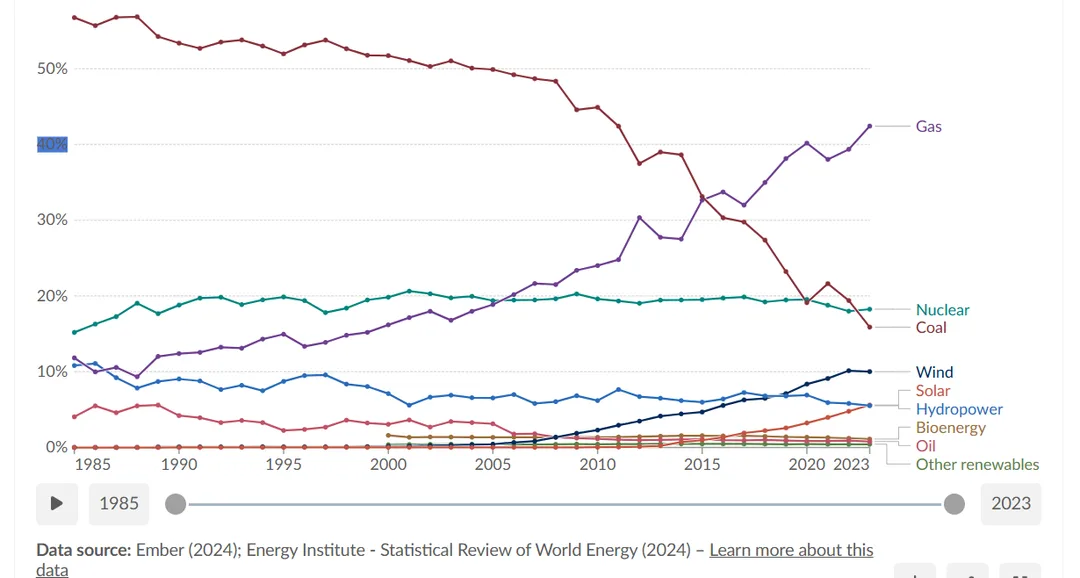
First note: nuclear drops 60% between primary and final demand (steam lost in chimneys) and serves only electricity. Since 2020 renewables share is half the nuclear share in US electricity (including hydro). And in 2024 just solar and wind approach nuclear’s ~18% share.
Let’s look at electric part:
In 2022, for the first time in modern history, the US produced more electricity from renewables (including hydro) than coal.
This trend continues: renewables make coal gradually disappear in the US and will attack gas as the capacity factors of gas plants decline IF US policies sustain massive renewables growth.
Because till now it’s the only part we know well to decarbonize at large scale, starting between 2000 and 2010 – very recently in reality. Policies mainly operated on this. Since electrification just begins, no effective replacements happened historically in fuel part – beginning now only in 2- and 4-wheel individual vehicles.
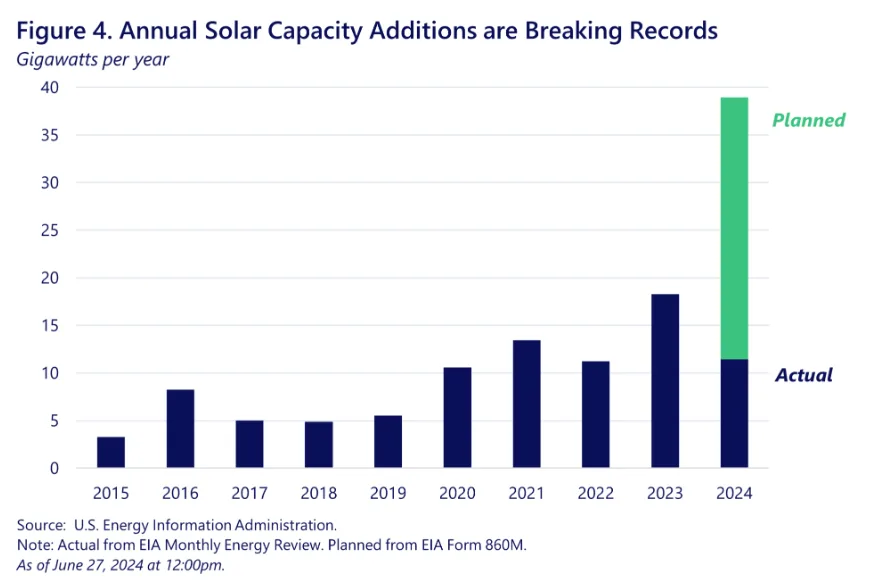
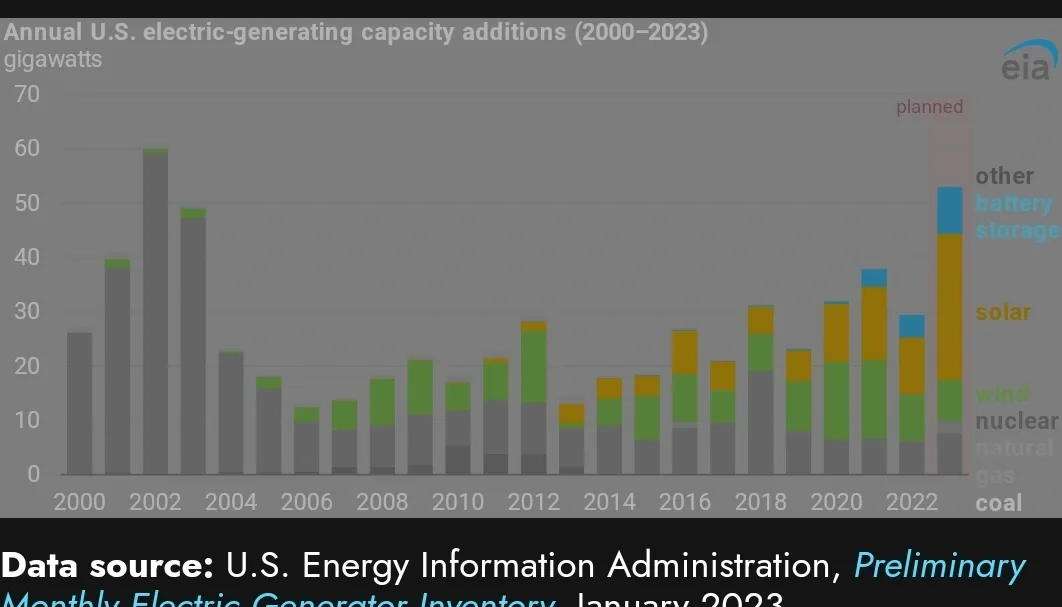
Do we see differences between Trump and Biden? Look at solar:
Look at historical power additions in electricity sector:
Big differences emerge using proper methods: look at 2024, IRA’s effect vs Trump mandate –> incomparable
As to oil, JMJ’s chart shows production: US became 4th-largest crude oil exporter in 10 years, starting from bottom, thanks to shale oil. In 2015, production was 88% higher than in 2008
⚠️ Remember these principles: don’t mix electricity and fuel, identify growth/decline factors well, link to policies, beware primary energy analysis traps.
Next: the American way of life!
2. Analytical errors using the US energy mix chart as basis, making it look like sourced discourse, really stem from an ideological origin easy to identify: JMJ’s discourse places sobriety as the key climate action without which no policy can impact – but this is false and greatly confuses citizen debate
Energy transition is humanity’s response to the climate crisis – and now includes environmental policies to extend to planetary limits: we call it ecological transition in France.
IPCC says world must be Net Zero between 2050 and 2070 to have 50% chance to stay below 2°C. The further we are, the more the world looks like Mad Max. For those keen on immigration, climate refugees will number hundreds of millions. And for security, climate is seen by major armies as an unprecedented national security issue.
How achieve Net Zero?
Energy accounts for 75% of emissions; rest is mainly agriculture. Moreover, agriculture and fossil/climate together cause breaches of almost all planetary boundaries. So climate and environmental discourses should merge, actors and activists should converge around actions and communications.
With 8 billion people, peaking at 9.6 billion, don’t expect to handle this without completely transforming energy systems as societies have minimal energy needs. Nor will clean living in today’s society magically eliminate emissions.
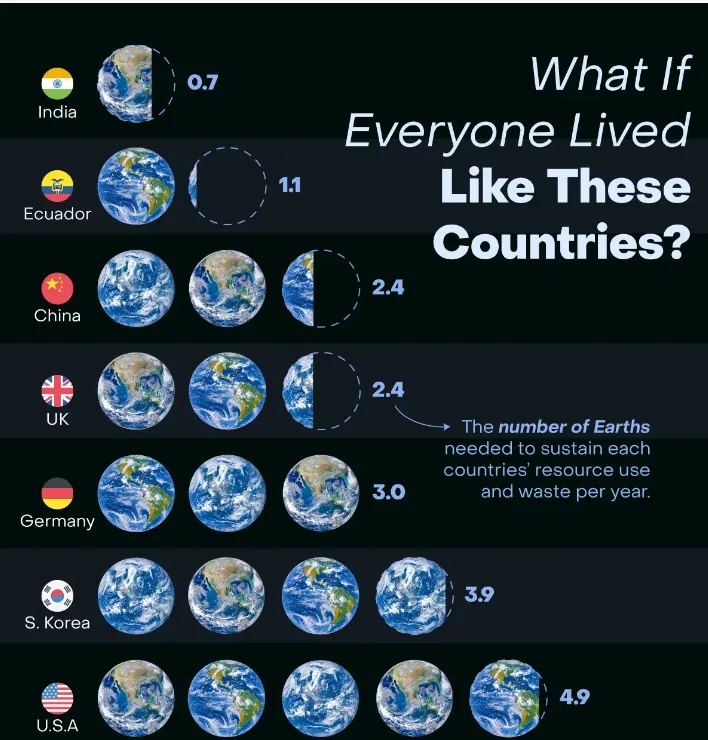
We live in a fossil world. Every activity necessarily consumes fossils. Many countries still lack basic infrastructure access. If OECD countries drastically reduce consumption, emerging countries’ demand will explode. Even at low per capita energy, if all lived like current India, we’d consume 0.7 planet!
Does this mean sobriety is useless?
Not at all. It’s a pillar of transition scenarios. Its definition varies, generating misunderstanding and confusion on its role and precise actions.
I propose a simple definition for this article and public use: strategies to reduce energy and carbon footprints.
It includes energy efficiency, social reorganizations, infrastructure changes, and behavior changes. It rests on 3 action levers: innovation (not only technical), infrastructures, and regulations.
These strategies are essential for:
We waste energy badly: 30% of food wasted, 67% of primary energy. Time to optimize a world built on infinite fossils with no impacts considered.
Less energy means less supply chain, fewer materials, less impacts, a lighter industrial challenge – which is huge even so.
Many demand reduction strategies cost little; ignoring them is absurd.
They create jobs, increase social bonds, improve quality of life.
Good tools against systemic risks potentially slowing low carbon infrastructure deployment; climate challenge requires multi-directional strategies.
We still live in a fossil world; until transition, efforts matter.
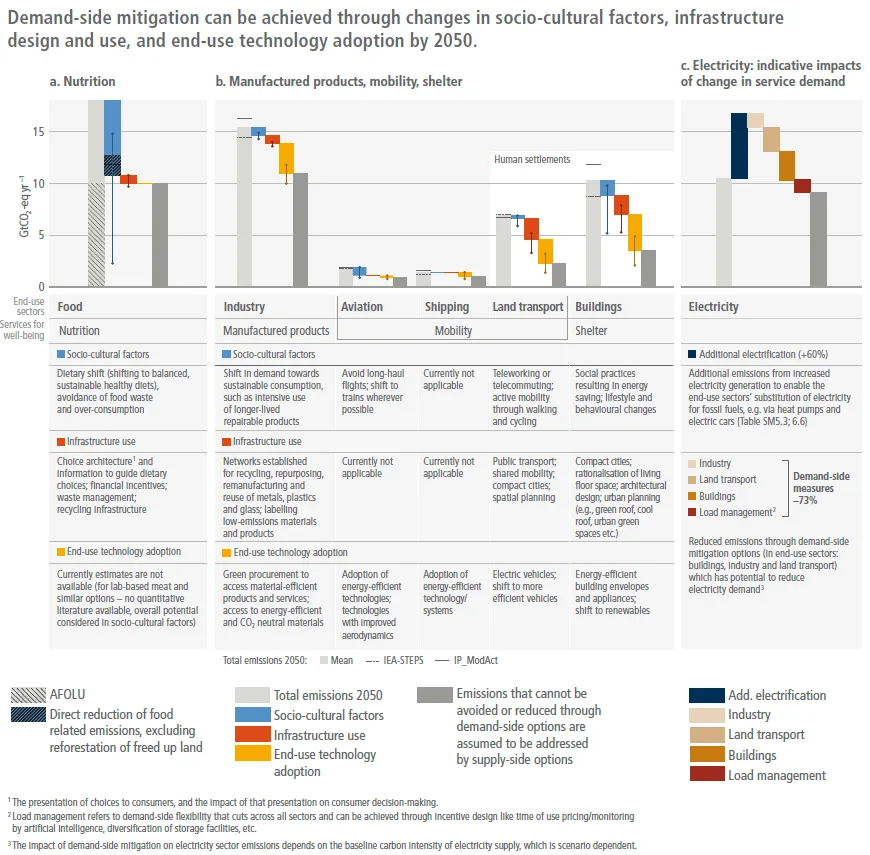
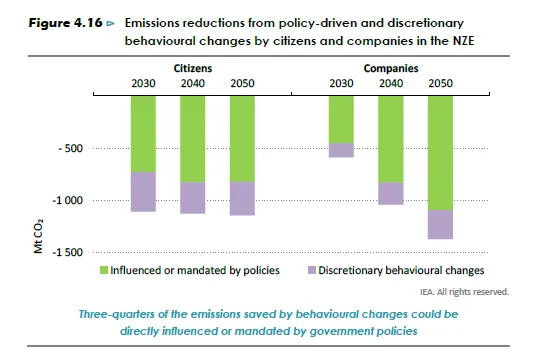
Here is what IPCC AR3 says about demand reduction strategies summarized as "avoid/shift/improve". Note the term also overlaps with infrastructure deployment policies like renewables or EVs. Sobriety potential depends on term’s definition and scope, so go into these graphs’ colors and legend for detail:
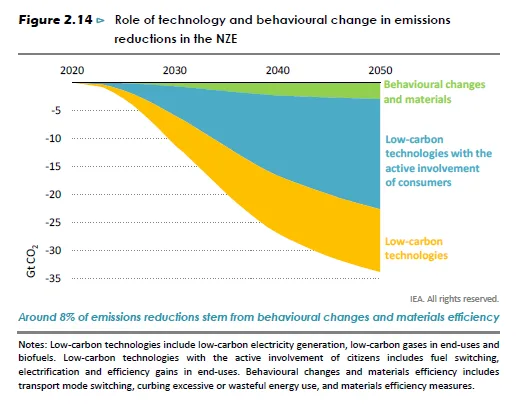
And this is just the beginning: the IEA, a growth advocate, here shows its vision of sobriety and importance in climate policies:
Sobriety is an integral part of transition scenarios; its absence's impact is known and ugly. The IEA issued a strong early warning during the Ukraine crisis to lower highway speed limits. Sobriety and transition go together!
So where is JMJ’s error since these strategies are essential, impactful, and the US neglects them for the “American way of life”?
Simple: sobriety is not the sole pillar nor sole actions. Even without it, we can go quite far reducing emissions, since current climate actions already include some sobriety – but not at correct scale: electrification, energy efficiency, footprint reduction, recycling development…
We must obviously move forward on all pillars at once, press governments for lagging ones to catch up. But if you discredit other pillars or downgrade them, you also lose transition gains without convincing, mostly helping climate skeptics.
Magical extreme sobriety discourse yields JMJ’s analysis: without sobriety no real climate impact and no difference between candidates since neither proposes sobriety policies.
Here is the 3rd principle: it is no longer possible to discuss climate without good knowledge of Net Zero scenarios. We must not oppose or hierarchize essential climate actions as if choosing; climate battle lasts decades, gradually transforming technology and organization, enabling new imaginaries. Transitions aren't quiet rivers; they lie at heart of power and financial stakes; some fight to keep status quo or slow transformations necessary. Power relations nibble away slowly; cherish achievements yet fight to advance.
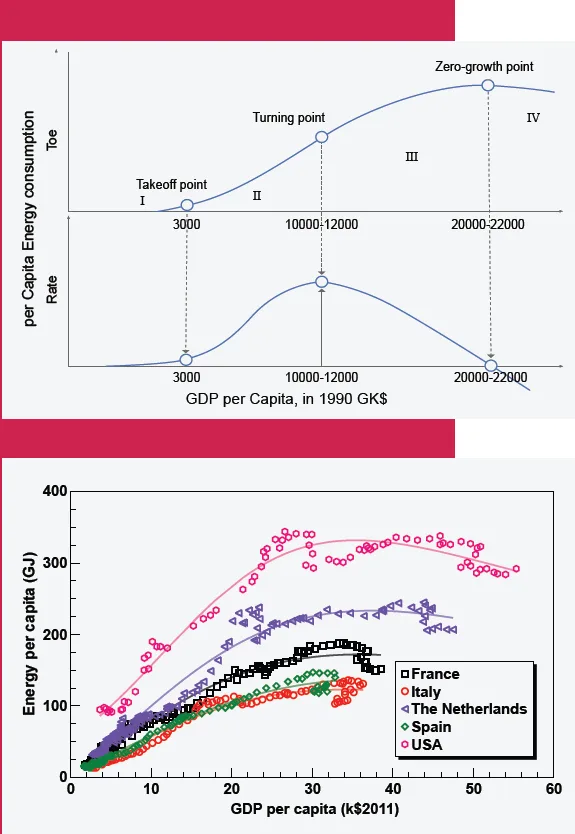
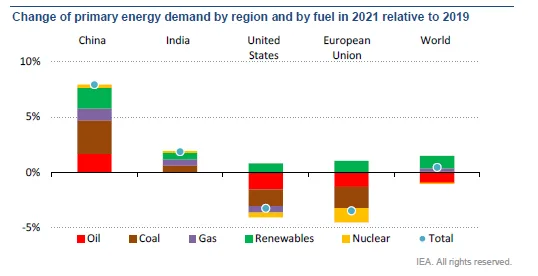
It evolves through waves of countries entering start, middle, and end of S-Curve. OECD countries are near top; populous emerging Asian countries grow, now responsible for 2/3 of emissions. China alone can create trends. This IEA graph shows this well:
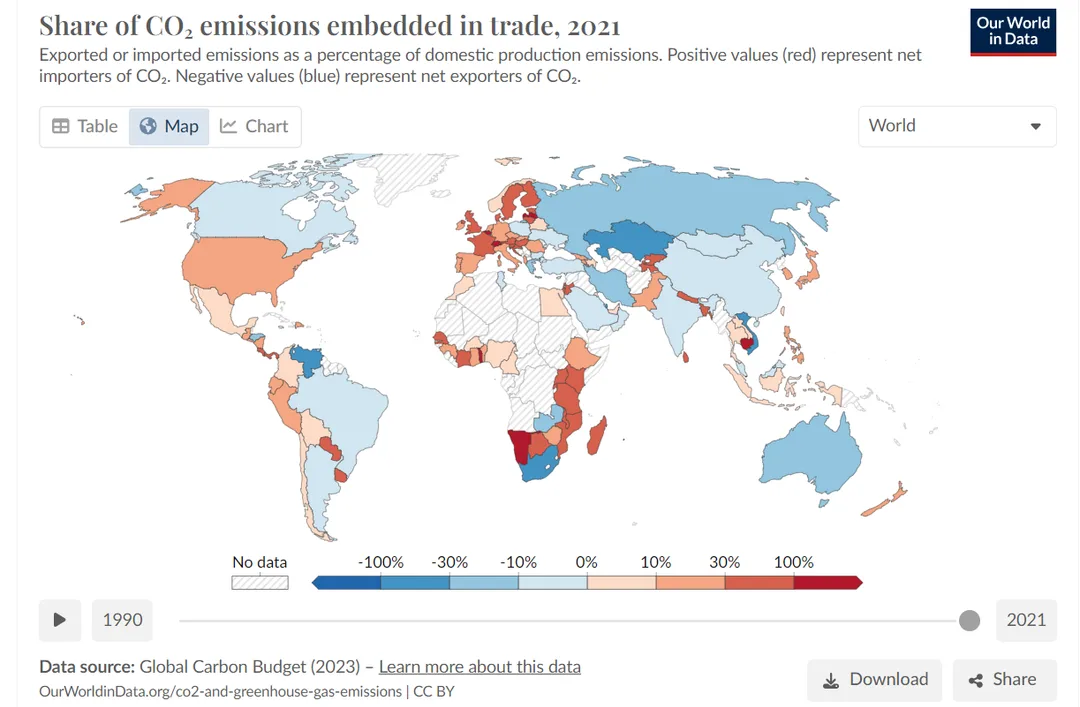
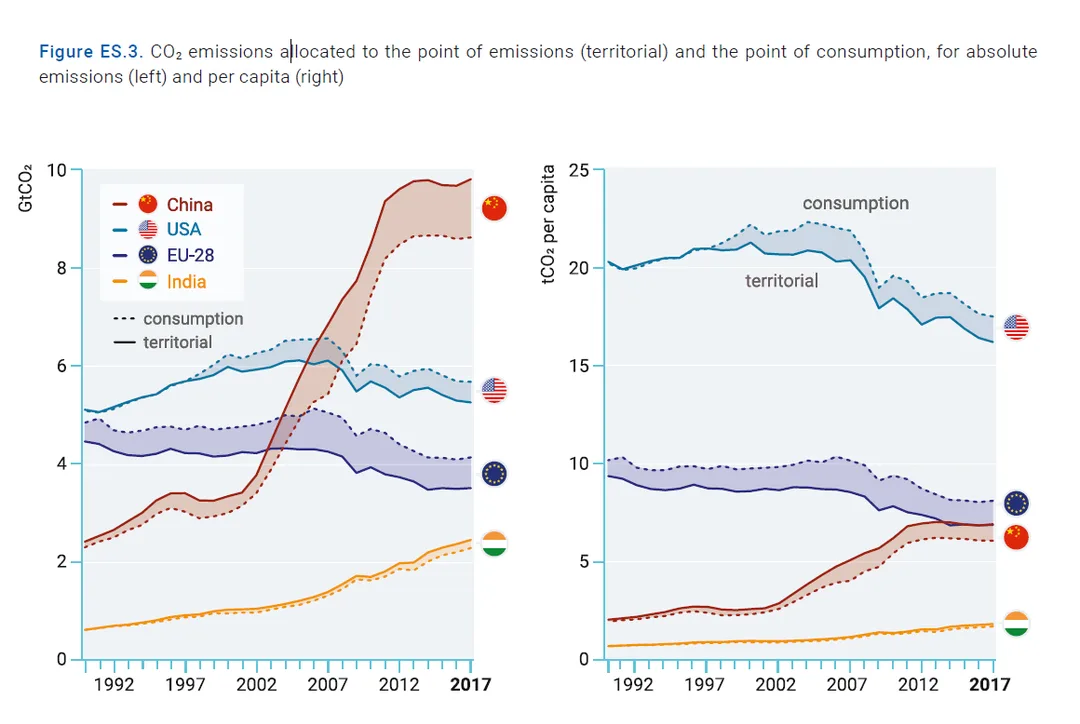
Of course, energy demand frictions exist via relocations but these can't explain deep trends or correct magnitudes, as this graph details CO2 export/import via trade – e.g. export/import explain only 10–15% of China's emissions, which mainly come from domestic market, same for India:
Aggregated curves mask this reality, causing misunderstanding of issues and solutions.
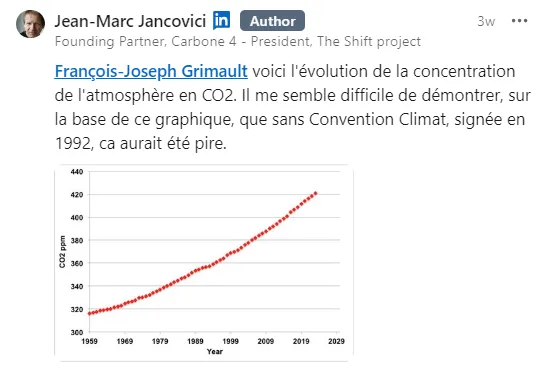
They enable inaction discourse, for example denigrating international climate negotiations. Here is JMJ’s reply to Trump wanting to exit Paris Agreements again: supposedly not a climate issue:
This major error is well explained by Loïc Giaccone, here is the article for those wishing to deepen international climate negotiations:
It is regularly repeated by various communicators in France linked to ecological, degrowth, and collapse spheres influenced by JMJ’s discourse. Today actually, climate skeptic circles spread it:
Comparatively, here are curves in carbon footprint (including imported CO2 , subtracting exports), data from 2017. Emission Gap Report, a COP reference document, then shows territorial emissions per Paris Agreement targets:
Emission Gap Report - 2019
Let’s conclude with a last principle: aggregated global curves show global situation but mask trends and don't allow demand analysis or projections nor solution identification.
Conclusion: The real radical discourse will sweep away the past and unite climate and environment actors around a positive transition discourse
JMJ’s influence is undeniable, in climate awareness, strengthening conservative nuclear circles in France, and the confusion many citizens and communicators face.
Many of his current messages have negative social impact: climate skeptical analyses by a climate information popularizer lose labels and spread beyond conservative networks.
In France, ecological and degrowth movements are especially touched by disinformation, and JMJ connection is easy to make: for many, he remains a key information source. Try to find communicators in those circles who apply principles from this article: very few, meaning discourses convey vast amounts of false info and non-conforming analyses.
Everyone should measure the consequences of ideological blindness:
-> Claiming voting Trump or Harris changes little for climate is ultimate nihilist position, paving way for disinformation and manipulations by actors fighting climate policies.
-> Claiming without sobriety no climate impact leads to diverting citizens’ engagement towards dead-end, conflictual ways.
Communicating on climate is no longer enough: we entered Net Zero era, i.e. implementing mitigation measures. They are well identified and largely consensual within decarbonation research trajectories.
We must advocate for regulations and policies enabling their implementation, refining research. Every citizen has an important role, influencing social negotiation evolution around transition.
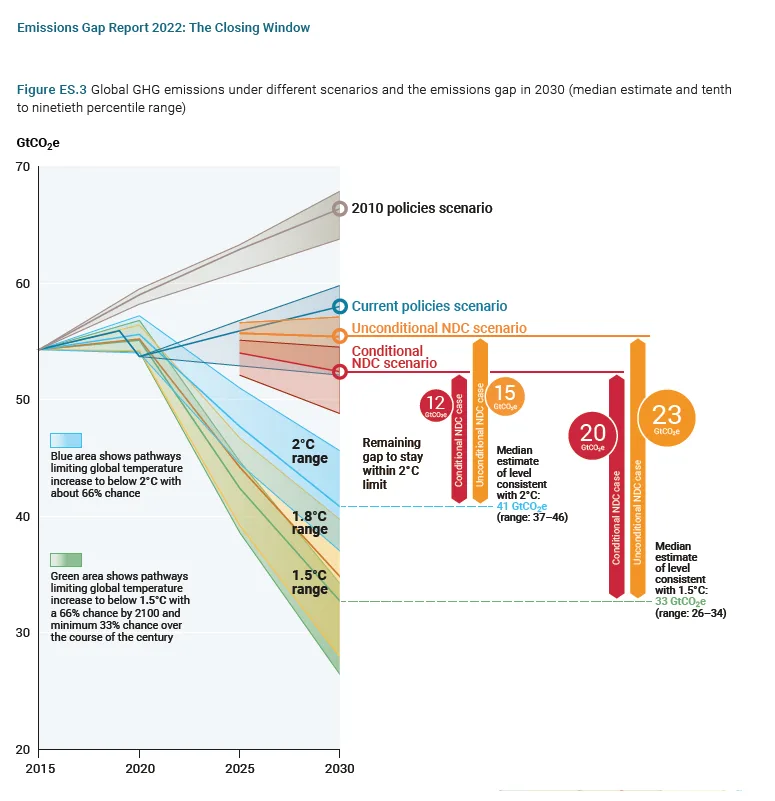
Because policies are not aligned under 2°C. The problem is not ignorance but that we don't implement the right policies, do not follow Net Zero scenarios including agriculture, environment, social justice, equity, and energy/social system transformations.
Emission Gap Report 2022
Why not implement right policies? Simple: between Net Zero scenarios and climate policies are governments, democratically elected and reflecting diverse societal influences.
Take France: social implosion, LR - Renaissance government influenced by RN. Don’t expect alignment under 2°C since influenced by conservative ideals including growth, austerity, fossils, nuclear, energy security...
More civil division empowers conservative circles with financial means to influence societies via media control, disinformation, and lobbyists.
How to escape this?
It is worth recalling: what makes an argument good is not the conclusions but methods to reach them. Participating in citizen debate means acquiring reflection tools, not swallowing conclusions.
Here are some ideas:
Experts and professionals: help democratize your daily tools. Listen to ideological critiques; if your tools can’t satisfy them, find alternatives and discuss.
Communicators: correct analyses when errors identified; evolve messages with new info and tools, challenge analyses to fit knowledge and respect values. This is the real, exciting challenge.
Citizens: simple shocking discourses trigger emotions and quick knowledge but carry disinformation risk and don’t allow sufficiently sophisticated opinion for positive debate participation. Refuse manipulation; vary sources honestly; step outside comfort zones; navigate imaginaries; avoid information bubbles which control you by building compliant environments increasingly hard to escape.
Politicians: democracy lives last hours; disinformation is too complex and efficient to combat, allowing control of democratic processes via citizen manipulation. Disseminating correct info won’t solve it; a rethinking of citizen roles and interactions with others and administrations is needed. Rebuilding social bonds requires ambitious social policies and reforms. Have courage; if not you, no one else; discontent will manifest via votes leading to destructive spiral.
These situations are not inevitable. We can and must act. The new generation especially: don’t repeat past errors opportunistically. Don’t form clans. The truly disruptive and radical discourse will unite us while preserving ideals and imaginaries diversity.
Learning to identify disinformation in public space, seeking convergence between actors with common causes, and learning about decarbonation scenarios research could already help.
**
For those wanting to identify essential climate actions, here are French reference documents:
For the electricity sector, RTE studies:
For other sectors, ADEME scenarios:
Here are our transition discussion workshops organized by Avenirs Energétiques
We analyse visits anonymously to measure audience statistics on this site.