
Renewable energies are today considered the cornerstone of the energy transition. However, the sun doesn’t shine at night, and the wind is not always reliable. So why/how do these technologies play an important role in our energy trajectories aimed at carbon neutrality by 2050?
What is the energy transition?
Electricity currently accounts for only about 20% of our global energy mix. The rest mainly consists of fossil fuels that we use either through combustion, for example in our car engines, or as raw materials for petrochemicals, for example to make plastic.
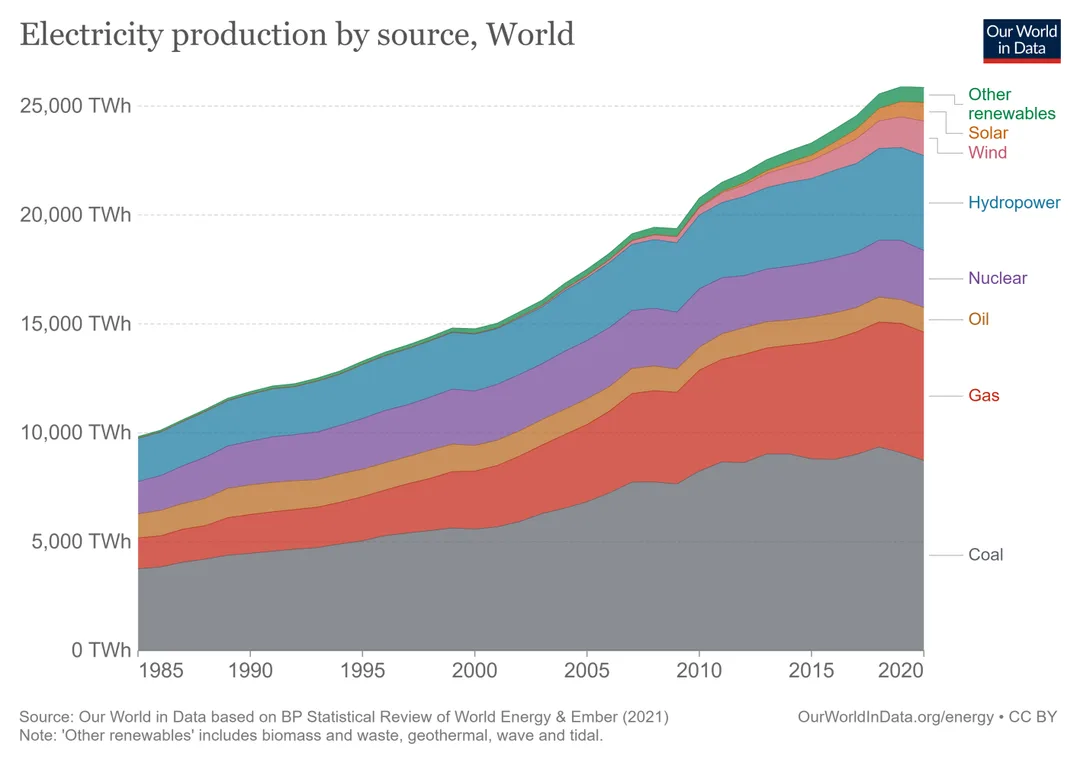
Electricity is still mainly produced using fossil fuels: coal (38%) and gas (23%). Then come hydroelectric power (16%), other renewables (10%), and nuclear (10%).
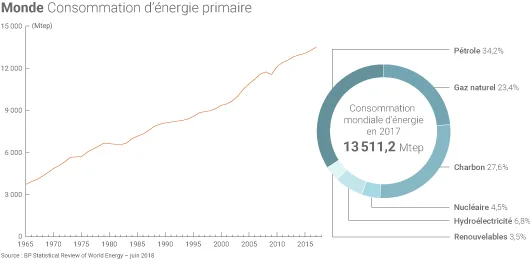
Combustion of fossil fuels produces the majority of our emissions (80%), with the rest coming from agriculture and land-use change. Therefore, it is necessary to stop these combustions quickly, but that would mean losing over 75% of our current energy production — leaving us with only 25% of available energy.
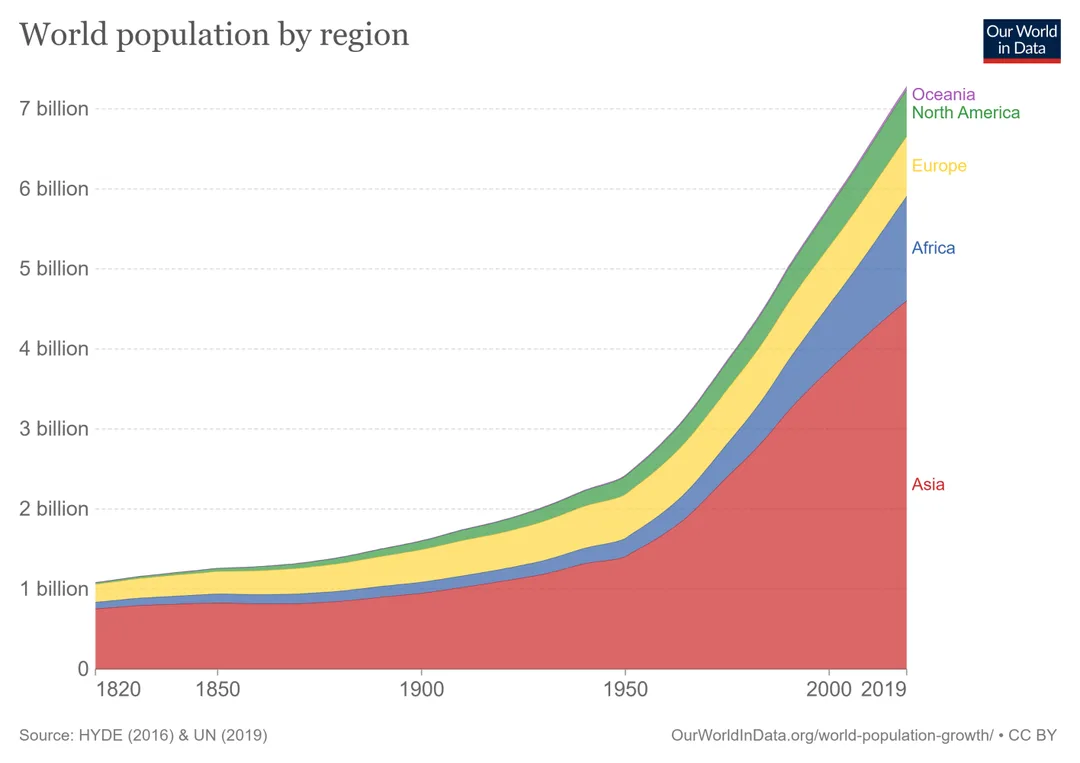
Looking at the historical evolution of our energy demand, one sees that 25% of our current energy production corresponds roughly to the energy level of 1950. This may seem close, but in 1950, there were fewer than 2.5 billion people, compared to nearly 8 billion today, and according to the latest Lancet study, a peak of 9.5 billion is expected by 2065.
Ensuring the survival of a population nearly 4 times larger with the same energy level as in 1950, knowing that within today’s global population 50% (almost 4 billion individuals) live with less than 5.5 USD per day, thus in complete energy poverty, seems an unrealistic scenario.
The objective of the energy transition is therefore twofold: on one hand, develop strategies to consume less energy, on the other, ensure the supply of the remaining energy needs by replacing fossil fuels with other low-emission sources.
What are these low-emission sources?
Many technologies exist, for example: wind, solar, green gas, nuclear, hydro, geothermal, biomass, and biofuels.
Most of these technologies are used to produce electricity, which thus becomes an important energy carrier in the energy transition, forcing a corresponding replacement of our infrastructures and equipment. For example, thermal engine cars will be replaced by electric cars, thermal ovens by electric ovens, heat pumps will be developed, and hydrogen production from electrolyzers will be expanded.
These new devices also require energy for their production, and generate environmental impacts, although incomparably less than fossil fuels. Strategies to limit these pressures must then be implemented, such as sobriety, energy savings, energy efficiency, and recycling.
Alongside the electrification of uses, we must decarbonize our electrical grids by replacing fossil fuel power plants with low-carbon technologies. As electricity becomes "green," this decarbonization also extends to electrical systems replacing fossil fuel uses, thus multiplying the impact of our climate actions.
Energy mix scenarios for a 1.5°C pathway?
To guide our climate policies, energy mix scenarios are developed by various actors such as national and international public institutions, associations, NGOs, industry, or research laboratories. These scenarios propose technological deployment trajectories to achieve net-zero emissions by 2050 under different assumptions.
They remain varied and naturally include uncertainties and debatable assumptions. However, they converge on at least two points:
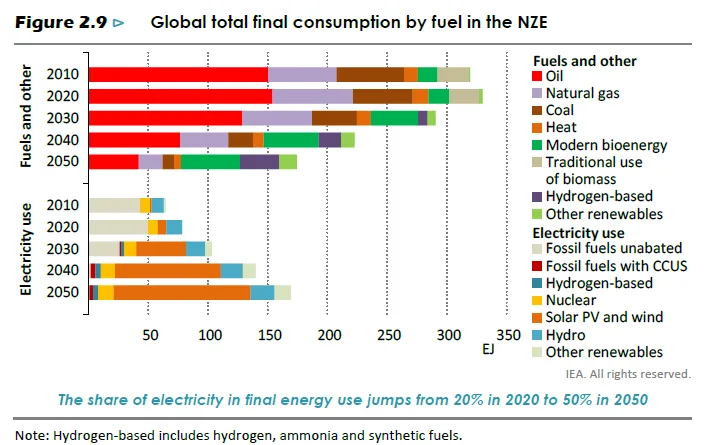
The share of electricity in the global energy mix must reach at least 50% by 2050
Renewable energies will provide the majority of this electricity
Here is, for example, the IEA scenario in final energy:
Several reasons explain this predominance of renewables, including: i) low LCOE ii) technical simplicity iii) ease of large-scale industrial deployment in all countries iv) low environmental impacts compared to other solutions v) diversity of financing modes vi) technological spillover effect.
Concerns about renewable energy development have been identified, including needs for and access to materials. Response strategies are being developed, such as recycling, new extraction processes, and various technological improvements.
See here the European Union’s critical materials strategy:
European Commission materials strategy (various links to explore): https://ec.europa.eu/growth/sectors/raw-materials/specific-interest/critical_en
An example is the case of lithium and batteries in Europe:
Extraction process: https://v-er.eu/
New extraction processes, in consortium with IFP Energies Nouvelles: https://www.eramet.com/en/activities/innovate-design/eugeli-project
Lithium extraction in Austria: https://europeanlithium.com/
Lithium in Europe: https://www.sciencedirect.com/science/article/abs/pii/S0169136818308011
Interesting site on lithium research: https://www.jadecove.com/research
Recycling: https://www.eramet.com/en/eramet-leader-battery-recycling-europe / https://www.eba250.com/new-battery-recycling-initiatives-in-europe/ / https://www.dw.com/en/battery-recycling-gains-speed-as-new-eu-regulation-pushes-investment/a-57933200 /
Let us also recall that the topic of materials goes far beyond the question of the energy transition, for example copper:
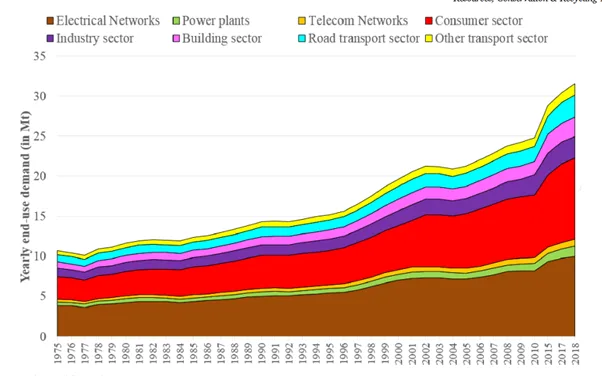
source https://www.iris-france.org/wp-content/uploads/2019/07/GENERATE-Working-Paper-5-E-HACHE.pdf
To date, there is no energy transition scenario, regardless of the source, that does not assume significant development of renewables. This does not mean that renewables alone are sufficient to reach our climate trajectories: they are not. Nor does it mean that renewable development should be unregulated. Simply put, contributing to their virtuous development within an appropriate framework is a positive action for the climate.
How does an electric system with a high renewable penetration work?
The majority presence of renewables in our electrical grids assumes that these technologies can ensure real-time supply-demand balances. How can this system function when renewable production depends on weather conditions?
Such a system prioritizes renewable energy flow, which otherwise would be lost or need to be stored. The best strategies are then examined to cover the residual demand, i.e., demand reduced by renewable production.
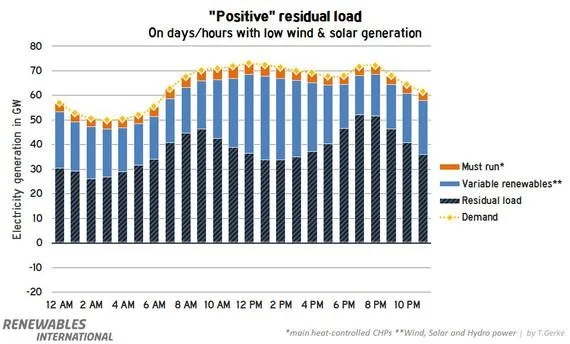
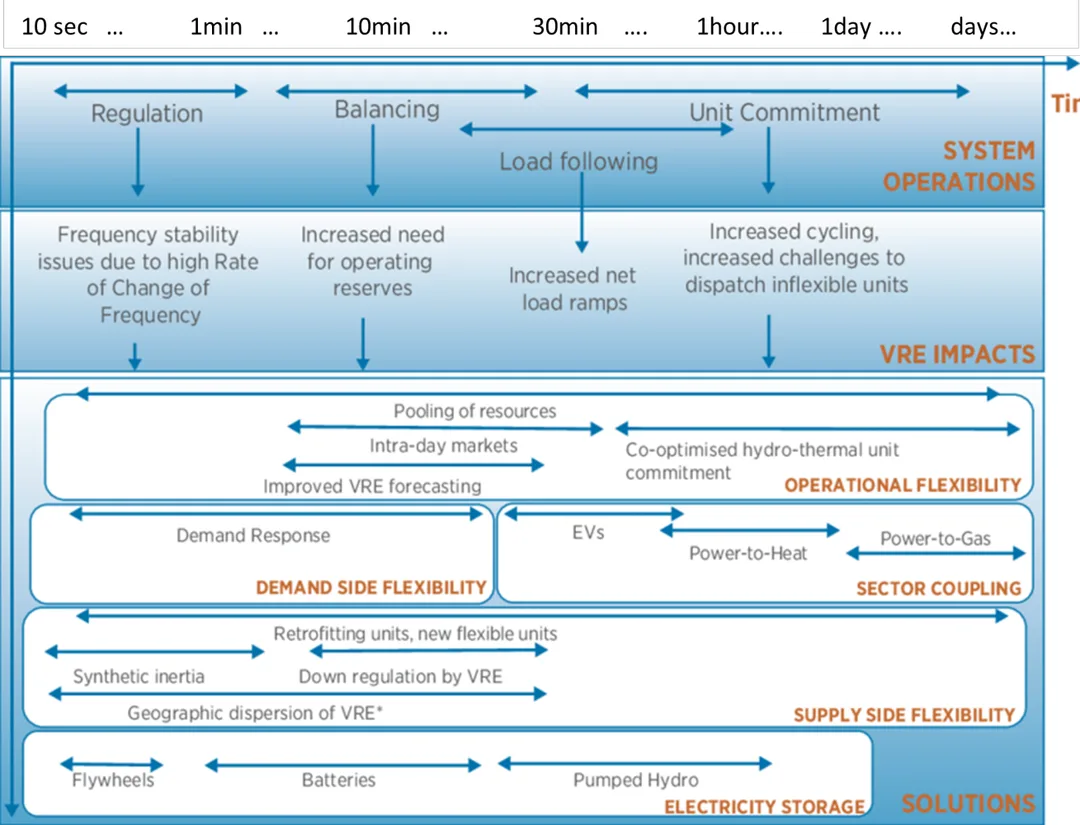
The higher the renewable penetration rate, the lower the residual demand. But also, the greater the need for flexibility. Flexibility is the system’s ability to adapt to renewable production variability. Tools vary depending on the time scale of variability: from seconds to weeks, even years. The graph below provides an overview:
A system with a high renewable penetration rate relies mainly on:
a high renewable penetration rate, which can be oversized to enable sector coupling and reduce residual demand
partially flexible demand (for example: hydrogen production can be stochastic and stored for later use)
dispatchable and flexible power plants and equipment acting as a "mirror" to renewable capacities, some of which remain on "stand-by", used to cover the remaining inflexible demand according to renewable production fluctuations. Among these are batteries, pumped hydro storage (PHS), or green gas plants, whose capacity factors will be low, requiring adapted market conditions to secure their financing.
Interconnections also allow supply/demand optimizations across a larger and more climatically diverse geographic area, enabling system cost reductions. For example, the role of dams can be adjusted within an integrated electricity platform: they could contribute to managing intermittency instead of baseload operation, as is the case with the Norway-UK interconnection:
We will illustrate 3 operating principles using a 100% renewable simulation for France – winter case (source: https://doi.org/10.5547/01956574.43.1.bshi)
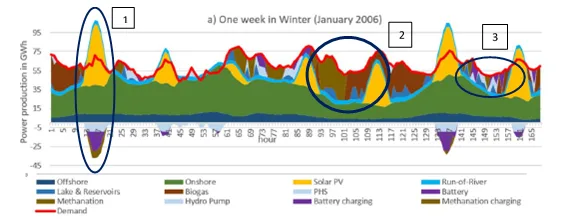
solar is oversized, allowing maximum possible yield over the year. When production exceeds demand, it is used to charge batteries, fill PHS, or produce hydrogen.
in the absence of wind and solar, for large powers and durations, green gas plants take over
in the same case but for small powers, a batteries/PHS/green gas plant mix can be used
Let us clarify some common misconceptions appearing in analyses on these subjects:
Renewable energy development does not lead to gas dependency! It is actually the opposite: in a world currently relying mainly on fossil fuels, renewable development aims to decrease the capacity factors of gas plants to a very low level, around 5% of electricity demand, some of which replaces direct gas use in industry or buildings. In parallel, we can develop green gas to partially cover this quantity.
Nevertheless, gas development is a point of attention for two reasons. First, unanticipated nuclear plant shutdowns lead to increased fossil use in the short term. Second, oil/gas companies have a strong interest in expanding gas supply both in the electricity sector and others (e.g., blue hydrogen).
A renewable world does not rely on large amounts of batteries! Batteries are used for short-term balancing called "day ahead" and are not the answer for long periods with little sun and wind. To give an idea, for a 100% renewables French case, batteries amount to around 150-300 GWh, roughly the order of TWh for the whole of Europe (depending on scenarios, this volume can vary).
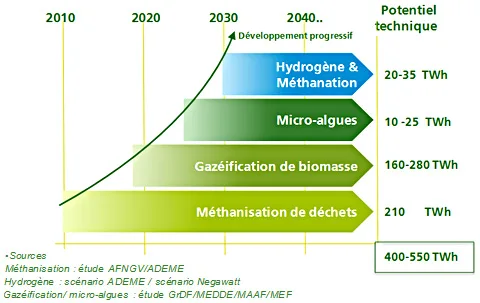
Recall here the potential of gas in France:
How to face a Dunkelflaute?
Dunkelflaute is a German term derived from Dunkelheit (darkness) and Flaute (calm) and refers to those few weeks during winter in Europe with little sun and wind. In English, it’s called "Dark Doldrums."
Such an event is thus covered by (green) gas power plants. According to simulations, although installed capacities may be significant, the required energy would remain around 5% of demand.
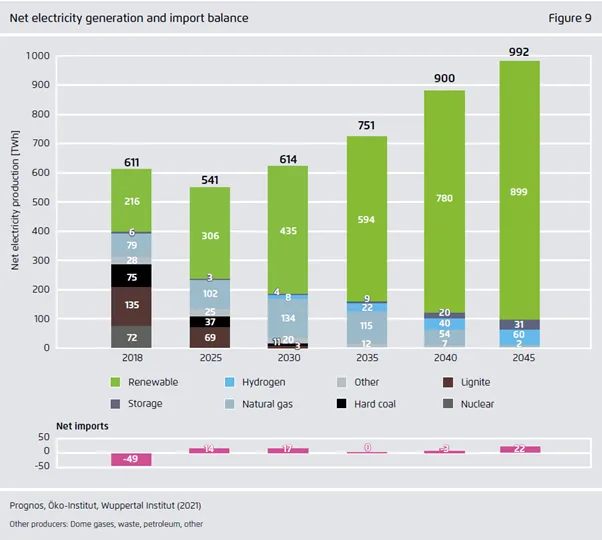
Take Germany as an example. Since it aims for a 100% renewable system, it must have gas plants with sufficient powers to cover, in mirror, part of the inflexible demand (also covered by biomass, hydro, and storage, in addition to renewables). But simulations (Agora, May 2021) based on climate scenarios and a 2045 demand of 1000 TWh show a total green gas need of 60 TWh, i.e., 6%.
Assuming an installed gas power plant capacity of 60 GW, corresponding to current installed gas + coal capacity (simple hypothesis for order of magnitude), and a production of 60 TWh, this means an average capacity factor of 11.5%.
Then arises the financing question for these plants, requiring changes in market rules. The following elements can be cited:
some of these plants can be owned by the national operator, bought back from private operators whose revenue expectations have evaporated with the energy transition. These plants are used depending on Dunkelflaute severity, knowing that such a climatic event varies in duration and magnitude by year. There is no need to mobilize private capital for exceptional situations.
the other part should benefit from various remuneration mechanisms, including capacity payments and a high electricity price to provide basic revenue in the few weeks of operation per year.
For resilience reasons, strategic green gas stocks equivalent to several weeks can also be maintained.
See the excellent article by Thijs Ten Brinck below to explore DunkelFlaute in more detail, which inspired the writing of this article:
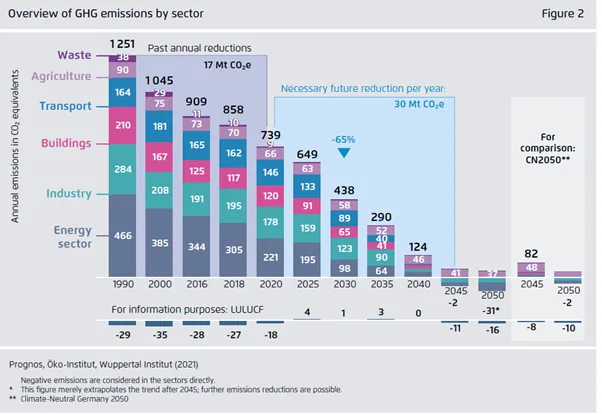
Recall here Germany’s direction (indicative scenario, source = Agora):
Emissions (countries)
Electricity sector (note the gas part evolution):
What about nuclear?
What role does nuclear play in climate scenarios?
While this technology remains a non-emitting solution that should be developed, its potential appears much more limited compared to renewables by 2050 due to long development times (in 2020: average construction time was 117 months) and many constraints related to the technology blocking widespread dissemination.
The most optimistic scenarios, notably from the nuclear industry itself, give a maximum of 25% of projected electricity demand for 2050:
To reach 25% of demand by 2050, more than 35 GW/year of nuclear plants would have to be installed. Yet over the past 30 years, the average annual installation was 2 GW/year. We would thus need to multiply installations by 17x, starting now. Taking SMRs: each SMR corresponds to 1/10 the power of an EPR; therefore, we would need to install 170x more per year.
In 2020, net of retirements of old reactors, 400 MW were installed, only 1% of the annual capacity needed to reach 25% of demand by 2050. In contrast, 260 GW of renewables were installed, i.e., 650x more capacity.
Current nuclear development figures therefore point to a trajectory around 10–15% — and new technologies, SMRs or GEN4, do not seem likely to change these projections, partly because they will enter the market late.
IAEA projections: https://world-nuclear-news.org/Articles/IAEA-forecasts-doubling-of-nuclear-capacity-by-205
IEA analysis: https://www.iea.org/reports/nuclear-power
These projections are naturally reviewed regularly: they remain complex exercises, especially given our current highly uncertain and rapidly changing environment.
The impact of nuclear in grids with high renewable penetration
Nuclear indeed has a role to play in such a system. On one hand, it lowers flexibility needs, including capacity factors of gas (green) plants; on the other, it helps to alleviate pressures on and exerted by renewable sectors.
To evaluate its economic relevance, the total system cost must be compared with and without nuclear depending on assumptions about plant costs. Such simulations can identify “no-regret” strategies, such as the three pairs of EPRs (RTE’s nuclear scenario N1 proposes 8 EPRs for 2050).
Some remarks:
the need to reduce construction costs to positively contribute to total system costs. We are talking about at least 50% below current costs in Europe. Example results:
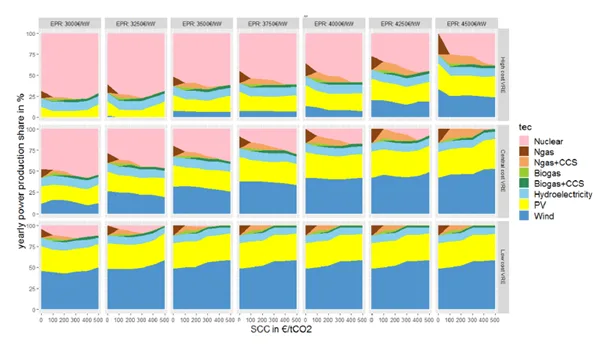
source: https://doi.org/10.1016/j.eneco.2020.105004
the higher the renewable rate, the higher the cost of flexibility. Nuclear thus competes where flexibility costs are progressively very high, making this solution attractive depending on its penetration rate and investment cost.
new nuclear is currently not designed as an economic flexibility tool. New plants must run at maximum capacity, mainly due to their kWh cost. Indeed, electricity prices from new nuclear plants are set through long-term electricity purchase contracts (for the HKP case, called CfD = Contract for Difference). This price depends on capacity factor. If 10% flexibility is planned, meaning the possibility to reduce 10% of production, it must be included in the price. For HKP: EUR 107/MWh becomes EUR 117.7/MWh, i.e., EUR 10.7/MWh extra spread over all electricity sold. By comparison, take a solar plant in Spain: EUR 15/MWh. Add 20% flexibility: EUR 18/MWh, i.e., EUR 3/MWh extra over all kWh sold. This better explains the interest, with renewables, of oversizing production, which minimizes residual demand while possibly doing curtailment or sector coupling to reduce system costs.
The worldwide development of nuclear capacity is a point of attention: renewable development and its impact on emission reductions are partially absorbed by the global nuclear fleet’s decline, slowing emission progress.
A nuclear revival (outside China), whose share in the energy mix has been decreasing since 1996, would however require a complete reorganization of the sector, notably in governance, communication flows, and a strategic repositioning within a predominantly renewable world.
Conclusion: what signals does the current gas price surge send us?
End of hydrocarbons, nuclear revival, energy shortages: these are the messages heard these days in France’s media amid rising gas prices. Not a single rational communication seems to have been issued.
The reality is very different: we are in full energy transition and are actually seeking to slow fossil fuel development, in particular by limiting investments in these sectors! So beyond production peaks, we are trying to generate both demand and supply peaks.
Unfortunately, our policies to slow fossil development are almost non-existent, so it is likely the current phenomenon is cyclical. However, it must be transformed into a structural phenomenon to meet our climate goals.
What solutions? Well, these have been discussed throughout this article. They involve accelerating the implementation of our climate change fight programs, which are well-known, with some energy-sector-related elements as follows:
Slow fossil development: carbon tax as high as possible in all sectors (along with redistribution mechanisms to avoid penalizing the poorest), professional retraining towards transition sectors, emission constraints, buyback of fossil assets for decommissioning (e.g., https://www.reuters.com/world/uk/exclusive-citi-hsbc-prudential-hatch-plan-asian-coal-fired-closures-sources-2021-08-03/), stopping financing of O&G assets (e.g., changing bank prudential ratios based on funding nature)
Massively develop renewables: double or triple annual installations, develop flexibility mechanisms, develop interconnections, smart grids, demand management systems, market rule evolutions, better integration of electric platforms, support industrial initiatives, strengthen citizen involvement in projects
Accelerate electrification of uses, especially with electric vehicles and charging stations (while accelerating the phase-out of thermal vehicles)
Develop green gas
Develop sobriety policies, energy savings, and energy efficiency
Avoid shutting down nuclear plants except for strong justifications (economic or technical, and for France to manage cliff-effect). Advance new plant construction projects where appropriate, provided that the nuclear sector restructuring happens in parallel to avoid past 20-year difficulties and prepare for ongoing energy/electric system changes.
Focus policies on climate challenges and at least 10-year visions, and launch necessary social and institutional transformations.
Identify “no-regret” scenarios to accelerate decision-making
We know what must be done and have all the tools at hand to meet our 2030 goals... Let’s not be afraid of the big bad DunkelFlaute!