NetZero Citizen
Home
Transition
Decarbonization
Write to us
NetZero Citizen
Utiliser de nouveaux outils pour penser la transition et bâtir une vision plus consensuelle de l'énergie - Part 1

Using New Tools to Think About the Transition and Build a More Consensus-Based Vision of Energy - Part 1

Karim Megherbi

Original source

Some time ago, I received two panels from Jean-Marc Jancovici's "Le Monde sans Fin" (JMJ) that I was asked to comment on but did not follow up, not finding the approach appropriate.

However, as our current context of energy and climate crisis demands strong measures and commitment to ecological transition, I recently observed that:

  • the opposition movements against wind turbines use the same arguments disseminated by the comic book. These movements, some of which are supported by circles of senior civil servants and elite engineers linked to the nuclear industry, have recently managed to find a hearing with our President, encouraging him to postpone our goal of doubling wind capacity to 2050 instead of 2030 (see: Belfort speech, reference at the end of the article). This position will almost certainly create problems given the current energy crisis—indeed, it would be surprising if this position were not revised
  • this comic quickly spread in France, a country that seems more receptive to the arguments proposed in this work than elsewhere

So, I finally decided to write this article taking an angle that I hope is constructive, which consists in using these two panels as a basis for a broader discussion covering our climate scenarios and the role of electricity, nuclear and renewables in this context, both internationally and in France.

Reaching zero emissions by 2050 is a vital question for humanity, as undoubtedly confirmed by the IPCC. However, this objective can only be achieved by implementing a long list of actions covering all sectors, far beyond the scope of the electricity mix question—a sector where France ultimately has very little flexibility. It would be healthy to build a calm debate space on this issue, to turn this page quickly.

This article will be in 2 parts. The first focuses on the environmental impact of renewables and the technological selection criteria for our electricity mix (panel 1), the second will address the link between gas and renewables (panel 2).

Brief overview of the definition of ecological transition

I propose the following definition of Ecological Transition: the transition of our current society into a new society that will find itself in a "net-zero" situation including all sectors such as agriculture, forests, our energy systems, our waste, etc...

  • A "net-zero" situation means that our emissions are balanced by carbon sinks (the "pluses" are offset by "minuses"). Since our capacities to capture carbon, both artificially via technologies and naturally with forests, mangroves, soils, and others, are limited (the "minuses" will not be very high), this means our society must emit very little CO2 to be "net-zero"
  • The difference between energy transition and ecological transition is the scope covered: [energy] = Energy Transition / [energy + agriculture + soils + waste etc...] = Ecological Transition. Likewise, ecological transition includes biodiversity considerations in all economic sectors.
  • The temporal horizon is 2050 to have a 50% chance of staying below 1.5°C, and 2070 to have a 50% chance of staying below 2°C. The difference between 2°C and 1.5°C is very important: we are talking about hundreds of millions fewer people lacking access to water, for example.

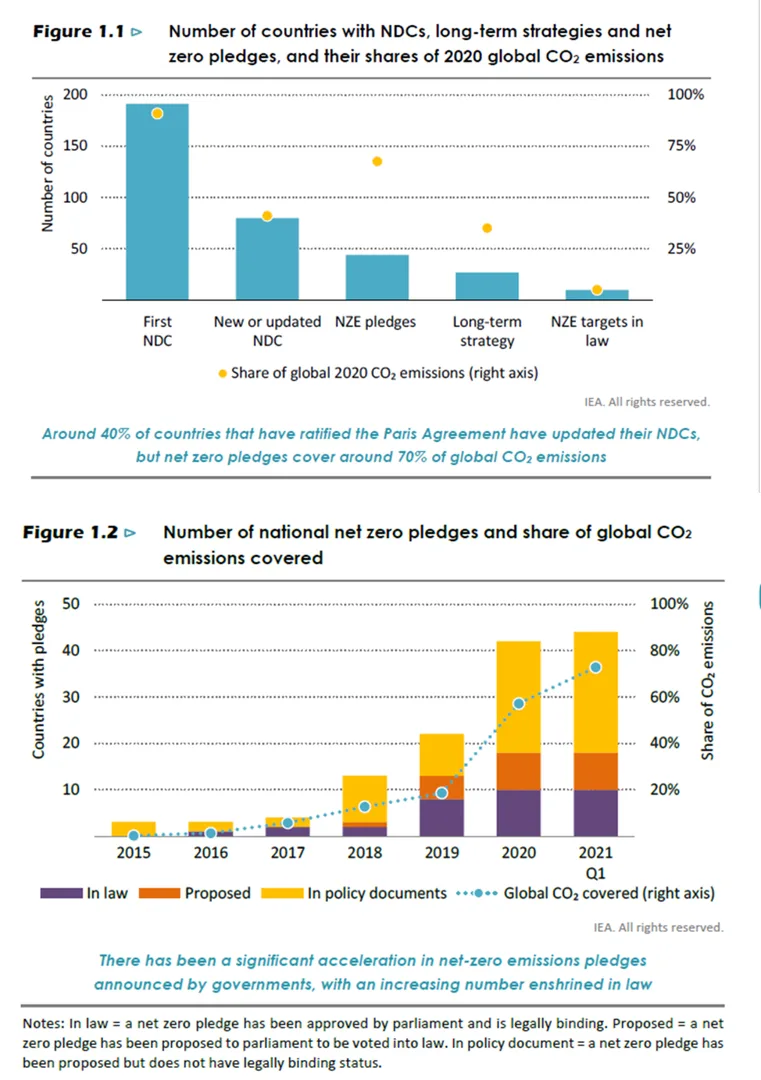
There are dozens, even hundreds of ecological transition scenarios worldwide: several per country, per continent, or covering the world. Many countries have made commitments to reach a NZE situation by 2050, 2060, or 2070, which in some cases have been translated into laws and policies.

This trend will strengthen in the coming years, and more and more countries will make these commitments, and more commitments will become laws and policies. See below the evolutions over recent years:
No alt text provided for this image

NZE scenarios are very diverse, covering variable scopes and based on hypotheses and strategies that vary from one document to another. The recent IPCC AR6 report provides an overview of all these scenarios and the different proposed strategies.

When analyzing these various scenarios [NB: this is one of my activities; for example, within the Coalition for Action, I work on the critical review of the IEA 1.5°C scenario. To learn more about the Coalition for Action: https://coalition.irena.org/] one quickly notices that these scenarios converge overall on the main actions to be taken.

⚠️ There seems little point in having sharp debates today over the exact target rates of renewables, nuclear, electric vehicles, sobriety for 2050, and even less to justify slowing the transition under the pretext that an agreement on the right trajectory until 2050 still needs to be found. The list of actions is practically the same in all scenarios.

⚠️ Of course, these rates will progressively become more important and precise as we progress in the transition. However, in 2022, we are just beginning our climate policies—still imperfect—so all the main identified actions must, in all cases, be deployed largely from today, whether sobriety, electrification, renewables, etc... The debates should therefore be reframed within their temporal horizons: our goals and actions to be taken by 2030 are actually very clear—and largely achievable with discipline and coherent policies—and put us on a trajectory that we can refine progressively based on results.

Ecological Transition in France: what does JMJ’s Shift Project say?

Like many nations, France also has its own energy and ecological transition scenarios. On the one hand institutional ones: RTE and ADEME. On the other hand, two associations: Negawatt and the Shift. An official scenario should, hopefully, be finalized soon: the National Low Carbon Strategy.

As internationally, there is convergence in the key climate actions list (sobriety, electrification, renewables, green gas, etc...), the same is found in France. Except for a few points—among them nuclear and the role of biomass versus electricity—the proposals are ultimately very similar.

The same applies to the PTEF which offers a list of actions similar to existing scenarios, in France and internationally. Regarding electricity sector trajectories, the Shift even relies on RTE scenarios and thus aligns with institutional scenarios.

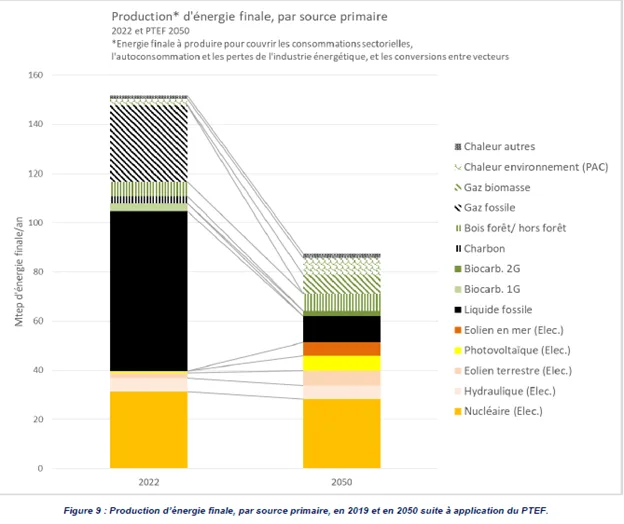
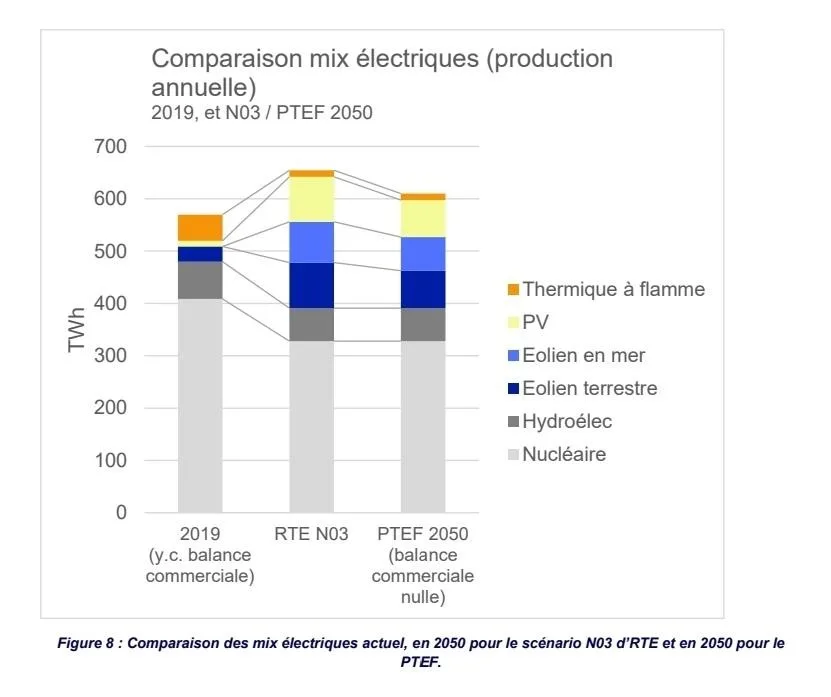
In the energy sector, here are the evolutions the PTEF proposes:

Electricity mix:
No alt text provided for this image

Energy mix, including electricity:

No alt text provided for this image

And here I put in comparison the IEA's mix
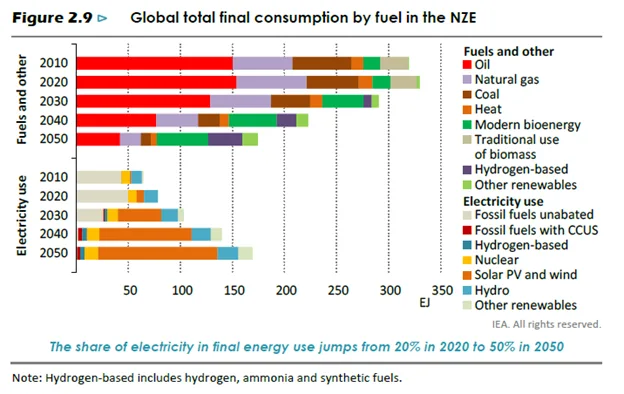
No alt text provided for this image

As can be seen in these charts, and then by looking at the content of the proposals (I leave it to everyone here to delve into these documents), the same major principles are found for the 2050 mix:

  1. Our energy demand must decrease (in the IEA scenario, the decrease is mainly in OECD countries, so aggregated it is only 7%, as it is offset by controlled demand growth in emerging countries)
  2. Our electricity demand will increase (>+20% for the Shift, with a share of at least 50% of the final mix, which aligns with all existing scenarios. The increase is stronger in the IEA scenario due to emerging countries—for example, hundreds of millions, even billions, worldwide still lack electricity access)
  3. Beyond electricity, biomass is present in different forms in both scenarios, as well as oil for various activities including petrochemicals. There remains 29% oil outside electricity in the Shift scenario, more than for the IEA, which thus supposes that by 2050 the demand from other countries in the world for oil has been met, and France can access this quantity.
  4. On the electricity part, a substantial development of renewables (40% for the Shift, 70% for the IEA). Nuclear takes a different place in the two scenarios, mainly because of France's particularity with a 70% nuclear mix today—we could however critically review the Shift’s proposal (for those wanting to go further, see Annex 3 here: https://www.linkedin.com/pulse/la-sobri%C3%A9t%C3%A9-nest-pas-synonyme-de-d%C3%A9roissance-ouvertes-karim-megherbi/)
  5. In both scenarios, batteries for cars and transport more generally, and hydrogen for industry are included.

⚠️ Renewables, batteries, and hydrogen play an important role in the PTEF, which envisions widespread deployment of these technologies in France by 2050. Shift thus implicitly assumes that by 2050 these technologies will continue to develop massively worldwide to achieve the required competitive level for adoption, and that intermittency issues for grids, raw material constraints for equipment, and other challenges will be resolved. These implicit assumptions underpin the feasibility of the PTEF, which cannot exist without them, like all decarbonization scenarios.

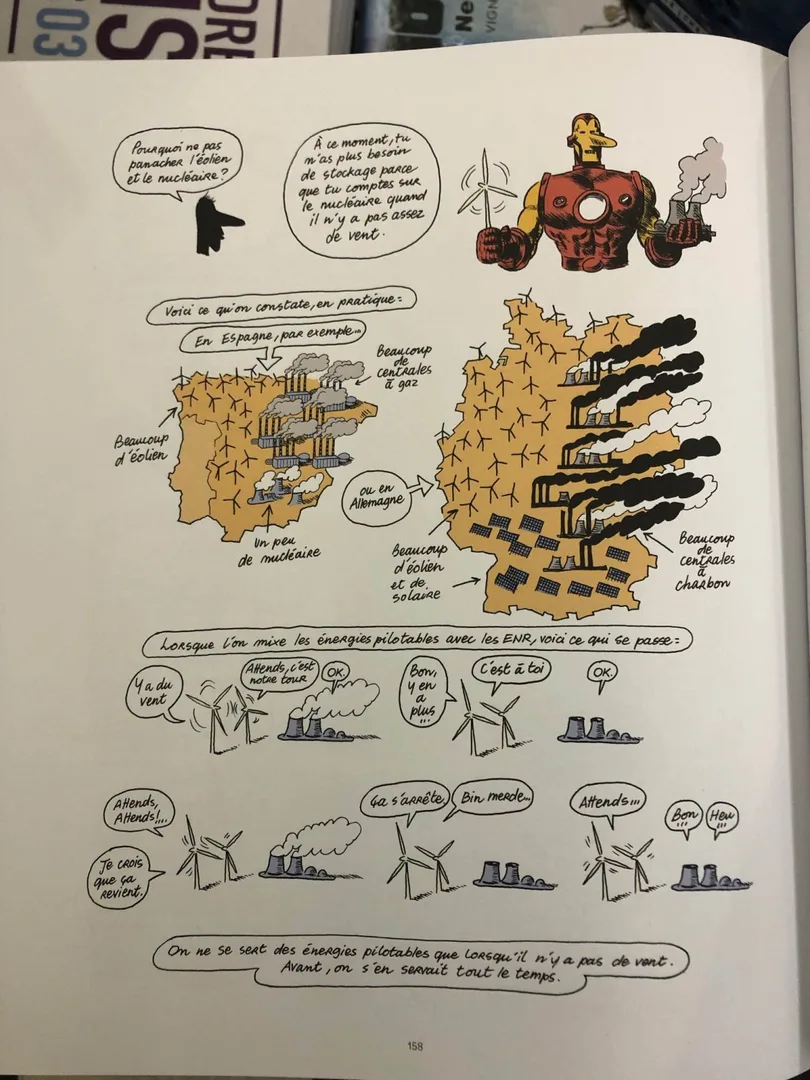
Presentation of the 2 panels

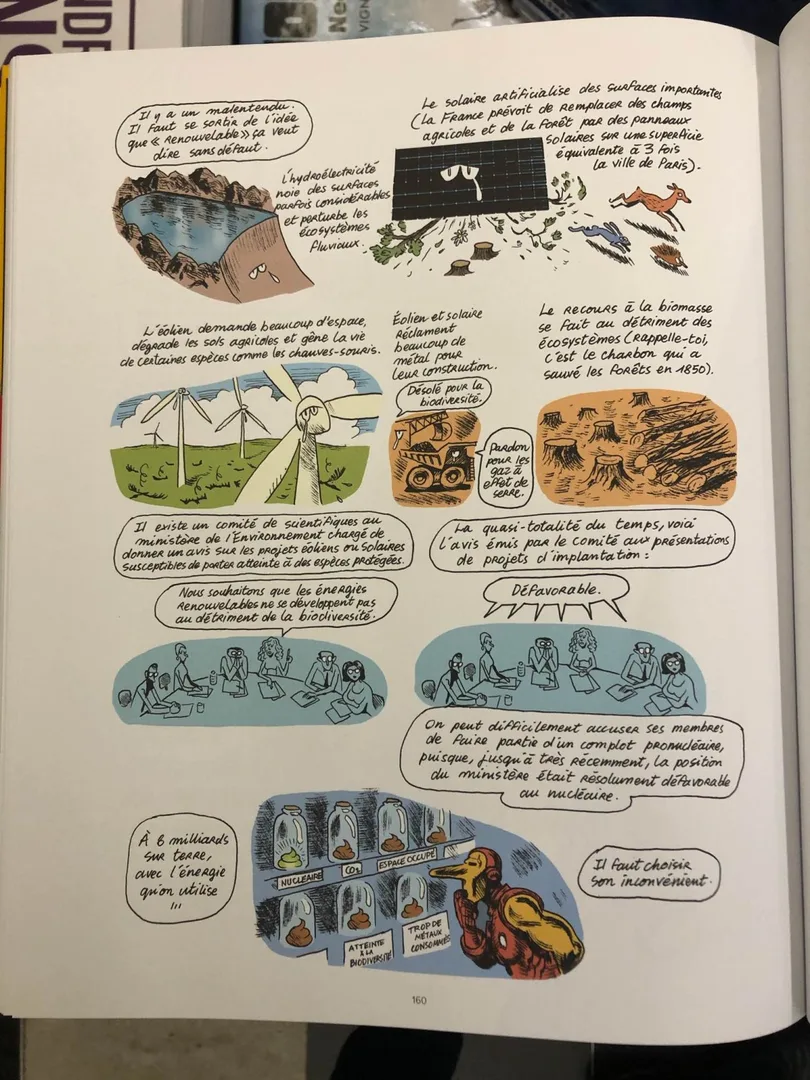
The 1st: Renewables and environment/technology selection criteria
No alt text provided for this image

The 2nd: Renewables and gas

No alt text provided for this image

Now to the analyses!

No alt text provided for this image
The aim of these two panels: rehabilitating nuclear power

The objective of rehabilitating nuclear power, the background of JMJ’s thinking, naturally appears in this work. On the one hand, several pages and sections are devoted to it, easily identifiable by the reader. On the other hand, in general, the entire energy argument of JMJ has this goal, which is much more complex to identify for the non-specialist public, who imagine they are dealing with a popularized scientific discourse.

I had already drawn attention to this point here, quickly describing the main guidelines of this ideology:

I share here Stéphane His's article regarding the content of - Karim Megherbi on LinkedIn | 20 comments

And here is an analysis confirming this point made by Polytechnique alumni:

A critique of Jean-Marc Jancovici's comic "Le Monde sans fin" (Class '81 alumnus)

A goal that is certainly defensible...

Rehabilitating nuclear power presents a climate benefit that is certainly defensible. This technology, indeed declining, is controllable and low-carbon, two elements beneficial for climate and our electricity grids.

Some citizens, in France and elsewhere, oppose the development of this technology for various reasons (among them: risks, waste, proliferation, isolation of this industry and decision-making chain escaping citizens) and naturally, this viewpoint must be respected, especially since the arguments used are often perfectly valid when formulated on a documented basis.

However, let us recall several elements in favor of nuclear:

1. Our climate goals require us to balance different risks, including those related to climate drift, which are extremely strong and immediate.

The increase in forest fire frequency and water crisis will certainly strongly mark citizens' minds. It is no longer possible to turn a blind eye.

2. The maximum potential for nuclear deployment remains limited, which naturally bounds its risks

Recall that even a significant increase in installations will only maintain the global installed capacity. Let's look at the numbers:

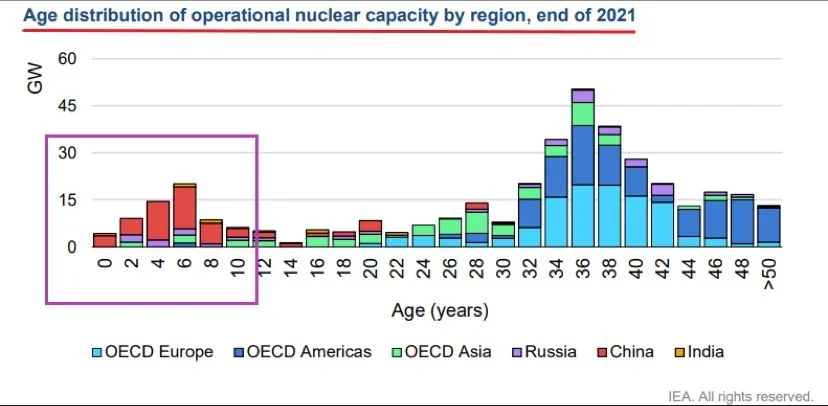
  • Waves, or rather tsunamis, of nuclear plant retirements will arrive over the next 20 years:
No alt text provided for this image
  • The pace of installations over the last 10 years will not replace the global fleet, and if this trend continues, installed capacity will decrease. Nuclear's share in our global electricity mix went from 17% in 1996 to 10% today. See here the sector results in 2021 (capacity decline) in Annex 2
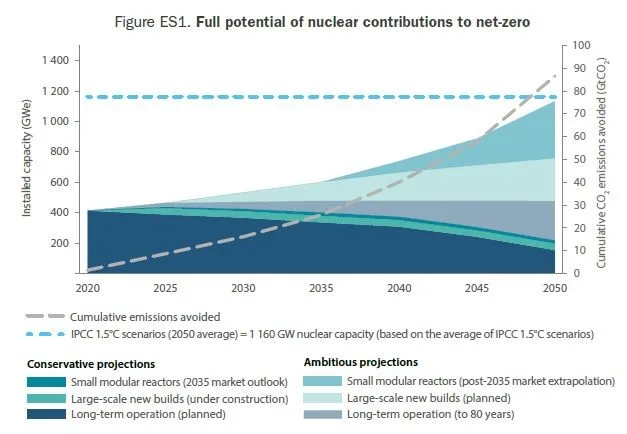
  • The high case of the IAEA foresees 792 GW for 2050, almost double the current capacity (~400 GW). This would mean, excluding replacements, 14 GW per year over the next 28 years, a number we are still below (currently less than 10 GW). While this does not give certainty about the future, nuclear's future—a long-term technology, unlike renewables that can react within months—seems today to be shaped in China, the pipeline outside this country being more limited.
  • Assuming we reach the high case, nuclear would still represent around 10% of our electricity mix for 2050, since the share of electricity must increase by 2050 within our overall energy mix.
  • The maximum potential of nuclear was estimated by the NEA (this is theoretical potential, not projections) at 1,200 GW, and a large part of growth beyond IAEA's high case comes from extremely aggressive assumptions about the sector evolution, including massive SMR development—a technology that does not exist today and whose real potential remains unknown. Without SMRs, we remain below 800 GW of "high case" potential for 2050, which aligns with the IAEA high case.
No alt text provided for this image
  • Even at 1,200 GW installed—a number very uncertain and not aligned with current figures—nuclear would contribute around 25% of the projected global electricity mix for 2050. See the Harmony program in Annex 2

3. The relatively small potential number of plants leads to a low volume of investment

The sums involved seem to represent a small fraction of the total amounts we must invest in climate actions. Take the French case and 6 EPRs: assuming a program cost of €50bn, doubling for budget overruns (I exaggerate), plus another €30bn to rebuild the French sector, that's €130bn spread over 25 years (last EPR possibly delivered in 2045), about €5bn/year, compared to, according to the Rousseau Institute, an investment program (2% for 2°C) in transition of €180bn/year.

2% for 2°C! - Rousseau Institute

Of course, this economic question should be detailed, but do not forget that France still subsidizes fossil energies, funds price shields, and various projects here and there with uncertain futures receive funding. This sum dedicated to a major industrial program for a strategic industrial sector seems to be within an acceptable order of magnitude—analysis subject to discussion.

4. More nuclear reduces grid flexibility needs

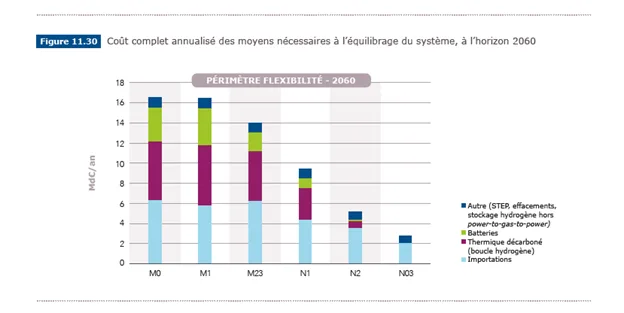
The nuclear penetration rate in our grids is limited in any case. Except for exceptional conditions, a maximum penetration probably around 20% is found in countries investing the most in the technology (for instance, China's target). This technology is not in competition with renewables, which are expected to be dominant on our grids and play a different role, since they are not dispatchable. Nuclear actually competes with the last very expensive decarbonization percentages. Studies by RTE clearly show this: the more nuclear in our grid, the lower flexibility costs, but this advantage diminishes to almost disappear around 50% share in the mix.
No alt text provided for this image

5. Nuclear development eases pressure on renewables

According to demand scenarios, the efforts to develop renewables are more or less important but remain significant for the next 30 years in all cases. Even if it only marginally reduces the need for renewables, it contributes and thus helps limit industrial challenges, especially regarding extraction and recycling.

⚠️ Provided nuclear development remains subject to strict regulations—as it currently is—and projects meet all necessary safety conditions, the risk profile of our societies if nuclear continues to develop does not seem to fundamentally change—even though lifetime extensions will require close monitoring.

⚠️ This technology is not competing with renewables, as seen, but with flexibility tools.

⚠️ A global nuclear Marshall Plan involving a tropical downpour of constant SMR deployment starting 2035, with current installation figures still very low, leads to 25% nuclear, so 75% of decarbonized electricity is still missing (and in reality probably 80-90%).

⚠️ Thus, when all conditions are met, we might consider a more positive view on this technology—which for example could already prevent early shutdowns.

... but it must rely on a realistic argumentation

We have just seen based on the given figures that nuclear is not the “degrowth parachute” nor this magic solution on which our industrial society will depend.

The orders of magnitude, both current (10% of global electricity production, declining) and potential (25% of maximum possible global electricity production, a direction we are absolutely not currently taking) are not the right ones, whatever scenario chosen.

On the contrary, the challenges of this sector are immense, and it is probable that only a major restructuring of this industry will stem its continuous decline since 1996.

  • The war in Ukraine has reignited safety debates
  • Long construction durations seem incompatible with our climate commitments. For example, to keep a 1.5°C trajectory, nearly all coal plants worldwide must close by 2035: nuclear can only contribute marginally.
  • Production costs per kWh are constantly rising, whereas RTE indicates they would need to fall by 30% for competitiveness
  • Financing this technology is complex, and again, per RTE, financing costs must be equal to renewables (impossible without state aid) to make it competitive
  • Confidentiality rules hinder rapid and massive information exchange
  • Few players operate in nuclear; supply chain bottlenecks exist. Due to the technology nature, approvals are needed on some segments, limiting market adaptation flexibility
  • In France, citizens are little involved in projects; see here the remarks from the Public Debate Commission

Public debate on nuclear: CNDP recommendation | CNDP

  • The limited pipeline means volumes of future investments remain uncertain. It is thus difficult for countries with small internal markets like France to exit the "First Of A Kind (FOAK)" situation and amortize heavy investments without public funds
  • A large unprecedented wave of retirements will happen in France within 15-20 years, absorbing sector resources. Meanwhile, uncertainties on lifetime and availability complicate schedule visibility

The list of challenges could be extended, but this article does not aim to exhaustively list them. This is simply to show the need to step back and raise analyses to more strategic levels.

⚠️ The nuclear sector has certain strengths that could allow it to find its place in the transition; it must find keys to solve the complex equation posed by its challenges. We can only hope it succeeds because societies need large amounts of decarbonized kWh to maintain decent living standards for nearly 9.5 billion people (population peak estimated by the Lancet for 2065).

⚠️ In this context, perhaps opposition movements to nuclear, rather than slowing development, could campaign for deep restructuring of the sector by presenting concrete proposals to the State, for example regarding governance and communication.

We could almost stop our analysis here; the reader will already have understood that the technological descriptions developed in the "Le Monde sans Fin" panels are not only very limited and biased but also very far from reality. For renewables, we will find the same problems. Let’s go further, this time to identify relevant analysis tools enabling a better understanding of our transitioning energy systems.

Recommended by LinkedIn
What are 'green' energies for? What are 'green' energies for? Gaëlle Cloarec 6 years ago From energy communities to Local Loops From energy communities to Local Loops Xavier Blot 6 years ago 2023 must be the year of acceleration shock! 2023 must be the year of acceleration shock! Agnès Pannier-Runacher 3 years ago
How to estimate the environmental impact of renewables?

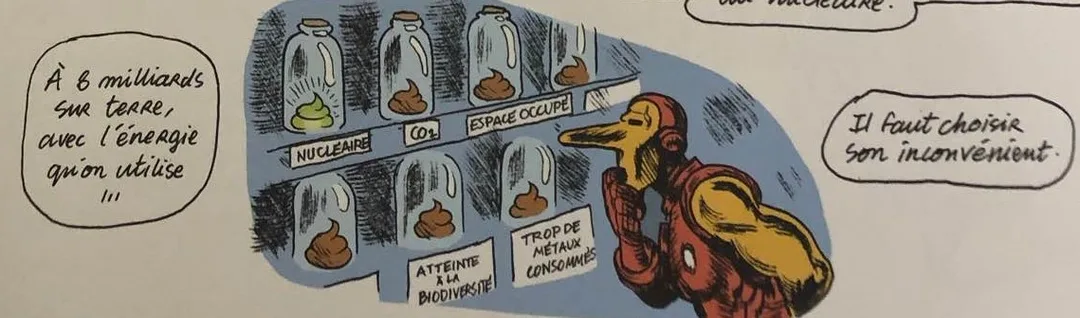
In the first panel, our friend Iron Man looks at a list of "brown turds" corresponding to the impacts of renewables, and seems attracted to the beautiful "green turd" of nuclear, whose color is objectively much more attractive.

He has conscientiously considered all the negative impacts of the different technologies (almost none for nuclear that are manageable, and a long list for renewables which damage nature) and their respective advantages (almost none for renewables, unlike nuclear which is great), and his decision seems made: nuclear it is!
No alt text provided for this image

But what our friend Iron Man doesn’t know is that this is not how we reason today, in 2022, to define technological choices for our energy mix.

No alt text provided for this image

In 2022, we use scenario analyses.

First, we build possible energy scenarios based on various constraints—industrial deployment, land footprint, construction time, human and financial resources, and supply-demand electricity balances which must be ensured each instant over the next 30 years until 2050.

We do not just set percentages arbitrarily on a projected 2050 demand: we study dynamically, under differing constraints, possible trajectories which then give various 2050 outcomes. This is a complex exercise, impossible without a team, models, access to hundreds—if not thousands—of data points, and coordination of various players to integrate data by sector. We also run climate simulations to take extreme cases and ensure systems operate under degraded conditions.

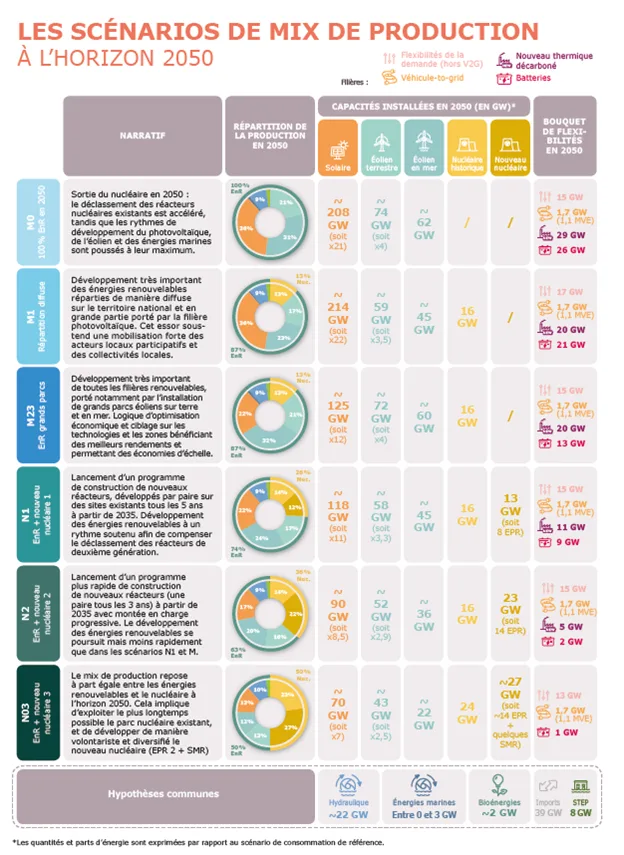
In France, RTE carried out this work, which took more than 2 years and gathered hundreds of stakeholders. Here are the scenarios developed:

  • 3 scenarios without new nuclear, including one with forced accelerated retirements leading France to a 100% renewables mix in 2050
  • 3 scenarios with new nuclear, following the industry’s own proposals: either 6 EPRs, or 14 EPRs, or 14 EPRs plus lifetime extensions beyond 60 years and SMRs. The latter case corresponds to 50 GW of nuclear in France in 2050, which the industry considers currently its maximum management capacity.
No alt text provided for this image

What we will now compare are these scenarios and their impact on the environment: land footprint, materials, etc... It naturally seems complicated, but RTE dedicated a whole chapter to this study!

No alt text provided for this image

So what does this study say?

Again, to conduct a thorough environmental analysis of scenarios, the right methodologies must be used. For example, impact is not taken in isolation but in reference frameworks to appreciate its significance. For each material, the consumption is estimated relative to national primary and secondary demand, and global reserves. For land, actual footprint and possible dual use are considered, comparing with available space. This is temporal as problems can evolve over time, as can solutions.

Take the example of recycling wind turbine blades (soon to be recyclable): when does the problem arise? What solutions? What quantity relative to other wastes? etc... We try to best understand the problem's importance to know what energy expense is acceptable to solve it.

I link here a video applying this methodology:

Wind Turbine End of Life Waste

Environmental analysis is thus not so simple, and methodological choices and references are crucial. Much misinformation on these topics plays precisely on these references.

Now let’s move on to RTE’s results:

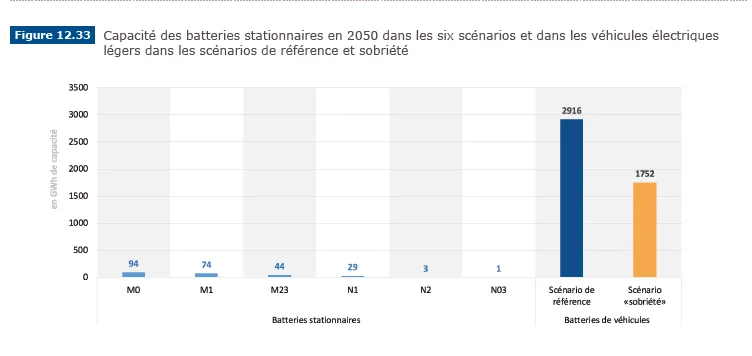
Battery needs in scenarios:
No alt text provided for this image

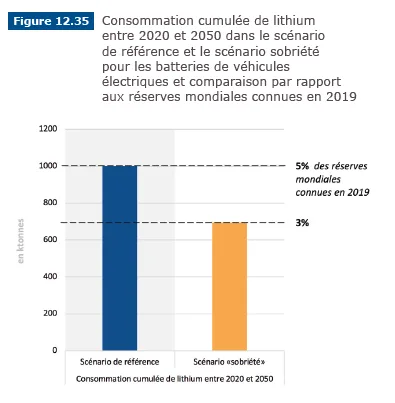
Cumulative lithium need 2020–2050 for electric vehicles versus known reserves in 2019:
No alt text provided for this image

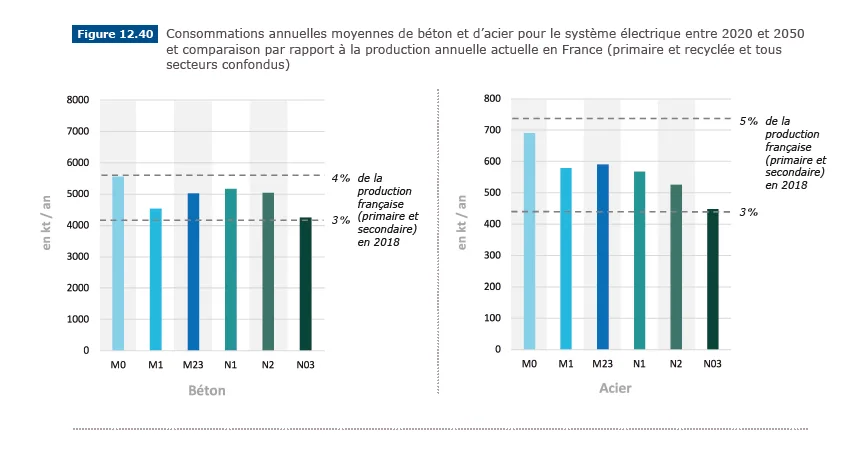
Cement and steel needs vs national demand
No alt text provided for this image

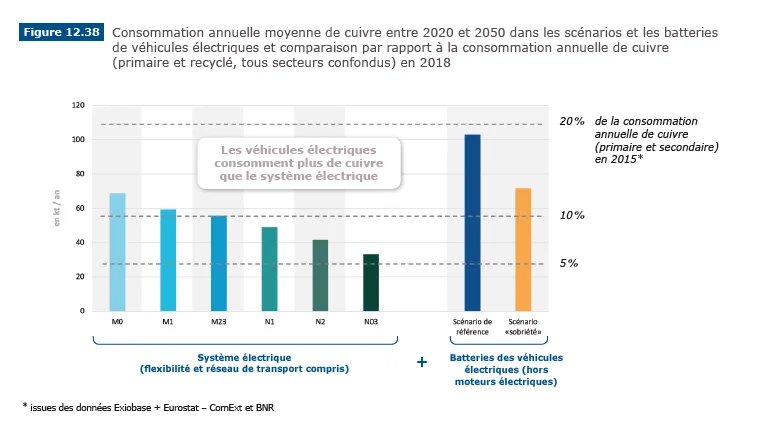
Copper consumption in the electrical sector vs electric vehicles vs French national demand
No alt text provided for this image

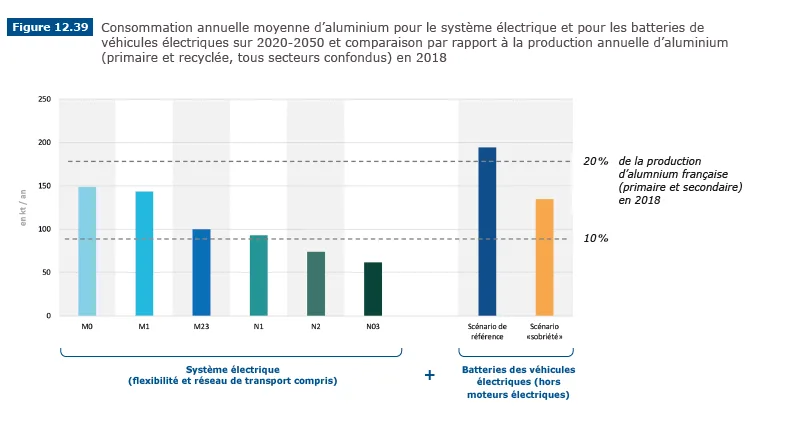
Aluminium consumption in the electrical sector vs electric vehicles vs French national demand
No alt text provided for this image

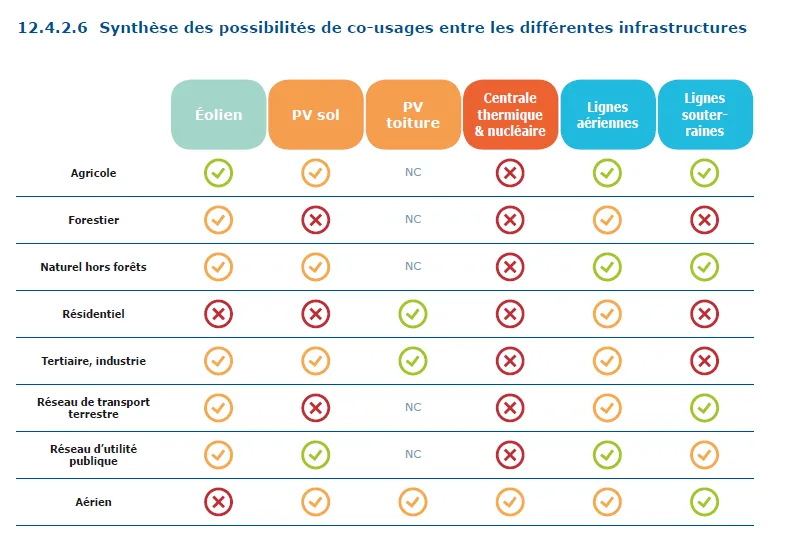
Land footprint: synthesis of possibilities for dual use
No alt text provided for this image

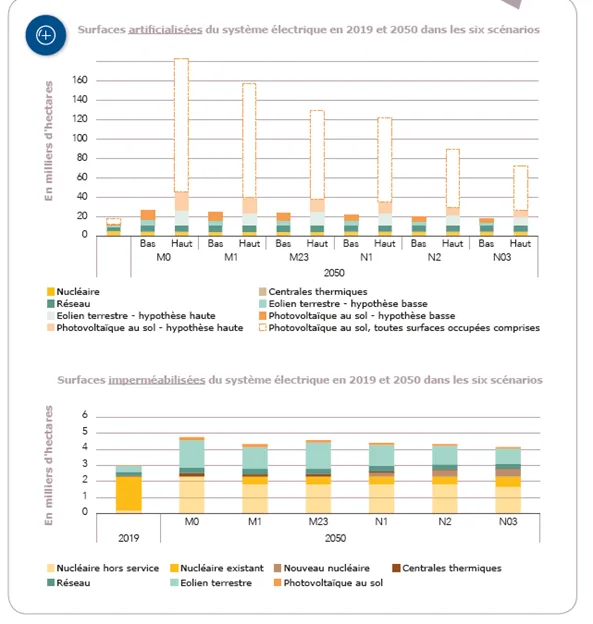
Artificial and impermeabilized surfaces by scenario
No alt text provided for this image

⚠️ Conclusion of this study: points of attention exist but these are not critical in choosing our electricity mix scenarios. And this is normal:

  • firstly, even if nuclear occupies less space or consumes fewer materials, in all scenarios—even those with a lot of nuclear—it is always necessary to have a lot of renewables. Thus, our next nuclear plant, outside of FLA3, in the full energy and climate crisis forcing us equally to accelerate sobriety and electrification, will arrive at best in 2037! So in the next 15 years France will see ONLY renewables connecting to its grid. There is thus no trade-off to make during this period.
  • Secondly, the electricity sector, compared to others, sometimes represents only a part of demand, sometimes very small—like for steel or cement. Material challenges exceed the electricity sector, and the mix choice has a weak impact on challenges faced. Recycling and sobriety remain important levers for all economic sectors.

No alt text provided for this image

For more, chapter 12 on environment from RTE: https://assets.rte-france.com/prod/public/2021-10/BP2050_rapport-complet_chapitre12_analyse-environnementale.pdf

The need to use new analytical tools to think about the transition

The energy transition moves us from a world where we burn oil, gas, and coal to produce energy to a world where we mainly use renewables (and other low carbon technologies like hydro, nuclear, geothermal, etc.) to produce electricity, and for the rest (outside electricity), we will burn biomass in various forms (gas, solid, and liquid).

To produce these renewables, we will consume many metals, but on one hand, once equipment is built, it usually has a long lifespan (at least 20 years, up to 40), and does not need non-renewable external sources impacting the environment to operate. On the other hand, these can be recycled. Geo-strategic dependencies and environmental impacts will thus strongly evolve over time as we advance in the transition:

  • Fossil consumption is a continuous flow we cannot stop (if no gasoline is put in a motor, it stops when the tank empties). Extraction flows are more complex: they increase during our infrastructure change phase and then decrease mostly to be replaced by recycling.
  • Extraction leads to dependencies on countries with deposits, but refining and recycling industries can be located on multiple continents

This is a complete transformation of our energy system and associated infrastructure, forcing us to review analytical tools used in the oil era, some of which are no longer suitable. Indeed, our energy will be different in nature (electrical characteristics differ greatly), and usage will change, as will social organization. Some changes:

1. The EROI concept is hard to apply to compare societies at different transition stages (before, during, after): energy needs and supply means evolve over time. Using EROI risks comparing ratios whose values have different meanings.

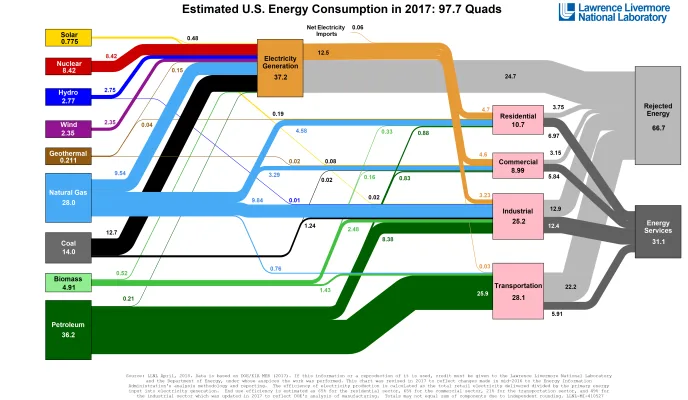
2. The concept of useful energy becomes fundamental. See table below: what we need to change is the dark gray box bottom right, not the primary energy entering the system on the left. This makes a huge difference—only a third of primary energy must be covered because today two-thirds of energy produced is lost as dissipated heat.
No alt text provided for this image

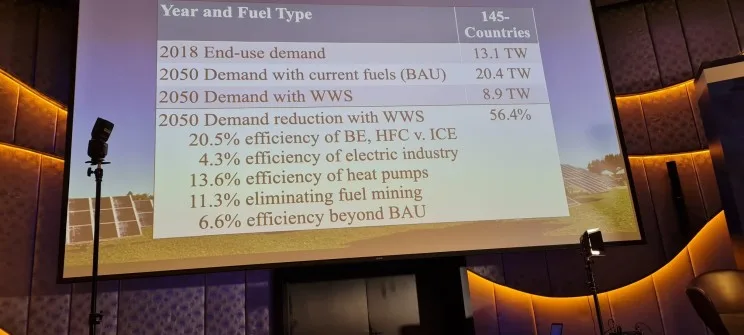
3. Electrification lowers final energy demand due to efficiencies generated. This is a fundamental point to remember, as it helps reduce pressure on the biosphere. Here are some estimates:
No alt text provided for this image

4. Our society will have an investment phase in new infrastructure, then a replacement/stabilization phase. Meanwhile, fossil flows will decline. We must model net impact of these changes and not consider them in isolation.

5. Transition technologies evolve quickly and constantly. It is hard to see exact limits of yields, material footprints, energy footprints, costs. Extending curves based on history no longer works.

6. A renewables world affects demand strongly through various flexibility tools and technologies (smart grids, smart meters, automata, variable pricing, technological coupling...). Renewables depend on natural phenomena (wind, sun, water), so managing variability and energy consumption control, our organization will gain flexibility and sobriety.

7. A renewables world brings energy production tools closer to homes. These means become more visible and gradually blend into daily life. This can be an opportunity, since each locality can take control and create new Energy-Industry-Agriculture business models, but also potential conflicts with locals: our landscape changes with industry, and while this could make us more cautious with energy spending (seeing concretely energy production costs), it can also cause outright refusal to install new infrastructure near homes.

No alt text provided for this image

8. Our laws, regulations, decision and democratic processes must adapt to this new technological environment. For example, it seems natural to involve locals strongly in defining renewable projects. See here excellent government proposals for better citizen ownership of these technologies:

10 measures for controlled and responsible wind development | Ministry for Territorial Partnerships and Decentralization Ministry of Ecological Transition, Energy, Climate, and Risk Prevention Ministry of Housing and Urban Renovation

The list of changes could continue; this is not exhaustive but simply shows it is difficult to use past analytic tools for our transitioning world.

Taking the example of metals again: although we consume more energy to extract them, newly created equipment consumes less energy for manufacturing and less material, and some reduce energy consumption in use. A systemic approach is therefore needed to avoid major analytical errors by focusing on a single parameter instead of the whole system.

Here's an article illustrating applying these analytic methodologies, comparing environmental impact of fossil world versus renewables world, thus avoiding usual pitfalls of discourses focusing solely on renewables' impact:

Energy to waste – fossil fuels’ dirty secret

The aim is not to validate specific numbers, or to say the transition will be simple, or especially to pretend we citizens and professionals do not need to stay vigilant and constantly propose improvements.

Quite the opposite: we must deepen knowledge, integrate finer analyses of systemic risks, and avoid drifts known in early 21st century fossil energy development. Our scenarios will likely continue to evolve. Moreover, climate actions are still only partially applied, with sobriety largely forgotten, though a central transition concept. We must all fight for full climate action implementation, the only option to follow least catastrophic climate trajectories.

In a fast-changing, uncertain transition world, we must learn to analyze by identifying possible practice changes chosen by us but that we could do differently for various reasons (costs, scarcity, geopolitical constraints...). For instance, choosing a high yield material as it is cheap and available, but if it becomes expensive, replacing or removing it.

This article simply highlights thought modes used today by researchers working on energy transition. Using these methods, recognizing when they are or aren’t applied, is important to filter information around us and better understand changes unfolding before our eyes, so we may ourselves be enlightened actors.

⚠️ Sometimes, solving a minor apparent problem A creates a more important hidden problem B!

⚠️ Sometimes, a solution A to a major problem B gets doubted because it causes other problems, but those are minor by comparison.

⚠️ Sometimes, a technological choice to lower costs is made but is not set in stone; a changing environment (economic or other) leads us to do things differently.

End of part one... now let’s move to the renewables-gas relationship: "I love you, me neither". Link to part two:

Regaining a consensual vision of energy and new analytical tools to think the transition (Part 2)

***
Annex 1
Belfort speech of the President announcing his proposed policy for the French electricity sector:

Speech of the President of the Republic on France's energy future - Analysis

Annex 2: some figures about the nuclear market

Sector results in 2021

Amid Global Crises, Nuclear Power Provides Energy Security with Increased Electricity Generation in 2021

Global nuclear sector Marshall Plan, the Harmony program = 25% nuclear share in our electricity mix

The Harmony Programme

Some time ago, I received two panels from Jean-Marc Jancovici's "Le Monde sans Fin" (JMJ) that I was asked to comment on but did not follow up, not finding the approach appropriate.

However, as our current context of energy and climate crisis demands strong measures and commitment to ecological transition, I recently observed that:

  • the opposition movements against wind turbines use the same arguments disseminated by the comic book. These movements, some of which are supported by circles of senior civil servants and elite engineers linked to the nuclear industry, have recently managed to find a hearing with our President, encouraging him to postpone our goal of doubling wind capacity to 2050 instead of 2030 (see: Belfort speech, reference at the end of the article). This position will almost certainly create problems given the current energy crisis—indeed, it would be surprising if this position were not revised
  • this comic quickly spread in France, a country that seems more receptive to the arguments proposed in this work than elsewhere

So, I finally decided to write this article taking an angle that I hope is constructive, which consists in using these two panels as a basis for a broader discussion covering our climate scenarios and the role of electricity, nuclear and renewables in this context, both internationally and in France.

Reaching zero emissions by 2050 is a vital question for humanity, as undoubtedly confirmed by the IPCC. However, this objective can only be achieved by implementing a long list of actions covering all sectors, far beyond the scope of the electricity mix question—a sector where France ultimately has very little flexibility. It would be healthy to build a calm debate space on this issue, to turn this page quickly.

This article will be in 2 parts. The first focuses on the environmental impact of renewables and the technological selection criteria for our electricity mix (panel 1), the second will address the link between gas and renewables (panel 2).

Brief overview of the definition of ecological transition

I propose the following definition of Ecological Transition: the transition of our current society into a new society that will find itself in a "net-zero" situation including all sectors such as agriculture, forests, our energy systems, our waste, etc...

  • A "net-zero" situation means that our emissions are balanced by carbon sinks (the "pluses" are offset by "minuses"). Since our capacities to capture carbon, both artificially via technologies and naturally with forests, mangroves, soils, and others, are limited (the "minuses" will not be very high), this means our society must emit very little CO2 to be "net-zero"
  • The difference between energy transition and ecological transition is the scope covered: [energy] = Energy Transition / [energy + agriculture + soils + waste etc...] = Ecological Transition. Likewise, ecological transition includes biodiversity considerations in all economic sectors.
  • The temporal horizon is 2050 to have a 50% chance of staying below 1.5°C, and 2070 to have a 50% chance of staying below 2°C. The difference between 2°C and 1.5°C is very important: we are talking about hundreds of millions fewer people lacking access to water, for example.

There are dozens, even hundreds of ecological transition scenarios worldwide: several per country, per continent, or covering the world. Many countries have made commitments to reach a NZE situation by 2050, 2060, or 2070, which in some cases have been translated into laws and policies.

This trend will strengthen in the coming years, and more and more countries will make these commitments, and more commitments will become laws and policies. See below the evolutions over recent years:

No alt text provided for this image

NZE scenarios are very diverse, covering variable scopes and based on hypotheses and strategies that vary from one document to another. The recent IPCC AR6 report provides an overview of all these scenarios and the different proposed strategies.

When analyzing these various scenarios [NB: this is one of my activities; for example, within the Coalition for Action, I work on the critical review of the IEA 1.5°C scenario. To learn more about the Coalition for Action: https://coalition.irena.org/] one quickly notices that these scenarios converge overall on the main actions to be taken.

⚠️ There seems little point in having sharp debates today over the exact target rates of renewables, nuclear, electric vehicles, sobriety for 2050, and even less to justify slowing the transition under the pretext that an agreement on the right trajectory until 2050 still needs to be found. The list of actions is practically the same in all scenarios.

⚠️ Of course, these rates will progressively become more important and precise as we progress in the transition. However, in 2022, we are just beginning our climate policies—still imperfect—so all the main identified actions must, in all cases, be deployed largely from today, whether sobriety, electrification, renewables, etc... The debates should therefore be reframed within their temporal horizons: our goals and actions to be taken by 2030 are actually very clear—and largely achievable with discipline and coherent policies—and put us on a trajectory that we can refine progressively based on results.

Ecological Transition in France: what does JMJ’s Shift Project say?

Like many nations, France also has its own energy and ecological transition scenarios. On the one hand institutional ones: RTE and ADEME. On the other hand, two associations: Negawatt and the Shift. An official scenario should, hopefully, be finalized soon: the National Low Carbon Strategy.

As internationally, there is convergence in the key climate actions list (sobriety, electrification, renewables, green gas, etc...), the same is found in France. Except for a few points—among them nuclear and the role of biomass versus electricity—the proposals are ultimately very similar.

The same applies to the PTEF which offers a list of actions similar to existing scenarios, in France and internationally. Regarding electricity sector trajectories, the Shift even relies on RTE scenarios and thus aligns with institutional scenarios.

In the energy sector, here are the evolutions the PTEF proposes:

Electricity mix:

No alt text provided for this image

Energy mix, including electricity:

No alt text provided for this image

And here I put in comparison the IEA's mix

No alt text provided for this image

As can be seen in these charts, and then by looking at the content of the proposals (I leave it to everyone here to delve into these documents), the same major principles are found for the 2050 mix:

  1. Our energy demand must decrease (in the IEA scenario, the decrease is mainly in OECD countries, so aggregated it is only 7%, as it is offset by controlled demand growth in emerging countries)
  2. Our electricity demand will increase (>+20% for the Shift, with a share of at least 50% of the final mix, which aligns with all existing scenarios. The increase is stronger in the IEA scenario due to emerging countries—for example, hundreds of millions, even billions, worldwide still lack electricity access)
  3. Beyond electricity, biomass is present in different forms in both scenarios, as well as oil for various activities including petrochemicals. There remains 29% oil outside electricity in the Shift scenario, more than for the IEA, which thus supposes that by 2050 the demand from other countries in the world for oil has been met, and France can access this quantity.
  4. On the electricity part, a substantial development of renewables (40% for the Shift, 70% for the IEA). Nuclear takes a different place in the two scenarios, mainly because of France's particularity with a 70% nuclear mix today—we could however critically review the Shift’s proposal (for those wanting to go further, see Annex 3 here: https://www.linkedin.com/pulse/la-sobri%C3%A9t%C3%A9-nest-pas-synonyme-de-d%C3%A9roissance-ouvertes-karim-megherbi/)
  5. In both scenarios, batteries for cars and transport more generally, and hydrogen for industry are included.

⚠️ Renewables, batteries, and hydrogen play an important role in the PTEF, which envisions widespread deployment of these technologies in France by 2050. Shift thus implicitly assumes that by 2050 these technologies will continue to develop massively worldwide to achieve the required competitive level for adoption, and that intermittency issues for grids, raw material constraints for equipment, and other challenges will be resolved. These implicit assumptions underpin the feasibility of the PTEF, which cannot exist without them, like all decarbonization scenarios.

Presentation of the 2 panels

The 1st: Renewables and environment/technology selection criteria

No alt text provided for this image

The 2nd: Renewables and gas

No alt text provided for this image

Now to the analyses!

No alt text provided for this image
The aim of these two panels: rehabilitating nuclear power

The objective of rehabilitating nuclear power, the background of JMJ’s thinking, naturally appears in this work. On the one hand, several pages and sections are devoted to it, easily identifiable by the reader. On the other hand, in general, the entire energy argument of JMJ has this goal, which is much more complex to identify for the non-specialist public, who imagine they are dealing with a popularized scientific discourse.

I had already drawn attention to this point here, quickly describing the main guidelines of this ideology:

I share here Stéphane His's article regarding the content of - Karim Megherbi on LinkedIn | 20 comments

And here is an analysis confirming this point made by Polytechnique alumni:

A critique of Jean-Marc Jancovici's comic "Le Monde sans fin" (Class '81 alumnus)

A goal that is certainly defensible...

Rehabilitating nuclear power presents a climate benefit that is certainly defensible. This technology, indeed declining, is controllable and low-carbon, two elements beneficial for climate and our electricity grids.

Some citizens, in France and elsewhere, oppose the development of this technology for various reasons (among them: risks, waste, proliferation, isolation of this industry and decision-making chain escaping citizens) and naturally, this viewpoint must be respected, especially since the arguments used are often perfectly valid when formulated on a documented basis.

However, let us recall several elements in favor of nuclear:

1. Our climate goals require us to balance different risks, including those related to climate drift, which are extremely strong and immediate.

The increase in forest fire frequency and water crisis will certainly strongly mark citizens' minds. It is no longer possible to turn a blind eye.

2. The maximum potential for nuclear deployment remains limited, which naturally bounds its risks

Recall that even a significant increase in installations will only maintain the global installed capacity. Let's look at the numbers:

  • Waves, or rather tsunamis, of nuclear plant retirements will arrive over the next 20 years:
No alt text provided for this image
  • The pace of installations over the last 10 years will not replace the global fleet, and if this trend continues, installed capacity will decrease. Nuclear's share in our global electricity mix went from 17% in 1996 to 10% today. See here the sector results in 2021 (capacity decline) in Annex 2
  • The high case of the IAEA foresees 792 GW for 2050, almost double the current capacity (~400 GW). This would mean, excluding replacements, 14 GW per year over the next 28 years, a number we are still below (currently less than 10 GW). While this does not give certainty about the future, nuclear's future—a long-term technology, unlike renewables that can react within months—seems today to be shaped in China, the pipeline outside this country being more limited.
  • Assuming we reach the high case, nuclear would still represent around 10% of our electricity mix for 2050, since the share of electricity must increase by 2050 within our overall energy mix.
  • The maximum potential of nuclear was estimated by the NEA (this is theoretical potential, not projections) at 1,200 GW, and a large part of growth beyond IAEA's high case comes from extremely aggressive assumptions about the sector evolution, including massive SMR development—a technology that does not exist today and whose real potential remains unknown. Without SMRs, we remain below 800 GW of "high case" potential for 2050, which aligns with the IAEA high case.
No alt text provided for this image
  • Even at 1,200 GW installed—a number very uncertain and not aligned with current figures—nuclear would contribute around 25% of the projected global electricity mix for 2050. See the Harmony program in Annex 2

3. The relatively small potential number of plants leads to a low volume of investment

The sums involved seem to represent a small fraction of the total amounts we must invest in climate actions. Take the French case and 6 EPRs: assuming a program cost of €50bn, doubling for budget overruns (I exaggerate), plus another €30bn to rebuild the French sector, that's €130bn spread over 25 years (last EPR possibly delivered in 2045), about €5bn/year, compared to, according to the Rousseau Institute, an investment program (2% for 2°C) in transition of €180bn/year.

2% for 2°C! - Rousseau Institute

Of course, this economic question should be detailed, but do not forget that France still subsidizes fossil energies, funds price shields, and various projects here and there with uncertain futures receive funding. This sum dedicated to a major industrial program for a strategic industrial sector seems to be within an acceptable order of magnitude—analysis subject to discussion.

4. More nuclear reduces grid flexibility needs

The nuclear penetration rate in our grids is limited in any case. Except for exceptional conditions, a maximum penetration probably around 20% is found in countries investing the most in the technology (for instance, China's target). This technology is not in competition with renewables, which are expected to be dominant on our grids and play a different role, since they are not dispatchable. Nuclear actually competes with the last very expensive decarbonization percentages. Studies by RTE clearly show this: the more nuclear in our grid, the lower flexibility costs, but this advantage diminishes to almost disappear around 50% share in the mix.

No alt text provided for this image

5. Nuclear development eases pressure on renewables

According to demand scenarios, the efforts to develop renewables are more or less important but remain significant for the next 30 years in all cases. Even if it only marginally reduces the need for renewables, it contributes and thus helps limit industrial challenges, especially regarding extraction and recycling.

⚠️ Provided nuclear development remains subject to strict regulations—as it currently is—and projects meet all necessary safety conditions, the risk profile of our societies if nuclear continues to develop does not seem to fundamentally change—even though lifetime extensions will require close monitoring.

⚠️ This technology is not competing with renewables, as seen, but with flexibility tools.

⚠️ A global nuclear Marshall Plan involving a tropical downpour of constant SMR deployment starting 2035, with current installation figures still very low, leads to 25% nuclear, so 75% of decarbonized electricity is still missing (and in reality probably 80-90%).

⚠️ Thus, when all conditions are met, we might consider a more positive view on this technology—which for example could already prevent early shutdowns.

... but it must rely on a realistic argumentation

We have just seen based on the given figures that nuclear is not the “degrowth parachute” nor this magic solution on which our industrial society will depend.

The orders of magnitude, both current (10% of global electricity production, declining) and potential (25% of maximum possible global electricity production, a direction we are absolutely not currently taking) are not the right ones, whatever scenario chosen.

On the contrary, the challenges of this sector are immense, and it is probable that only a major restructuring of this industry will stem its continuous decline since 1996.

  • The war in Ukraine has reignited safety debates
  • Long construction durations seem incompatible with our climate commitments. For example, to keep a 1.5°C trajectory, nearly all coal plants worldwide must close by 2035: nuclear can only contribute marginally.
  • Production costs per kWh are constantly rising, whereas RTE indicates they would need to fall by 30% for competitiveness
  • Financing this technology is complex, and again, per RTE, financing costs must be equal to renewables (impossible without state aid) to make it competitive
  • Confidentiality rules hinder rapid and massive information exchange
  • Few players operate in nuclear; supply chain bottlenecks exist. Due to the technology nature, approvals are needed on some segments, limiting market adaptation flexibility
  • In France, citizens are little involved in projects; see here the remarks from the Public Debate Commission

Public debate on nuclear: CNDP recommendation | CNDP

  • The limited pipeline means volumes of future investments remain uncertain. It is thus difficult for countries with small internal markets like France to exit the "First Of A Kind (FOAK)" situation and amortize heavy investments without public funds
  • A large unprecedented wave of retirements will happen in France within 15-20 years, absorbing sector resources. Meanwhile, uncertainties on lifetime and availability complicate schedule visibility

The list of challenges could be extended, but this article does not aim to exhaustively list them. This is simply to show the need to step back and raise analyses to more strategic levels.

⚠️ The nuclear sector has certain strengths that could allow it to find its place in the transition; it must find keys to solve the complex equation posed by its challenges. We can only hope it succeeds because societies need large amounts of decarbonized kWh to maintain decent living standards for nearly 9.5 billion people (population peak estimated by the Lancet for 2065).

⚠️ In this context, perhaps opposition movements to nuclear, rather than slowing development, could campaign for deep restructuring of the sector by presenting concrete proposals to the State, for example regarding governance and communication.

We could almost stop our analysis here; the reader will already have understood that the technological descriptions developed in the "Le Monde sans Fin" panels are not only very limited and biased but also very far from reality. For renewables, we will find the same problems. Let’s go further, this time to identify relevant analysis tools enabling a better understanding of our transitioning energy systems.

Recommended by LinkedIn

What are 'green' energies for? What are 'green' energies for? Gaëlle Cloarec 6 years ago From energy communities to Local Loops From energy communities to Local Loops Xavier Blot 6 years ago 2023 must be the year of acceleration shock! 2023 must be the year of acceleration shock! Agnès Pannier-Runacher 3 years ago
How to estimate the environmental impact of renewables?

In the first panel, our friend Iron Man looks at a list of "brown turds" corresponding to the impacts of renewables, and seems attracted to the beautiful "green turd" of nuclear, whose color is objectively much more attractive.

He has conscientiously considered all the negative impacts of the different technologies (almost none for nuclear that are manageable, and a long list for renewables which damage nature) and their respective advantages (almost none for renewables, unlike nuclear which is great), and his decision seems made: nuclear it is!

No alt text provided for this image

But what our friend Iron Man doesn’t know is that this is not how we reason today, in 2022, to define technological choices for our energy mix.

No alt text provided for this image

In 2022, we use scenario analyses.

First, we build possible energy scenarios based on various constraints—industrial deployment, land footprint, construction time, human and financial resources, and supply-demand electricity balances which must be ensured each instant over the next 30 years until 2050.

We do not just set percentages arbitrarily on a projected 2050 demand: we study dynamically, under differing constraints, possible trajectories which then give various 2050 outcomes. This is a complex exercise, impossible without a team, models, access to hundreds—if not thousands—of data points, and coordination of various players to integrate data by sector. We also run climate simulations to take extreme cases and ensure systems operate under degraded conditions.

In France, RTE carried out this work, which took more than 2 years and gathered hundreds of stakeholders. Here are the scenarios developed:

  • 3 scenarios without new nuclear, including one with forced accelerated retirements leading France to a 100% renewables mix in 2050
  • 3 scenarios with new nuclear, following the industry’s own proposals: either 6 EPRs, or 14 EPRs, or 14 EPRs plus lifetime extensions beyond 60 years and SMRs. The latter case corresponds to 50 GW of nuclear in France in 2050, which the industry considers currently its maximum management capacity.
No alt text provided for this image

What we will now compare are these scenarios and their impact on the environment: land footprint, materials, etc... It naturally seems complicated, but RTE dedicated a whole chapter to this study!

No alt text provided for this image

So what does this study say?

Again, to conduct a thorough environmental analysis of scenarios, the right methodologies must be used. For example, impact is not taken in isolation but in reference frameworks to appreciate its significance. For each material, the consumption is estimated relative to national primary and secondary demand, and global reserves. For land, actual footprint and possible dual use are considered, comparing with available space. This is temporal as problems can evolve over time, as can solutions.

Take the example of recycling wind turbine blades (soon to be recyclable): when does the problem arise? What solutions? What quantity relative to other wastes? etc... We try to best understand the problem's importance to know what energy expense is acceptable to solve it.

I link here a video applying this methodology:

Wind Turbine End of Life Waste

Environmental analysis is thus not so simple, and methodological choices and references are crucial. Much misinformation on these topics plays precisely on these references.

Now let’s move on to RTE’s results:

Battery needs in scenarios:

No alt text provided for this image

Cumulative lithium need 2020–2050 for electric vehicles versus known reserves in 2019:

No alt text provided for this image

Cement and steel needs vs national demand

No alt text provided for this image

Copper consumption in the electrical sector vs electric vehicles vs French national demand

No alt text provided for this image

Aluminium consumption in the electrical sector vs electric vehicles vs French national demand

No alt text provided for this image

Land footprint: synthesis of possibilities for dual use

No alt text provided for this image

Artificial and impermeabilized surfaces by scenario

No alt text provided for this image

⚠️ Conclusion of this study: points of attention exist but these are not critical in choosing our electricity mix scenarios. And this is normal:

  • firstly, even if nuclear occupies less space or consumes fewer materials, in all scenarios—even those with a lot of nuclear—it is always necessary to have a lot of renewables. Thus, our next nuclear plant, outside of FLA3, in the full energy and climate crisis forcing us equally to accelerate sobriety and electrification, will arrive at best in 2037! So in the next 15 years France will see ONLY renewables connecting to its grid. There is thus no trade-off to make during this period.
  • Secondly, the electricity sector, compared to others, sometimes represents only a part of demand, sometimes very small—like for steel or cement. Material challenges exceed the electricity sector, and the mix choice has a weak impact on challenges faced. Recycling and sobriety remain important levers for all economic sectors.
No alt text provided for this image

For more, chapter 12 on environment from RTE: https://assets.rte-france.com/prod/public/2021-10/BP2050_rapport-complet_chapitre12_analyse-environnementale.pdf

The need to use new analytical tools to think about the transition

The energy transition moves us from a world where we burn oil, gas, and coal to produce energy to a world where we mainly use renewables (and other low carbon technologies like hydro, nuclear, geothermal, etc.) to produce electricity, and for the rest (outside electricity), we will burn biomass in various forms (gas, solid, and liquid).

To produce these renewables, we will consume many metals, but on one hand, once equipment is built, it usually has a long lifespan (at least 20 years, up to 40), and does not need non-renewable external sources impacting the environment to operate. On the other hand, these can be recycled. Geo-strategic dependencies and environmental impacts will thus strongly evolve over time as we advance in the transition:

  • Fossil consumption is a continuous flow we cannot stop (if no gasoline is put in a motor, it stops when the tank empties). Extraction flows are more complex: they increase during our infrastructure change phase and then decrease mostly to be replaced by recycling.
  • Extraction leads to dependencies on countries with deposits, but refining and recycling industries can be located on multiple continents

This is a complete transformation of our energy system and associated infrastructure, forcing us to review analytical tools used in the oil era, some of which are no longer suitable. Indeed, our energy will be different in nature (electrical characteristics differ greatly), and usage will change, as will social organization. Some changes:

1. The EROI concept is hard to apply to compare societies at different transition stages (before, during, after): energy needs and supply means evolve over time. Using EROI risks comparing ratios whose values have different meanings.

2. The concept of useful energy becomes fundamental. See table below: what we need to change is the dark gray box bottom right, not the primary energy entering the system on the left. This makes a huge difference—only a third of primary energy must be covered because today two-thirds of energy produced is lost as dissipated heat.

No alt text provided for this image

3. Electrification lowers final energy demand due to efficiencies generated. This is a fundamental point to remember, as it helps reduce pressure on the biosphere. Here are some estimates:

No alt text provided for this image

4. Our society will have an investment phase in new infrastructure, then a replacement/stabilization phase. Meanwhile, fossil flows will decline. We must model net impact of these changes and not consider them in isolation.

5. Transition technologies evolve quickly and constantly. It is hard to see exact limits of yields, material footprints, energy footprints, costs. Extending curves based on history no longer works.

6. A renewables world affects demand strongly through various flexibility tools and technologies (smart grids, smart meters, automata, variable pricing, technological coupling...). Renewables depend on natural phenomena (wind, sun, water), so managing variability and energy consumption control, our organization will gain flexibility and sobriety.

7. A renewables world brings energy production tools closer to homes. These means become more visible and gradually blend into daily life. This can be an opportunity, since each locality can take control and create new Energy-Industry-Agriculture business models, but also potential conflicts with locals: our landscape changes with industry, and while this could make us more cautious with energy spending (seeing concretely energy production costs), it can also cause outright refusal to install new infrastructure near homes.

No alt text provided for this image

8. Our laws, regulations, decision and democratic processes must adapt to this new technological environment. For example, it seems natural to involve locals strongly in defining renewable projects. See here excellent government proposals for better citizen ownership of these technologies:

10 measures for controlled and responsible wind development | Ministry for Territorial Partnerships and Decentralization Ministry of Ecological Transition, Energy, Climate, and Risk Prevention Ministry of Housing and Urban Renovation

The list of changes could continue; this is not exhaustive but simply shows it is difficult to use past analytic tools for our transitioning world.

Taking the example of metals again: although we consume more energy to extract them, newly created equipment consumes less energy for manufacturing and less material, and some reduce energy consumption in use. A systemic approach is therefore needed to avoid major analytical errors by focusing on a single parameter instead of the whole system.

Here's an article illustrating applying these analytic methodologies, comparing environmental impact of fossil world versus renewables world, thus avoiding usual pitfalls of discourses focusing solely on renewables' impact:

Energy to waste – fossil fuels’ dirty secret

The aim is not to validate specific numbers, or to say the transition will be simple, or especially to pretend we citizens and professionals do not need to stay vigilant and constantly propose improvements.

Quite the opposite: we must deepen knowledge, integrate finer analyses of systemic risks, and avoid drifts known in early 21st century fossil energy development. Our scenarios will likely continue to evolve. Moreover, climate actions are still only partially applied, with sobriety largely forgotten, though a central transition concept. We must all fight for full climate action implementation, the only option to follow least catastrophic climate trajectories.

In a fast-changing, uncertain transition world, we must learn to analyze by identifying possible practice changes chosen by us but that we could do differently for various reasons (costs, scarcity, geopolitical constraints...). For instance, choosing a high yield material as it is cheap and available, but if it becomes expensive, replacing or removing it.

This article simply highlights thought modes used today by researchers working on energy transition. Using these methods, recognizing when they are or aren’t applied, is important to filter information around us and better understand changes unfolding before our eyes, so we may ourselves be enlightened actors.

⚠️ Sometimes, solving a minor apparent problem A creates a more important hidden problem B!

⚠️ Sometimes, a solution A to a major problem B gets doubted because it causes other problems, but those are minor by comparison.

⚠️ Sometimes, a technological choice to lower costs is made but is not set in stone; a changing environment (economic or other) leads us to do things differently.

End of part one... now let’s move to the renewables-gas relationship: "I love you, me neither". Link to part two:

Regaining a consensual vision of energy and new analytical tools to think the transition (Part 2)

***
Annex 1
Belfort speech of the President announcing his proposed policy for the French electricity sector:

Speech of the President of the Republic on France's energy future - Analysis

Annex 2: some figures about the nuclear market

Sector results in 2021

Amid Global Crises, Nuclear Power Provides Energy Security with Increased Electricity Generation in 2021

Global nuclear sector Marshall Plan, the Harmony program = 25% nuclear share in our electricity mix

The Harmony Programme